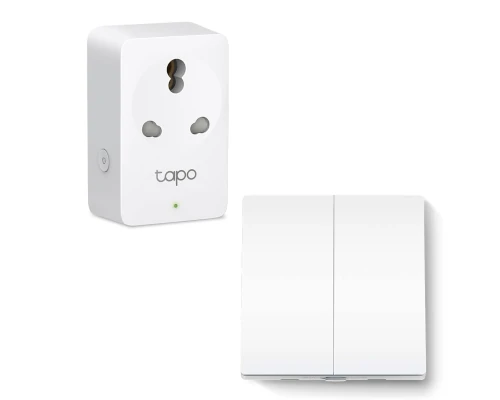
TP-Link Tapo P110 Mini Smart Plug with Energy Monitoring Review
The TP-Link Tapo P110 is the smallest 16A smart plug available in India, engineered specifically to fit tight socket configurations without blocking adjacent outlets. Its 2-year historical energy data storage and bill prediction algorithm provide the most comprehensive consumption analytics in the Indian smart plug market.
Value
Great Value
Rating
4.4/5
Reviews
32,500
Pick
Best Compact
Decision Snapshot
At Rs 1,299 with the most compact 16A design, 2-year energy history, child safety shutters, and TP-Link's reliable global support, the Tapo P110 is the premium compact option. The mandatory Tapo app requirement and slightly higher price than Indian alternatives are minor compromises for the superior hardware design.
Best For
Apartment dwellers with tight socket spacing who need 16A heavy-duty capability with detailed long-term energy analytics.
Watch Outs
Users already invested in the older Kasa ecosystem who do not want to migrate to the Tapo app, or budget buyers under Rs 1,000.
What We Checked
Ratings, feature mix, ownership trade-offs, source-guide commentary, and context against the rest of the shortlist.
Detailed Review
Editorial Take
At A Glance
Best Pick
Best Compact
User Rating
4.4/5 from 32,500 reviews
Best For
Apartment dwellers with tight socket spacing who need 16A heavy-duty capability with detailed long-term energy analytics.
Pros And Cons
What We Like
- +Most compact 16A plug on the market
- +Excellent energy tracking with predictions
- +Reliable TP-Link quality and support
- +Away Mode adds security benefit
- +Child safety design for families
What Could Be Better
- -Requires Tapo app and cannot use older Kasa app
- -Slightly expensive compared to Indian brands
- -Limited to 2.4GHz Wi-Fi only
Frequently Asked Questions
Can I use my existing TP-Link Kasa account with the Tapo P110?
No. Tapo and Kasa are separate ecosystems with separate apps, even though both are TP-Link. If you already have Kasa bulbs or cameras, the Tapo P110 will not appear in your Kasa app - you will have to run both apps side by side. For buyers setting up a new smart home, pick Tapo as your entry point since TP-Link has effectively shifted new product launches in India to Tapo and Kasa is in slow wind-down.
How accurate is the Tapo bill prediction feature in practice?
The prediction works by multiplying a rolling 90-day average by the tariff you set in the app. It is useful for spotting trends (for example, your AC consumption in May versus October) but drifts during seasonal changes, summer AC-heavy months, or when a new appliance is added. Treat the predicted bill as directional, not exact. The 2-year historical data itself is genuinely useful for tracking whether an old appliance is starting to consume more for the same output.
Does the Away Mode actually deter burglars during long trips?
It randomises on/off of a connected lamp to simulate household presence, which is a reasonable low-effort deterrent for 5-7 day Diwali or summer holidays. It works best on a bedroom or living-room table lamp visible through a window. It is not a replacement for a security camera or a proper alarm - think of it as cheap psychological insurance rather than active security. The same Rs 1,299 spent on a TP-Link Tapo C210 camera would give you monitoring instead of simulation.
How It Compares
| Product | Rating | Badge |
|---|---|---|
| TP-Link Tapo P110 Mini Smart Plug with Energy Monitoring | 4.4/5 | Best Compact |
| Wipro 16A Wi-Fi Smart Plug with Energy Monitoring | 4.3/5 | Best Overall |
| QUBO 10A Smart Plug from Hero Group | 4/5 | Best Value |
| Crabtree 16A Smart Socket with Safety Features | 4.1/5 | Safest Choice |
| Philips WiZ 16A Smart Plug with Energy Monitoring | 4.2/5 | Premium Choice |
| AZIOT 16A Smart Plug - Made in India | 4/5 | Made in India |
How We Evaluate Products
Real buyer feedback
We combine marketplace review signals with the strengths and drawbacks documented inside the original buying guide.
India-first fit
Recommendations are framed for Indian homes, pricing realities, and ownership expectations rather than generic global advice.
Value analysis
We look at positioning, compromises, and the quality of the product’s feature mix instead of just headline specs.
Contextual comparisons
Every review stays connected to the rest of the shortlist, so buyers can move from one product page to alternatives without losing context.
Discussion
Be the first to comment