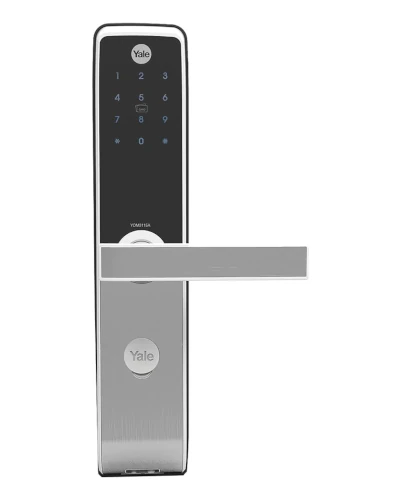
Editor's take
The Yale YDM 3115-A takes a deliberately different approach from every other lock in this guide by skipping fingerprint sensors entirely and relying on RFID cards and PIN codes instead. At first, this seems like a downgrade - until you consider that fingerprint sensors are the most common failure point in smart locks, especially during Indian monsoons when humidity and sweat cause misreads. The card-based system works identically whether it is a bone-dry Delhi winter or a soaking Kolkata monsoon.
At Rs 14,000-18,000, the pricing is premium and gets steeper when you add the separately sold Bluetooth module (Rs 2,500-3,500) and Wi-Fi module (Rs 3,000-4,500). With all modules, you are looking at Rs 20,000-26,000, which enters Godrej Advantis territory. The base model without modules is essentially a sophisticated card-and-PIN lock with an intrusion alarm, which is perfectly adequate for most use cases.
The mortise design is a significant practical advantage for Indian homes. Most Indian doors use mortise locks, and the YDM 3115 replaces them directly without major door modifications. The LAVNA and QUBO locks often require adapter plates or additional drilling, which can weaken the door frame if not done properly. Yale's installation team handles this seamlessly, and the silver matte finish genuinely elevates the look of your entrance.
Running costs are lower than fingerprint-based locks because the card reader draws less power - expect 10-12 months from a set of batteries. The RFID cards cost Rs 50-100 each, and we recommend getting at least 4-5 per family member since they are easy to misplace. The fake PIN feature lets you add random digits before your actual code in case someone is watching, which is a clever security touch. For homeowners who want Yale quality without biometric complexity, the YDM 3115 is a refined, weather-proof choice.


Discussion
Be the first to comment