The best tankless reverse osmosis system for a US home in 2026 is the one that clears your actual contaminants, fits beside your garbage disposal, and does not send four gallons to the drain to make one.
Tank systems still fill the shelves at big-box stores. Under real American sinks, though, the tankless design has quietly won.
A tankless reverse osmosis system is an under sink water filter that pushes water through an RO membrane on demand, using a booster pump instead of a pressurized storage tank. That change removes the 12-inch tank and cuts drain waste by half or more.
It also ends the stale-water complaint that followed reverse osmosis for thirty years. In exchange it adds two requirements most buying guides skip: a 120V outlet inside the sink cabinet, and a pump that hums while you fill a glass.
We compared Amazon.com listings, IAPMO and NSF certification records, manufacturer performance data sheets, EPA point-of-use guidance, and owner complaint patterns across nine verified systems.
Our pick for most households is Waterdrop G3P800. It is the only unit here holding IAPMO certification against NSF/ANSI 42, 53, 58, and 372 at the same time.
Want the short version? Buy the Waterdrop G3P800 when certification paperwork matters, the Frizzlife PD600-TAM3 when you want remineralized drinking water for less, and the Waterdrop G2P600 when you simply want clean water under $300.
Tankless Reverse Osmosis Systems Compared Side by Side
At a glance
Nine Verified Tankless RO Systems for US Homes
Amazon ratings, membrane flow rate, drain efficiency and the standout reason to pick each one.
Two numbers in that table decide most purchases. Flow rate tells you how long you stand at the faucet, and the drain ratio tells you what the system costs you in metered water every month.
Every rating and review count above was read from the live Amazon.com listing in September 2026. Where two model numbers share a single Amazon review pool, we list only one of them, which is why the Waterdrop G3P600 and the Frizzlife PD800-TAM4 are absent.
Why Tankless RO Took Over American Under-Sink Cabinets
Reverse osmosis is a filtration method that forces water through a semi-permeable membrane, leaving dissolved contaminants behind and sending them to the drain. The chemistry has not changed. The packaging has.
Classic RO needed a storage tank because the membrane produces water slowly, often 50 to 100 gallons per day.
A tankless system replaces that tank with a booster pump, which raises pressure at the membrane and lifts output to 400 GPD and beyond. The tank disappears, and so does the water that used to sit in it.
The efficiency gain is the part that surprises people. Older tank systems commonly ran at a 1:4 ratio, sending four gallons to the drain for every filtered gallon. The Waterdrop G3P800 runs 3:1 in the other direction, and the non-electric Frizzlife M800 is rated 4:1 by Frizzlife.
Three forces pushed the category into American kitchens in 2025 and 2026. Municipal PFAS testing results started reaching households, lead service line replacement notices went out under the federal Lead and Copper Rule Improvements, and bottled water prices kept climbing.
The PFAS timeline matters more than most guides admit. The EPA has proposed extending the PFOA and PFOS compliance deadline for public water systems from 2029 to 2031.
That means a utility finding forever chemicals in 2027 may legally have years before it must fix them. Point-of-use treatment is the only part of that timeline a homeowner controls.
How to Read Your Water Report Before You Shop
Every community water system in the United States must publish an annual Consumer Confidence Report, and it is the cheapest research you will do on this purchase.
Search your utility name plus "Consumer Confidence Report" and you will usually find a PDF listing measured contaminant levels against the federal maximum.
Three numbers on that report decide whether you need reverse osmosis at all. Look for lead, nitrate, and total dissolved solids, then scan the detected-contaminants table for arsenic, chromium, and any PFAS entry.
The report has a blind spot that matters in older homes. It measures water leaving the treatment plant and at sample points around the system, not water arriving at your kitchen faucet through your own service line and interior plumbing.
That gap is why lead is the contaminant worth testing yourself. Homes built before 1986 can have lead solder in copper joints, and homes served by a lead service line can show a clean municipal report and a dirty tap sample.
A $25 to $40 home test kit covers lead, nitrate, hardness, chlorine, and pH. That is enough to make a buying decision.
Certified laboratory testing through a state-approved lab runs $100 to $300. It is the right call for well owners and anyone with a specific suspicion.
Private wells get no report at all, because the EPA does not regulate them.
If you are on a well, annual testing for coliform bacteria and nitrate is the baseline. A broader panel every three years catches arsenic, uranium, and metals that vary with the aquifer.
Write the results down before you shop. A buyer who knows their water is 320 ppm TDS with 8 grains of hardness and no detected lead will make a completely different choice from a buyer facing a nitrate reading of 7 mg/L.
Tankless RO vs Other Home Water Filters: Which Should You Buy?
Reverse osmosis is not the default answer to every water complaint, and the honest comparison saves a lot of people several hundred dollars.
A pitcher filter costs $25 to $60 and reduces chlorine taste, some lead, and little else. It is the right tool when you rent, when you move often, or when you want one jug of better-tasting water in the fridge.
A carbon block under-sink filter costs $60 to $180 and handles chlorine, taste, odor, sediment, and certain VOCs. It wastes nothing, needs no outlet, and does nothing for nitrate, arsenic, fluoride, or high TDS.
A countertop RO unit costs $350 to $600 and requires no plumbing at all, which makes it the strongest option for renters. The tradeoffs are a permanent chunk of counter space and a tank you refill by hand.
A whole-house system treats every tap, which matters for chlorine, sediment, and hardness across showers and appliances. It is not a substitute for point-of-use RO, because whole-house reverse osmosis is impractical and expensive for a normal home.
An under sink reverse osmosis system sits exactly where most American households need it: dissolved contaminant removal at the tap you actually drink from, no counter footprint, no tank.
That is the case for the category. It collapses the moment your water report comes back clean.
What Separates a Serious Tankless RO System From a Cheap One
We did not rank these by stage count. Stage marketing is the noisiest number in this category, and an eleven-stage system is not automatically better than a six-stage one.
The first filter was certification honesty. NSF/ANSI 372 only certifies that wetted materials are lead-free, and several listings imply it means contaminant reduction.
NSF/ANSI 58 is the standard that covers RO performance and TDS reduction. NSF/ANSI 53 covers health-related contaminants such as lead and cysts.
The second filter was drain efficiency, because it is a recurring cost. In a metered city, the gap between a 1.5:1 and a 3:1 system is hundreds of gallons a year for a family that drinks and cooks with filtered water.
The third filter was cabinet reality. A system that clears every contaminant and then refuses to fit past a garbage disposal is a return, not a purchase, so published dimensions and faucet requirements carried real weight here.
The fourth filter was owner sentiment at scale. We read patterns across Amazon.com reviews and plumbing forums, and the complaint that recurs across every brand is pump noise, not water quality.
A pump bolted to a thin cabinet floor turns a 50 dB hum into a cabinet-wide buzz.
The fifth filter was replacement filter economics. A cheap system with proprietary $90 filter cartridges on a six-month cycle costs more over five years than a pricier unit with $35 annual filters.
Check These Before You Buy a Tankless RO System
Get a water test firstYour utility Consumer Confidence Report is free, and a $30 home kit covers lead, nitrate and hardness
Find a grounded 120V outletAlmost every tankless unit needs one inside or near the sink cabinet
Measure clear cabinet widthMeasure to the left or right of the drain trap, not the full cabinet opening
Count your countertop holesA spare sprayer or soap dispenser hole saves you from drilling granite
Read the certification line carefullyNSF/ANSI 372 is lead-free materials only, 58 is RO performance, 53 is health contaminants
Price a year of filtersAdd up every cartridge on its real replacement interval before you compare systems
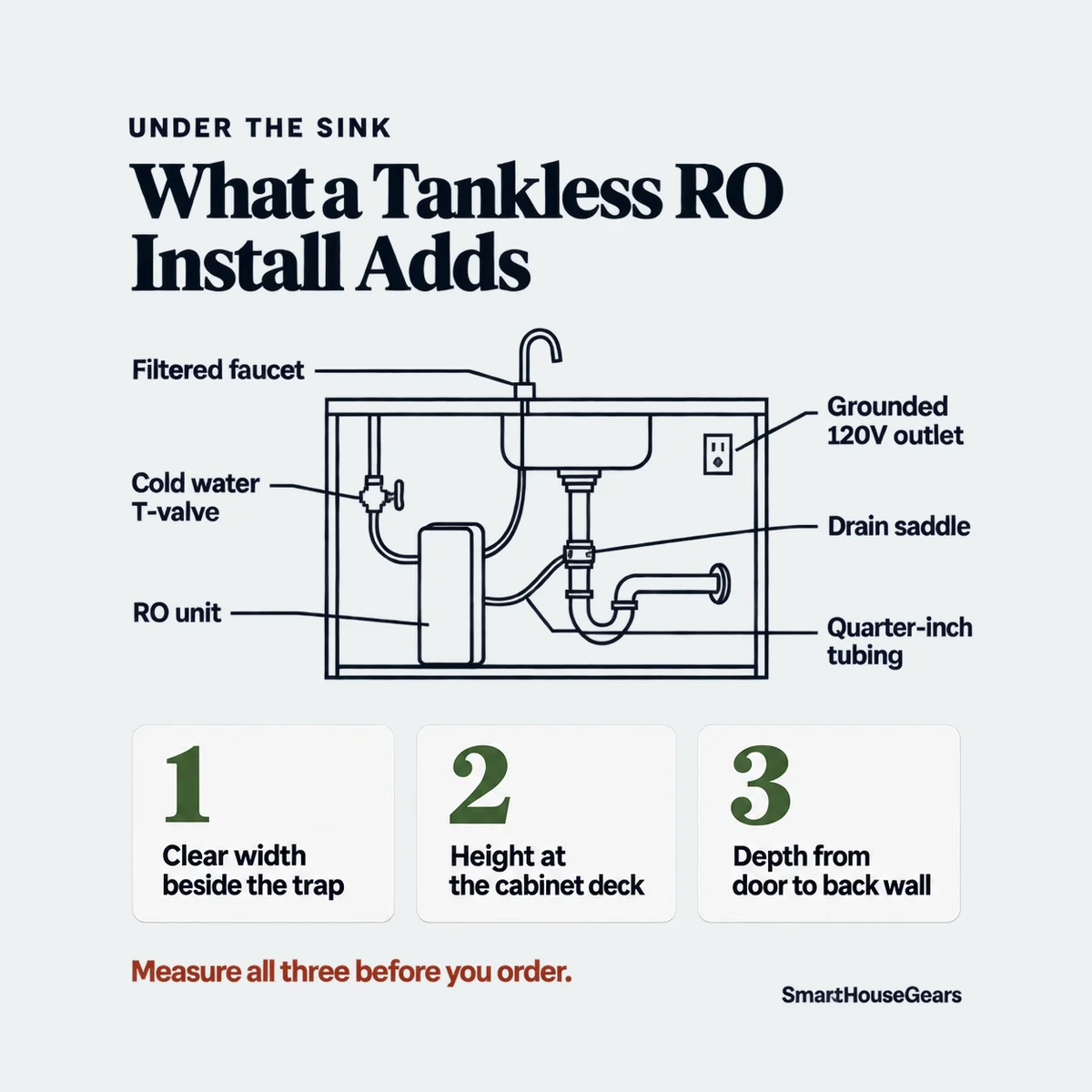
What a tankless RO install actually puts in your sink cabinet, and the three measurements to take before you order anything.
The 9 Best Tankless Reverse Osmosis Systems for US Homes in 2026
These are ranked on the whole ownership picture: certification depth, drain efficiency, flow, cabinet fit, filter cost, and how loudly the pump announces itself at 6 AM. Price matters, but it is not the tiebreaker.
Best Overall
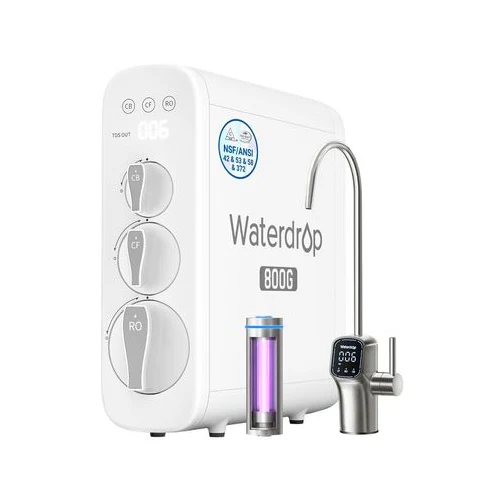
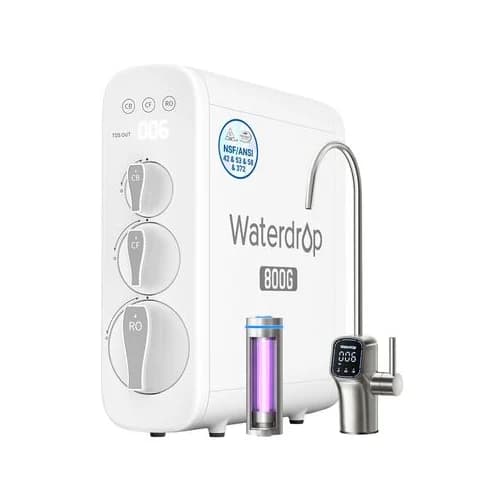
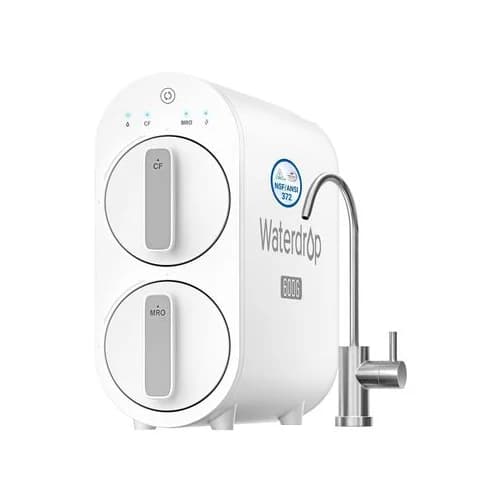
1. Waterdrop G3P800 - Best Overall
Rated 4.5 out of 54.5· 5,235 reviews
The most thoroughly certified tankless RO system on Amazon.com, combining 800 GPD flow, a 3:1 drain ratio, an integrated UV stage, and IAPMO certification against four separate NSF/ANSI standards.
Key features
IAPMO R&T certified against NSF/ANSI 42, 53, 58 and 372, the widest certification set in this guide
800 GPD works out to about 1.2 fl oz per second, so a 16 oz glass fills in roughly 13 seconds
3:1 pure to drain ratio, the most water-efficient powered system in this lineup
Built-in UV LED sterilization on the outlet side, plus a 10-stage filter path
Smart faucet displays live TDS and remaining filter life instead of a guess-based reminder
What we like
The only pick here certified to NSF/ANSI 42, 53, 58 and 372 together
Best drain efficiency of any powered system in this comparison
Largest owner base in the category, which makes troubleshooting far easier
UV stage adds a layer that most tankless competitors charge extra for
Watch out for
Most expensive system in this guide by a wide margin
Proprietary filters cost more per year than the iSpring or SimPure cartridges
Still needs a grounded outlet and produces audible pump noise while filling
If you are buying one tankless RO system and you want the fewest asterisks, buy the Waterdrop G3P800. It is the closest thing this category has to a default answer.
The reason is paperwork, not marketing. Most listings in this price band claim certification against one standard and imply the rest.
Waterdrop holds IAPMO R&T certification against NSF/ANSI 42, 53, 58, and 372 for this model. That set covers aesthetic reduction, health contaminants, RO performance, and lead-free materials.
Flow is genuinely fast at 800 GPD. In practice that means a pitcher fills without the pause tank systems force on you once the bladder empties, which is the moment most people notice their old RO system was undersized.
The 3:1 drain ratio is the number that pays you back. A family running 3 gallons of filtered water a day sends about 1 gallon to the drain.
A legacy 1:4 tank system would have sent roughly 12. Over a year that gap is real money in Phoenix, Las Vegas, or any metered Southern California district.
The UV stage sits after filtration and targets microbiological contaminants on the outlet side. It matters most on a private well, or after a boil water notice in the last few years.
City water users will treat it as insurance rather than a daily need.
The smart faucet is more useful than it sounds. It reads out live TDS, so you can see membrane performance drift months before taste changes, instead of replacing filters on a calendar the manufacturer chose.
The honest downside is running cost. Waterdrop G3P800 cartridges are proprietary and priced accordingly, so the five-year total lands higher than an iSpring RO5004F even though both do the core job well.
Cabinet fit is the practical check before you order. This is a full-size flagship rather than a compact unit, so measure the clear strip beside your drain trap and confirm the faucet will land in a spare deck hole rather than a freshly drilled one.
Noise sits where the category average sits. Owners describe a pump hum during the twenty to forty seconds it runs.
The fix is the same one that works on every system here: a foam pad under the unit so the cabinet floor stops acting as a soundboard.
Buy Waterdrop G3P800 if you want the deepest certification set, the best drain efficiency, and a system you will not second-guess. Skip it if your budget stops near $400, because the Frizzlife PD600-TAM3 covers most of the same ground for less.
Best Value Premium
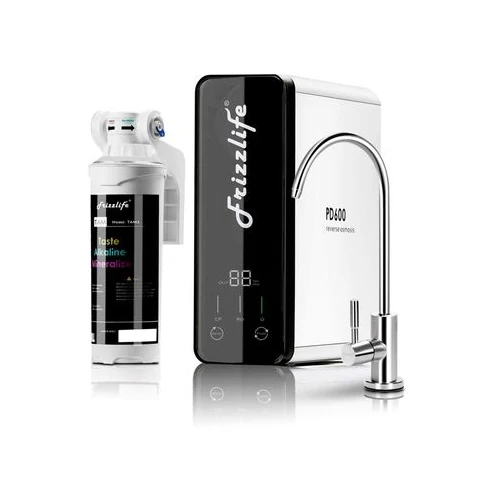
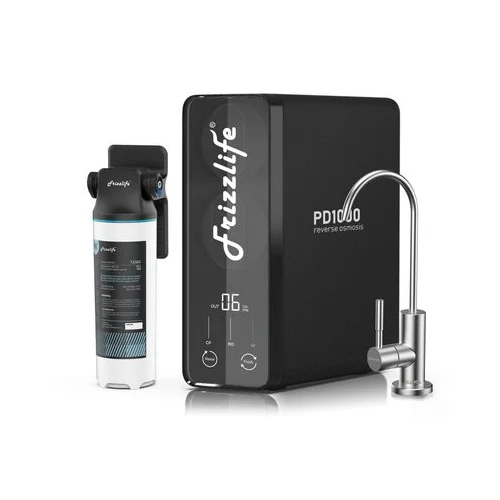
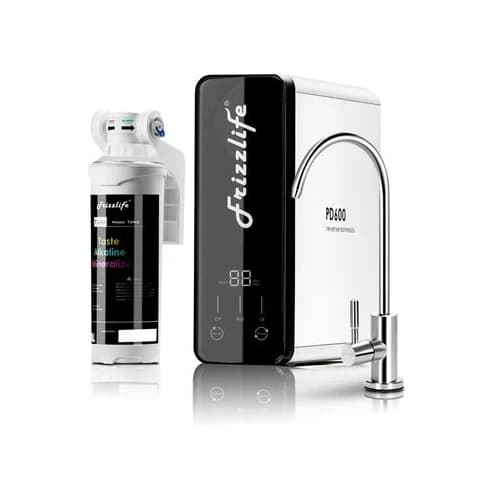
2. Frizzlife PD600-TAM3 - Best Value Premium
Rated 4.6 out of 54.6· 2,190 reviews
The best balance of price, remineralized taste and PFAS-conscious filtration in this guide, with 600 GPD flow, a 2:1 drain ratio, and a smart panel that reports outlet TDS in real time.
Key features
Alkaline mineral pH+ stage adds calcium and magnesium back after the membrane
600 GPD flow with a 2:1 pure to drain ratio, roughly double the efficiency of legacy tank systems
Built to NSF/ANSI 58, 53, 42 and 372 standards, with a published PFAS and PFOA reduction claim
Smart LED display shows live outlet TDS and remaining life for each cartridge separately
Quick-change twist cartridges with no wrench, no shutoff valve and no sanitizing ritual
What we like
Best price-to-capability ratio of any system in this guide
Remineralization solves the flat-taste complaint that makes people abandon RO
Strong Amazon review base at 2,190 ratings and a 4.6 star average
Per-cartridge life tracking is more useful than a single system-wide countdown
Watch out for
2:1 drain ratio is good but not as efficient as the Waterdrop G3P800
Alkaline stage raises TDS readings slightly, which confuses first-time owners
Frizzlife documents NSF standards for this model rather than listing a third-party certification mark
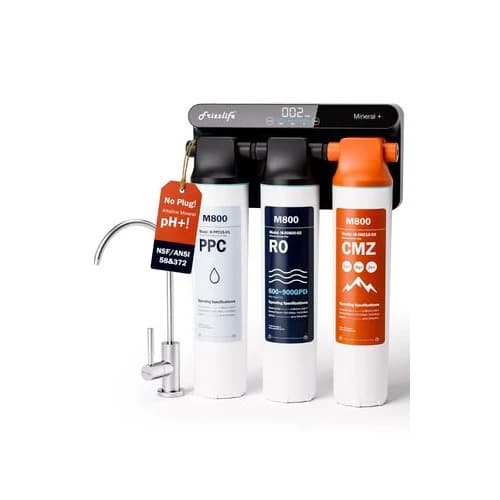
Frizzlife PD600-TAM3 is the system we would recommend to a friend who asked one question and did not want a lecture. It covers the important ground and costs roughly half of the flagship.
Remineralization is the feature that keeps this unit in kitchens. Straight RO water tastes flat because the membrane strips calcium and magnesium along with the contaminants, and a lot of returns in this category are taste returns rather than performance returns.
The alkaline stage adds those minerals back after filtration. The side effect confuses people: your TDS meter will read higher than a bare RO system, sometimes 30 to 60 ppm, and that is added mineral rather than remaining contaminant.
The PFAS story is credible here. Frizzlife publishes a PFOA and PFAS reduction claim for this model and builds it to NSF/ANSI 58, 53, 42, and 372.
That is still a step below the third-party certification mark Waterdrop G3P800 carries, and we say so plainly rather than pretending they are equivalent.
Flow at 600 GPD is more than enough for a family of four. The gap between 600 and 800 GPD is perceptible only when you are filling a stockpot, which is not a daily event in most homes.
The 2:1 drain ratio is the one real compromise against the flagship. You send half a gallon to the drain per filtered gallon rather than a third, which costs a few dollars a year in most municipal districts and more in drought-priced markets.
Owner reports are consistent about installation. The quick-change cartridges twist out without a wrench and without shutting off the supply, which is the detail that decides whether a household actually keeps up with filter changes.
The per-cartridge life tracking is a small thing that saves money. Instead of one system-wide countdown that pushes you to replace everything at once, the panel tracks each stage separately.
A sediment filter on a clean municipal supply can then run its full interval, while the carbon stage changes on its own schedule.
One caution for the hard-water belt. The remineralization cartridge sits after the membrane and does not protect it, so homes above 10 grains per gallon should still run a softener upstream rather than assuming the alkaline stage compensates.
Buy Frizzlife PD600-TAM3 if you want RO water that tastes like water, at a price that does not require a second thought. Step up to the flagship only if you specifically want the four-standard certification mark and the 3:1 ratio.
Best for PFAS
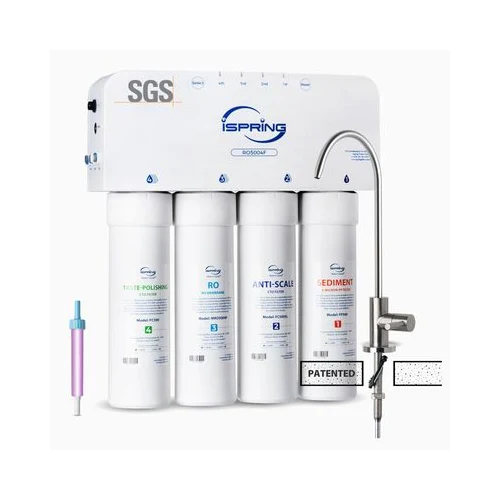
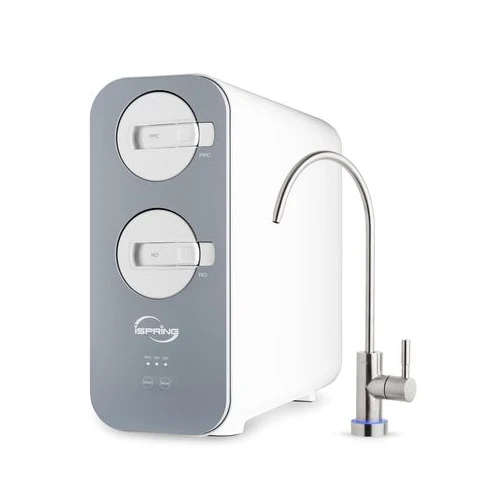
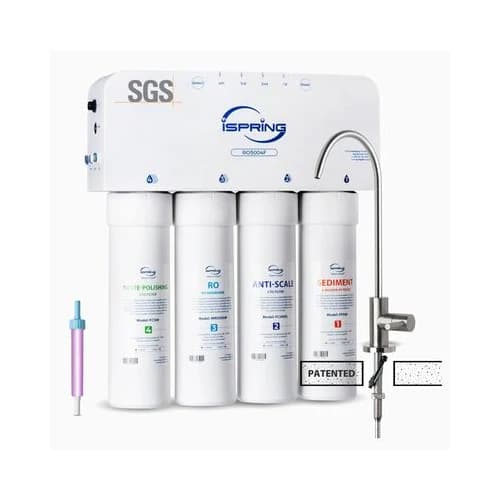
3. iSpring RO5004F - Best for PFAS Reduction
Rated 4.7 out of 54.7· 953 reviews
The highest-rated system in this guide and the one we would choose for a home with a confirmed PFAS or low-pressure problem, thanks to SGS-tested PFAS reduction, a UV stage and an internal booster pump.
Key features
Independently SGS tested for PFAS and TDS reduction, with the test result published by iSpring
6-layer filtration with a UV stage, rated for reduction of more than 1,000 contaminants
Internal booster pump designed for homes with low incoming water pressure
500 GPD flow with a 2:1 pure to drain ratio and an onboard filter life monitor
Shipped and sold by Amazon, so returns and replacement parts move faster than third-party listings
What we like
Highest Amazon rating in this guide at 4.7 stars across 953 ratings
The booster pump genuinely helps homes below 40 psi, where other tankless units underperform
Replacement cartridges are among the cheapest per year in this comparison
Amazon fulfillment removes the support lottery that comes with brand-direct sellers
Watch out for
500 GPD is the slowest powered system here, noticeable when filling large pots
No remineralization stage, so the water tastes flat unless you add one
SGS testing is not the same as a full IAPMO or NSF certification mark
iSpring RO5004F carries the highest owner rating in this guide, and the reasons behind that number are unusually specific.
Start with the pump. Many tankless systems assume 45 to 80 psi at the tap, and American homes at the end of a long municipal run often sit below that.
The RO5004F includes a booster stage built for exactly that case. That is why its reviews skew toward rural and older-home buyers.
The PFAS claim is the reason it leads that category here. iSpring commissioned SGS testing for PFAS and TDS reduction and publishes the result, which is a meaningful step above a listing that simply prints the word PFAS in a bullet.
That said, an SGS test report and an IAPMO certification mark are not the same document. Certification carries ongoing audits and production surveillance. A commissioned lab test is a snapshot of one sample, and buyers deserve to know the difference.
The UV stage matters most on well water and in homes with a history of boil water advisories. It handles microbiological risk that a membrane alone does not fully address once water sits in tubing between uses.
Flow is the trade. At 500 GPD this is the slowest powered unit in the lineup, so a stockpot takes a noticeably longer time than it does on the Frizzlife PD1000-TAM4. For glasses, bottles, and coffee, nobody notices.
The missing remineralization stage is the other trade. If flat water bothers your household, either add an inline mineral cartridge later or buy the Frizzlife PD600-TAM3 instead.
Running cost is where this quietly beats the flagship. iSpring prices replacement cartridges aggressively and the six-layer path uses fewer proprietary parts, which is the difference between a $75 year and a $140 year over the life of the system.
The filter life monitor deserves a note too. It counts usage rather than calendar days, so a second home or a light-use household stops paying for cartridges it never exhausted.
Buy iSpring RO5004F if PFAS is your reason for shopping, if your water pressure is weak, or if you want the cheapest long-term filter bill in a well-rated system. Skip it if flow rate or mineral taste is your priority.
Best Under $300
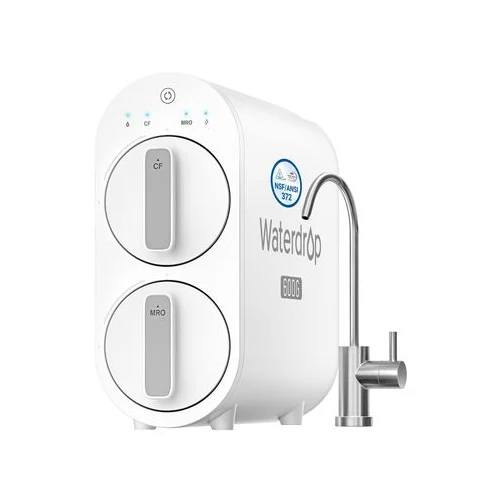
4. Waterdrop G2P600 - Best Under $300
Rated 4.6 out of 54.6· 1,738 reviews
The sensible entry point into tankless RO, pairing 600 GPD flow and a 2:1 drain ratio with a two-cartridge design that keeps both the install and the yearly maintenance genuinely simple.
Key features
Two-cartridge, 7-stage layout that cuts replacement complexity to a twist and a pull
600 GPD flow with a 2:1 pure to drain ratio at an entry-level price
NSF/ANSI 372 certified for lead-free wetted materials
Integrated water and electrical circuit design intended to reduce leak points
Most owners report finishing the install inside an hour with the included fittings
What we like
Strong 4.6 star average across 1,738 ratings at the lowest powered price here
Two cartridges instead of five makes the annual maintenance hard to get wrong
600 GPD matches systems costing $150 more
Slim footprint fits cabinets that cannot take a flagship unit
Watch out for
Certified only to NSF/ANSI 372, which covers materials and not contaminant reduction
No remineralization and no UV stage at this price
Basic faucet with no TDS readout, so you replace filters on schedule rather than on data
Waterdrop G2P600 is the answer to the most common version of this question: what is the least you can spend without buying something you will regret?
The two-cartridge design is the quiet reason it works. Five-stage systems look impressive on a box and then punish you every spring, while a two-cartridge system makes the annual routine a ninety-second job that people actually do.
Flow and efficiency are not compromised to hit the price. You get the same 600 GPD and the same 2:1 drain ratio as the Frizzlife PD600-TAM3, which is unusual at this level.
The certification line is where the saving shows, and it deserves plain language. Waterdrop certifies this model to NSF/ANSI 372, which confirms the wetted materials are lead-free. It does not certify contaminant reduction performance the way NSF/ANSI 58 does.
That does not mean the membrane fails. RO membranes reduce dissolved solids as a matter of physics.
It means you are trusting the manufacturer's own data rather than a third-party performance certification. At this price, on clean municipal water, that is a reasonable trade.
The faucet is basic. There is no TDS readout, so you follow the recommended replacement schedule instead of watching performance drift. For a household on city water with a published quality report, that is fine.
Owner installs go smoothly by the standards of this category. The integrated water and electrical circuit design cuts the number of external connections, and fewer push-fit joints under a sink means fewer 2 AM discoveries.
Buy Waterdrop G2P600 if you want tankless RO without the flagship budget and your water problem is ordinary. Move up to the iSpring RO5004F if you need a documented PFAS claim.
Best High Flow
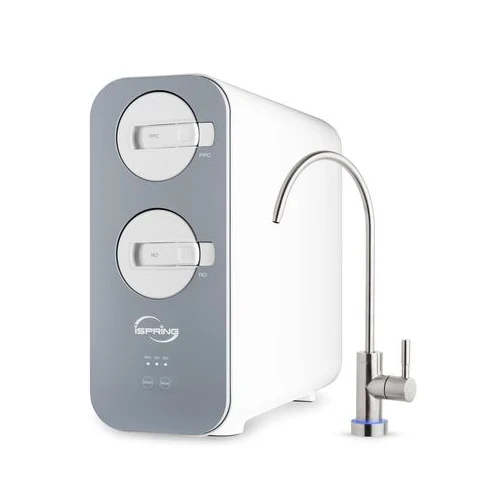
5. iSpring RO800G - Best High-Flow Pick
Rated 4.5 out of 54.5· 222 reviews
An 800 GPD tankless system built around two composite cartridges and a 2.5:1 drain ratio, aimed at large households that want flagship flow without flagship complexity.
Key features
800 GPD output matched to a 2.5:1 pure to drain ratio
Two-stage layout with a PP and CTO composite pre-filter ahead of the RO membrane
TDS and PFAS reduction claims published by iSpring for this model
Lead-free brushed nickel designer faucet included, with BPA-free wetted materials
Shipped and sold by Amazon with DIY-oriented instructions and standard quick-connect fittings
What we like
Flagship-level 800 GPD flow for well under flagship pricing
Only two cartridges to track despite the high output
Better drain efficiency than most systems in the $400 band
Included faucet is a genuine brushed nickel fixture rather than a plastic stand-in
Watch out for
Smallest review base of the established picks here at 222 ratings
No UV stage and no remineralization
Two-stage filtration means the pre-filter works harder on sediment-heavy supplies
iSpring RO800G exists for the household where the faucet never gets a rest: a family of five, a coffee habit, a nugget ice maker, and a dog bowl that gets refilled three times a day.
At 800 GPD it matches the flagship on raw output. Where it differs is architecture, since iSpring gets there with two cartridges rather than a five-stage path, which keeps both the price and the annual maintenance down.
The 2.5:1 drain ratio sits between the Waterdrop G3P800 and the 2:1 field. For a heavy-use household that difference compounds, because high flow and high waste together are what make a water bill jump.
Two-stage filtration has a real limitation worth naming. With fewer pre-filter stages, sediment-heavy or high-chlorine supplies put more load on a single composite cartridge, which shortens its life in some regions.
The included faucet is better than the category norm. Most kits ship a lightweight fixture that looks wrong next to a real kitchen faucet, and the brushed nickel unit here holds up against mid-range Delta and Moen finishes.
Amazon fulfillment is a practical advantage that buying guides underrate. Brand-direct sellers in this category vary widely on replacement parts and warranty response, and a Prime return window removes most of that risk.
The caution is the review base. At 222 ratings this has far less owner data behind it than the Waterdrop G2P600, so you are buying on specification more than on crowd evidence.
Buy iSpring RO800G if you need real 800 GPD flow, want simple maintenance, and can accept a thinner review history. Choose the flagship instead if certification depth matters more than price.
Best With Instant Hot
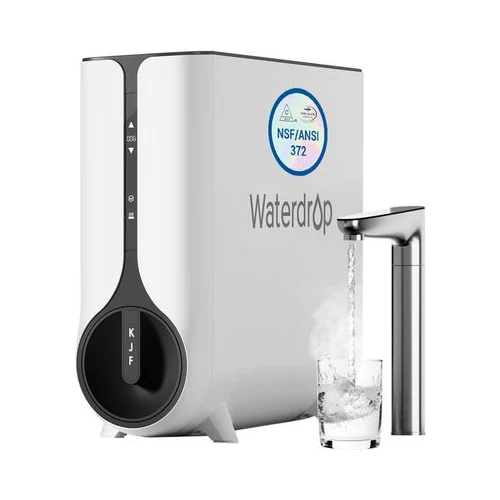
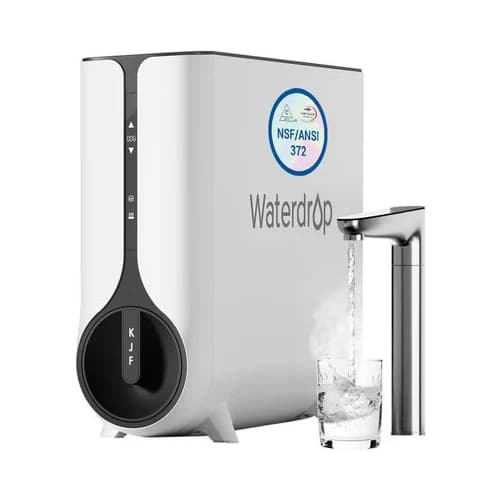
6. Waterdrop KJ600 - Best With Instant Hot Water
Rated 4.3 out of 54.3· 718 reviews
A 600 GPD tankless RO system with an integrated on-demand water heater, dispensing filtered water at a temperature you select from the same smart faucet in seconds.
Key features
On-demand heating built into the RO system, with selectable dispensing temperatures
600 GPD flow through a 5-in-1 cartridge containing the RO membrane and carbon stages
Smart display faucet reporting live TDS and filter condition
Replaces both an under-sink RO unit and a separate instant hot water dispenser
Tankless design with no stored hot water and no standby reheating cycle
What we like
The only system here that serves tea, formula and instant coffee without a kettle
Saves the counter space and the second under-sink appliance a hot water dispenser needs
No standby heat loss, because it heats only what you dispense
Single 5-in-1 cartridge keeps replacement to one part number
Watch out for
Lowest rating in this guide at 4.3 stars, with heating faults the recurring complaint
Draws noticeably more power than a filtration-only system
A single combined cartridge means one failed stage replaces the whole assembly
Waterdrop KJ600 is the most interesting product in this guide and the one that needs the most honest framing. It combines reverse osmosis and instant hot water in a single under-sink box, and almost no competing buying guide covers it.
The case for it is a two-appliance problem solved once. A traditional instant hot water dispenser needs its own tank, its own outlet, and its own hole in the counter.
Pairing one with an RO system usually means two units competing for the same cabinet.
Dispensing is genuinely fast and temperature-selectable, which matters more than novelty suggests. Baby formula wants a specific temperature, green tea wants a lower one than black tea, and a kettle gives you one setting: boiling.
The 5-in-1 cartridge keeps maintenance to one part number, which is welcome. It also means a single failure point, because one exhausted stage retires the whole assembly rather than one $25 cartridge.
The rating is the reason this sits at number six rather than higher. At 4.3 stars across 718 ratings it is the weakest score in this guide, and the recurring theme in critical reviews is the heating element rather than the filtration.
We are listing it anyway, with that disclosure, because the filtration side is standard Waterdrop and the heating function has no real competitor at this price. Buyers who want it should want it specifically.
Power draw is the other practical note. Heating water on demand is electrically hungry, so confirm the sink circuit is not already carrying a disposal and a dishwasher on a shared 15A breaker.
Check your sink deck before you commit. The heated faucet is larger than a standard RO fixture and needs its own hole, so a deck already carrying a sprayer, a soap dispenser, and an air gap leaves you drilling stone.
There is a safety note worth stating plainly. This dispenses water hot enough to steep tea, so households with small children should confirm the faucet has a child-safe dispensing action before installing it within reach.
Buy Waterdrop KJ600 if instant hot filtered water solves a daily annoyance in your kitchen and you accept the reliability trade. Buy the Waterdrop G3P800 instead if you only need cold filtration done extremely well.
Best Max Capacity
7. Frizzlife PD1000-TAM4 - Best Max Capacity
Rated 4.4 out of 54.4· 283 reviews
The fastest system in this guide at 1000 GPD, with nine filtration stages, alkaline remineralization and a 2:1 drain ratio, built for large households and fridge-plumbed installations.
Key features
1000 GPD output, the highest flow rate of any pick in this comparison
Nine-stage path with alkaline remineralization after the membrane
Certified against NSF/ANSI 372 and built to the 58, 53 and 42 standards
2:1 pure to drain ratio maintained despite the higher output
Smart panel with real-time TDS reading and per-stage filter life monitoring
What we like
Fills a stockpot or a 5-gallon jug faster than anything else here
Remineralization included at a capacity level where it is usually dropped
Holds a 2:1 drain ratio at 1000 GPD, which is genuinely difficult engineering
Best choice when you plan to run a line to a refrigerator or ice maker
Watch out for
Thin review base at 283 ratings and a 4.4 star average
Most households will never use 1000 GPD of capacity
Larger cabinet footprint than the 400 to 600 GPD systems
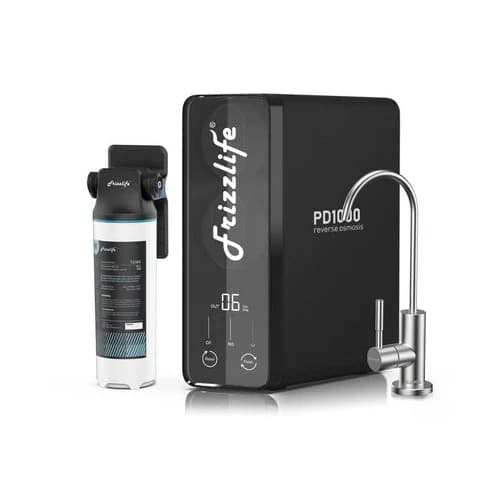
Frizzlife PD1000-TAM4 is built for a specific household, and if you are not that household you should buy something cheaper.
The case for 1000 GPD is not daily volume. It is instantaneous flow, which matters when one RO line feeds a kitchen faucet, a refrigerator dispenser, and one of the machines in our countertop nugget ice maker guide pulling hard on its duty cycle.
Holding a 2:1 drain ratio at that output is the impressive part. High-flow systems usually buy their speed with drain water, and Frizzlife did not take that shortcut here.
The nine-stage path includes the same alkaline remineralization as the Frizzlife PD600-TAM3, which is unusual at the top of a lineup. Most manufacturers treat mineral return as a mid-range feature and drop it on the performance model.
Certification follows the same pattern as the rest of the Frizzlife range. NSF/ANSI 372 is the certified mark, while 58, 53, and 42 are the standards the product is built and tested to, and that distinction is worth reading carefully on the listing.
The review base is the real caution. At 283 ratings this is early-adopter territory compared with the thousands behind the flagship Waterdrop, and high-capacity systems have more moving parts to go wrong.
Footprint is the other practical limit. This is not the unit for a 30-inch sink base already holding a disposal, a dishwasher air gap, and a trash pull-out.
Buy Frizzlife PD1000-TAM4 if you are feeding multiple fixtures from one RO line or you run a genuinely high-volume kitchen. For a family of four at a single faucet, this is capacity you will pay for and never use.
Best Compact
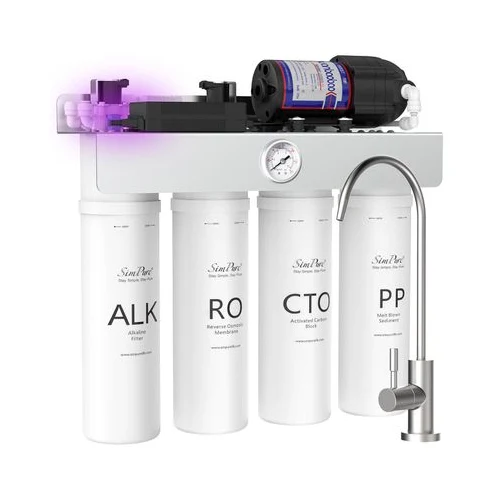
8. SimPure T1-400ALK - Best Compact Fit
Rated 4.2 out of 54.2· 1,400 reviews
The smallest complete package here, fitting UV sterilization, alkaline remineralization and 400 GPD flow into a footprint built for tight cabinets and apartment sinks.
Key features
400 GPD flow with a 1.5:1 pure to drain ratio
UV stage that runs automatically on dispensing rather than continuously
Alkaline remineralization stage restores mineral balance after the membrane
Independently SGS tested against the NSF/ANSI 58 standard
Quick-change cartridge set designed for tool-free swaps in cramped cabinets
What we like
Fits cabinets where the 600 to 1000 GPD systems physically will not
UV and remineralization together at the lowest price in this guide
Solid 1,400-rating review base for a compact system
Sensible choice for condos, townhouses and apartment kitchens
Watch out for
Lowest rating in this guide at 4.2 stars
1.5:1 drain ratio is the least water-efficient here
400 GPD is slow if you regularly fill large containers
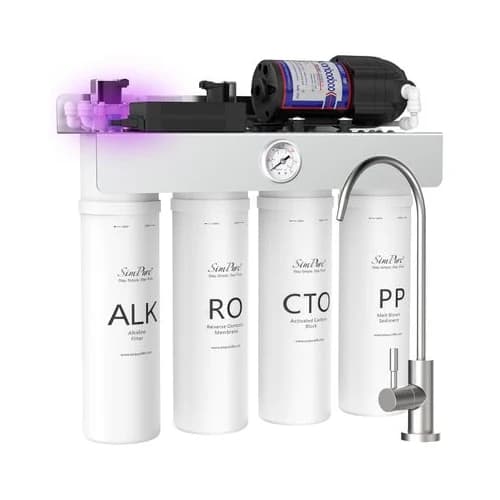
SimPure T1-400ALK solves the problem that kills more RO purchases than any specification: the cabinet is full.
American sink bases are crowded. A disposal, a dishwasher drain loop, a trash pull-out, and the shutoff valves leave a usable strip that is often under 7 inches wide, and half the systems in this guide simply will not go in.
This one fits, and it does not strip out features to get there. You still get a UV stage and an alkaline remineralization stage, which is a combination the other sub-$300 picks do not offer.
The UV runs on dispensing rather than continuously. That extends lamp life and cuts standby power, and it is the right design choice for a unit that will spend most of the day idle in a small household.
Two numbers are the honest cost of that packaging. At 4.2 stars this has the weakest rating in the guide, and at 1.5:1 it is the least water-efficient system here, sending two thirds of a gallon to the drain per filtered gallon.
The 1,400-rating review base is large enough to trust, and the pattern in critical reviews points at fitting leaks during install rather than filtration failures. Hand-tighten, then quarter-turn, and pressure-test before you close the cabinet.
Flow at 400 GPD is fine for glasses, bottles, and a coffee maker. It is slow for a stockpot, and if you cook with filtered water in volume you want the Frizzlife PD1000-TAM4 instead.
Buy SimPure T1-400ALK if your cabinet is tight, your budget is real, and you still want UV and mineral return. Skip it if you live somewhere with drought pricing, because that drain ratio is the wrong one for a metered desert district.
Best Non-Electric
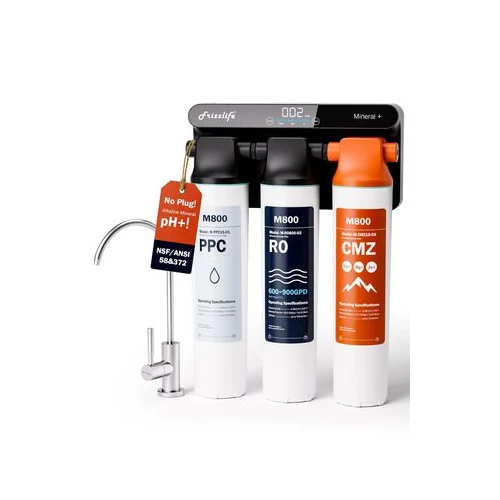
9. Frizzlife M800 - Best Non-Electric Pick
Rated 4.5 out of 54.5· 59 reviews
A cordless tankless RO system that runs on household line pressure alone, rated by Frizzlife at up to 900 GPD and a 4:1 drain ratio, for sinks with no outlet and homeowners who refuse to live with pump noise.
Key features
Runs with no electricity and no cord, using household line pressure instead of a booster pump
Rated by Frizzlife at up to 900 GPD with a 4:1 pure to drain ratio
Eight-stage filtration with alkaline mineralization and an auto flush cycle
Certified against NSF/ANSI 58 and 372, with a smart TDS and filter life monitor
Oversized cartridge measuring 14.5 by 5.1 by 19.7 inches, sized for long replacement intervals
What we like
The only pick here that works in a cabinet with no outlet
Silent in operation, because there is no pump to hum
Best rated drain efficiency in this guide at 4:1
Large cartridge means fewer replacements over the life of the system
Watch out for
Only 59 Amazon ratings, far too few to judge long-term reliability
Output depends entirely on your incoming water pressure, so the 900 GPD figure is a ceiling
At 19.7 inches tall it is the hardest unit here to fit vertically
Frizzlife M800 is the pick nobody else in this category is writing about, and it answers a problem American homes have constantly: there is no outlet under the sink.
Older housing stock rarely put a receptacle in a sink base, and adding one means an electrician, a GFCI, and in some jurisdictions a permit. For a renter or anyone in a 1960s ranch, that cost can exceed the RO system itself.
This unit sidesteps it entirely. Frizzlife designs the M800 to run on household line pressure with no pump and no cord, which also eliminates the single most common complaint in this whole category.
That silence is a real feature. Pump noise in a tankless RO system sits around 50 dB, and a pump resting on a thin cabinet floor turns that hum into a resonating buzz that carries into an open-plan kitchen.
The 4:1 rated drain ratio is the best number in this guide. Frizzlife publishes it, and it is worth understanding that non-electric systems usually trade efficiency for simplicity, so this is a genuinely unusual claim at this price.
Two cautions are non-negotiable. First, the review base is 59 ratings, which is nowhere near enough to judge three-year reliability, and we are listing this as a promising new design rather than a proven one.
Second, the 900 GPD figure is a ceiling that depends on your incoming pressure. With no booster pump, a home at 35 psi will not see anything close to the rated output, and the iSpring RO5004F is the better answer for low-pressure supplies.
Buy Frizzlife M800 if your sink cabinet has no outlet, if pump noise is a dealbreaker, or if you want the best drain efficiency available and can accept early-adopter risk.
Everyone with an outlet and a preference for proven hardware should buy one of the first four picks.
How Do You Choose a Tankless RO System for Your Kitchen?
Start with a water test, not a product page. Your utility publishes an annual Consumer Confidence Report with measured contaminant levels, and a $30 home kit adds lead, nitrate, and hardness numbers specific to your tap.
Everything below depends on what that report says.
Do You Actually Need Reverse Osmosis?
Reverse osmosis is the right answer when your water carries dissolved contaminants that carbon cannot hold: lead, nitrate, arsenic, fluoride, PFAS, chromium-6, and high total dissolved solids. It is the wrong answer when your only complaint is chlorine taste.
A carbon block under-sink filter costs $60 to $180, wastes nothing, and fixes chlorine taste and odor completely. Buying a $500 RO system to solve a taste problem is the most common overspend in home water treatment.
The test result decides it. If your report shows lead above the action level, nitrate above 5 mg/L, or any detected PFAS, reverse osmosis is the technology that handles it.
What Does Tankless Actually Change Under the Sink?
Tankless removes the pressurized storage tank and replaces it with a booster pump that raises pressure at the membrane on demand. The practical effect is a footprint roughly half the size of a tank system.
You also lose the stale-water problem. Tank systems store filtered water in a bladder for days, and the resulting flat taste and bacterial regrowth risk are the two oldest complaints about home RO.
What you gain in return is a power requirement and noise. Every powered tankless unit needs an outlet, and every one of them hums for the twenty to sixty seconds it runs.
How Many GPD Does Your Household Really Need?
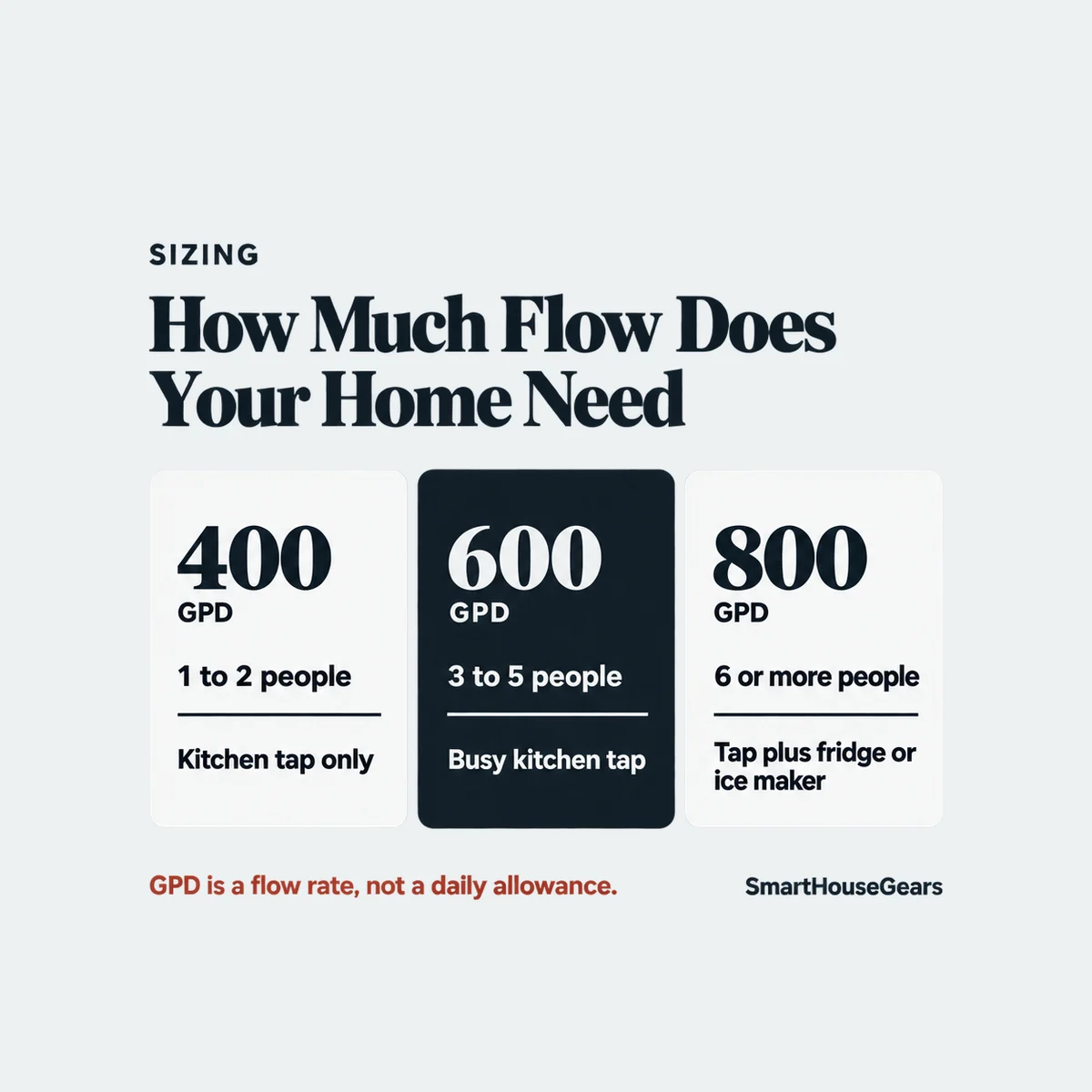
A 400 GPD system suits one or two people, 500 to 600 GPD suits a family of three to five, and 800 GPD or more makes sense only for large households or multi-fixture installs. GPD measures flow capability, not a quota you must consume.
Be honest about the second fixture. If you plan to plumb the RO line to a refrigerator dispenser or a countertop ice maker, the effective demand roughly doubles, and that is when 800 to 1000 GPD stops being overkill.
For a single kitchen faucet in a household of four, 600 GPD is the sweet spot on price, flow, and cabinet size.
How to match GPD to your household: people in the home, how many fixtures the RO line feeds, and what each tier feels like at the faucet.
What Is a Good Pure to Drain Ratio?
A 3:1 pure to drain ratio is the best figure available on a powered tankless RO system, and anything at 2:1 or better is good. Every membrane sends rejected contaminants down the drain in a concentrated stream, and this ratio tells you how much.
A 3:1 system makes three gallons of filtered water for every gallon discarded. A 1.5:1 system makes one and a half.
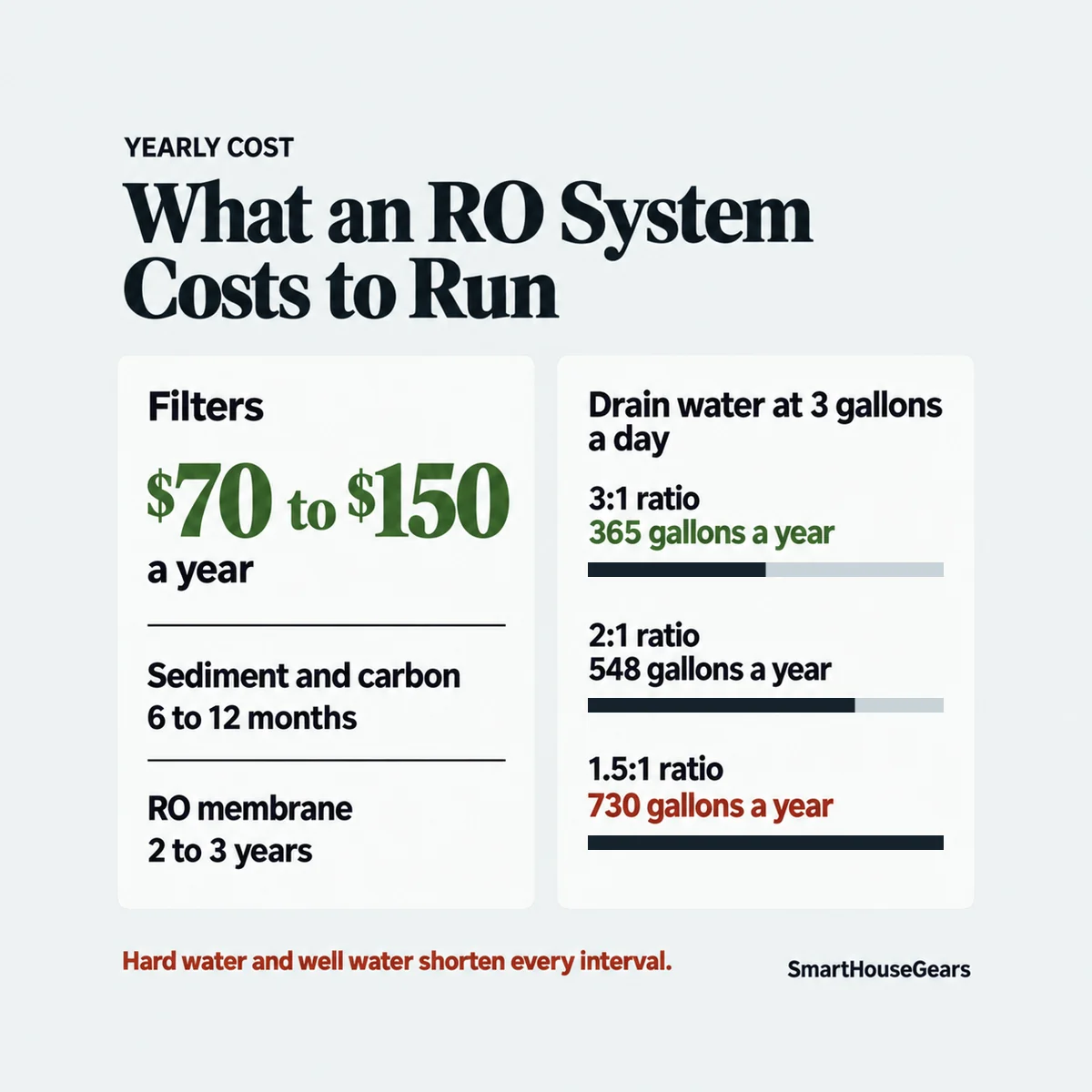
Run the math on your own use. A family drinking and cooking with 3 gallons a day sends roughly 365 gallons a year to the drain at 3:1, and 730 gallons at 1.5:1.
That difference is small in Cleveland and meaningful in Phoenix, Las Vegas, or a Southern California district with tiered pricing. It also matters if you are on a septic system, where every extra gallon loads the field.
Does a Tankless RO System Need an Outlet Under the Sink?
Almost every tankless RO system needs a standard grounded 120V outlet, because the booster pump is what replaces the tank. Check inside the cabinet before you order, not after the box arrives.
Many pre-1980s American homes have no receptacle in the sink base at all. Adding one usually means a GFCI-protected circuit installed by an electrician, which is a real cost on top of the system.
The workaround is a non-electric unit such as the Frizzlife M800, which runs on line pressure. The other workaround, running an extension cord from a nearby outlet into a cabinet that also holds plumbing, is a bad idea and most manufacturers say so.
Which NSF Certifications Actually Mean Something?
Four numbers appear on RO boxes, and only two of them describe contaminant removal. Reading them correctly is the single most useful skill in this category.
TableWhat Each NSF/ANSI Number Certifies on an RO System
Standard
What It Certifies
Why It Matters to You
NSF/ANSI 42
Aesthetic effects such as chlorine, taste and odor
Taste and smell only, no health contaminant claim
NSF/ANSI 53
Health effects including lead, cysts and certain VOCs
The standard that backs a lead reduction claim
NSF/ANSI 58
Reverse osmosis performance and TDS reduction
The core RO standard, and the base for most PFAS claims
NSF/ANSI 372
Lead-free content of wetted materials
Says nothing about what the system removes from your water
SGS or third-party tested
A commissioned laboratory result on sampled units
Real evidence, but a snapshot rather than an audited certification
NSF/ANSI 42
What It Certifies
Aesthetic effects such as chlorine, taste and odor
Why It Matters to You
Taste and smell only, no health contaminant claim
NSF/ANSI 53
What It Certifies
Health effects including lead, cysts and certain VOCs
Why It Matters to You
The standard that backs a lead reduction claim
NSF/ANSI 58
What It Certifies
Reverse osmosis performance and TDS reduction
Why It Matters to You
The core RO standard, and the base for most PFAS claims
NSF/ANSI 372
What It Certifies
Lead-free content of wetted materials
Why It Matters to You
Says nothing about what the system removes from your water
SGS or third-party tested
What It Certifies
A commissioned laboratory result on sampled units
Why It Matters to You
Real evidence, but a snapshot rather than an audited certification
NSF/ANSI 372 is the one that trips buyers up. It certifies that the plastics, fittings, and faucet do not leach lead into your water. That is worth having, and it tells you nothing about filtration performance.
Look for 58 first, then 53 if lead is your concern. The Waterdrop G3P800 is the only system in this guide carrying an IAPMO certification mark against all four.
Should You Remineralize Reverse Osmosis Water?
Reverse osmosis strips most dissolved minerals along with the contaminants, so RO water tastes flat and reads near zero on a TDS meter. Remineralization stages add calcium and magnesium back after the membrane.
The health argument is weaker than marketing suggests. Food supplies the large majority of daily calcium and magnesium intake.
The World Health Organization has flagged very low-mineral drinking water as worth attention mainly for people who drink a lot of it and get little from diet.
The taste argument is the real one. Households that abandon RO usually abandon it over flatness, and a remineralization stage in the Frizzlife PD600-TAM3 or SimPure T1-400ALK is what keeps the system in daily use.
Will a Tankless RO System Fit Under Your Sink?
Measure the clear floor width beside your drain trap, not the cabinet opening. That usable strip is what the system has to live in, and a garbage disposal typically eats the left or right half of it.
Then count your countertop holes. A standard American sink deck has three or four, and a spare sprayer or soap dispenser hole saves you from drilling granite or quartz. A pro-drilled hole in stone runs $100 to $250 in most metros.
Height matters more on tankless systems than people expect. The Frizzlife M800 stands 19.7 inches tall, which will not clear a shallow cabinet with a low deck.
How Should Well Owners Set Up Reverse Osmosis?
Well water needs pretreatment before it reaches an RO membrane, without exception. Sediment, iron, manganese, and hardness above roughly 7 grains per gallon foul membranes and turn a three-year cartridge into a one-year cartridge.
Build the chain in order. A sediment filter first, then a softener or iron filter, then the RO system handles nitrate, arsenic, and dissolved solids that the earlier stages cannot touch.
A UV stage is worth more on a well than on city water. The iSpring RO5004F and SimPure T1-400ALK both include one, which is the right specification for an untreated private supply.
What Do Filters Actually Cost Per Year?
Budget $70 to $150 a year across this lineup, and check the real replacement interval before you compare prices. A $30 cartridge on a six-month cycle costs more than a $50 cartridge on an annual one.
Sediment and carbon stages typically run 6 to 12 months. RO membranes last 2 to 3 years on municipal water and considerably less on hard or well water.
Two-cartridge systems such as the Waterdrop G2P600 and iSpring RO800G keep this simplest. Five-stage systems give you more filtration control and more part numbers to track.
What Warranty and Return Window Should You Expect?
Most tankless RO systems carry a 1 to 2 year manufacturer warranty on the unit, with cartridges excluded as consumables. Waterdrop, Frizzlife, and iSpring all publish warranty terms, and registering the product usually extends coverage by a year.
The Amazon 30-day return window is the more useful protection, because it is the window in which fit problems reveal themselves. Install within the first week, run the system for several days, and check every joint before that window closes.
Fulfillment changes your odds here. A unit shipped and sold by Amazon, like the iSpring RO5004F and the iSpring RO800G, gets you a standard returns process, while brand-direct sellers vary widely on replacement parts and response time.
Keep the box until you are certain. Returning an installed RO system without its original packaging is difficult, and the shipping cost on a rejected return can exceed the difference you saved by buying the cheaper model.
Do You Need an Air Gap Faucet?
An air gap creates a physical break between the RO drain line and your household drain, which stops drain water backing up into the system. Some municipal plumbing codes require it, and others accept a standard drain saddle clamp.
Air gap faucets have real drawbacks. They gurgle audibly during operation, need a wider hole in the counter, and are one of the more common leak sources in RO installations.
Most tankless kits in this guide ship a non-air-gap faucet. Call your city building department before ordering if you live somewhere with strict cross-connection requirements, because retrofitting an air gap later means a new faucet and possibly a new hole.
Regional Reality: What Changes by Where You Live in the US
The same RO system is a different purchase in Tucson than it is in Portland, and the regional differences are bigger than the differences between the products.
In the hard-water belt running through Texas, Arizona, Nevada, Utah, Indiana, and much of the Midwest, incoming hardness above 10 grains per gallon scales an RO membrane early.
Pair the system with a softener upstream, or plan on replacing membranes closer to every 18 months than every 3 years. That same hard water leaves the spots our countertop dishwasher guide keeps warning apartment renters about.
In drought-priced Western districts, the drain ratio stops being a footnote. Tucson, Las Vegas, and much of Southern California use tiered rates, and a 1.5:1 system in a heavy-use household can push you into a higher tier that a 3:1 system would not.
In the Northeast and the older industrial Midwest, lead service lines are the reason people shop. Cities from Chicago to Newark are still replacing them under the federal Lead and Copper Rule Improvements. NSF/ANSI 53 certification is the specification that speaks to that problem directly.
In agricultural regions across the Central Valley, the Corn Belt, and eastern Nebraska, nitrate from fertilizer runoff is the contaminant of concern, especially for households with infants. Reverse osmosis is one of the few point-of-use technologies that reduces nitrate meaningfully.
In the Southeast and anywhere near a military base, an airport, or a former firefighting foam training site, PFAS testing results have been the story of the last three years. That is where a published PFAS reduction claim earns its premium.
Rural well country changes the equation again. There is no utility report, no compliance deadline, and no one testing on your behalf, so the pretreatment chain and a UV stage matter more than any certification mark on the box.
The real yearly cost of owning a tankless RO system: filter replacement spend against the drain water each efficiency tier sends away.
Head to Head: Which Tankless RO System Wins Each Matchup?
Side by sideWaterdrop G3P800 vs Frizzlife PD600-TAM3
Best Overall
Waterdrop G3P800
$599 to $759
Certification
IAPMO mark on NSF/ANSI 42, 53, 58, 372(wins this comparison)
Drain Ratio
3:1(wins this comparison)
Taste
No remineralization
Price
Roughly double
Best Value Premium
Frizzlife PD600-TAM3
$329 to $400
Certification
Built to 58, 53, 42; certified to 372
Drain Ratio
2:1
Taste
Alkaline remineralization included(wins this comparison)
Price
Far better value(wins this comparison)
Specification
Best OverallWaterdrop G3P800$599 to $759
Best Value PremiumFrizzlife PD600-TAM3$329 to $400
Certification
IAPMO mark on NSF/ANSI 42, 53, 58, 372(wins this comparison)
Built to 58, 53, 42; certified to 372
Drain Ratio
3:1(wins this comparison)
2:1
Taste
No remineralization
Alkaline remineralization included(wins this comparison)
Price
Roughly double
Far better value(wins this comparison)
The Waterdrop G3P800 wins this matchup on evidence. An IAPMO certification mark against four standards is a different class of assurance from a manufacturer statement, and the 3:1 drain ratio is the best among powered systems.
The Frizzlife PD600-TAM3 wins on value and on taste. If you are not going to read a certification listing anyway, you are better off spending the difference on something else in your kitchen.
Side by sideiSpring RO5004F vs Waterdrop G2P600
Best for PFAS
iSpring RO5004F
$279 to $330
PFAS Evidence
SGS-tested reduction published(wins this comparison)
Low Pressure
Booster pump included(wins this comparison)
Flow
500 GPD
Rating
4.7 stars, 953 ratings(wins this comparison)
Best Under $300
Waterdrop G2P600
$239 to $289
PFAS Evidence
No published PFAS claim
Low Pressure
Standard pump
Flow
600 GPD(wins this comparison)
Rating
4.6 stars, 1,738 ratings
Specification
Best for PFASiSpring RO5004F$279 to $330
Best Under $300Waterdrop G2P600$239 to $289
PFAS Evidence
SGS-tested reduction published(wins this comparison)
No published PFAS claim
Low Pressure
Booster pump included(wins this comparison)
Standard pump
Flow
500 GPD
600 GPD(wins this comparison)
Rating
4.7 stars, 953 ratings(wins this comparison)
4.6 stars, 1,738 ratings
The iSpring RO5004F takes this one for anyone with a contaminant to name. Published SGS testing, a UV stage, and a low-pressure pump are three things the cheaper unit does not offer for a $40 to $50 difference.
The Waterdrop G2P600 still wins on raw simplicity and flow. If your municipal report is clean and you want filtered water for taste and peace of mind, it is the lower-friction buy.
Side by sideFrizzlife M800 vs iSpring RO800G
Best Non-Electric
Frizzlife M800
$259 to $287
Power Needed
None, runs on line pressure(wins this comparison)
Noise
Silent, no pump(wins this comparison)
Proven Track Record
59 ratings
Output Certainty
Depends on your water pressure
Best High Flow
iSpring RO800G
$429 to $491
Power Needed
Grounded 120V outlet required
Noise
Audible pump during use
Proven Track Record
222 ratings, Amazon fulfilled(wins this comparison)
Output Certainty
800 GPD delivered by the pump(wins this comparison)
Specification
Best Non-ElectricFrizzlife M800$259 to $287
Best High FlowiSpring RO800G$429 to $491
Power Needed
None, runs on line pressure(wins this comparison)
Grounded 120V outlet required
Noise
Silent, no pump(wins this comparison)
Audible pump during use
Proven Track Record
59 ratings
222 ratings, Amazon fulfilled(wins this comparison)
Output Certainty
Depends on your water pressure
800 GPD delivered by the pump(wins this comparison)
The iSpring RO800G wins for most buyers because certainty beats elegance. A pump delivers its rated flow regardless of what your street pressure does on a summer evening.
The Frizzlife M800 wins outright in one situation: no outlet in the cabinet. In that case it is not the better product, it is the only product.
Full Tankless RO Specification Table for US Buyers
TableTankless Reverse Osmosis Specs Compared for American Homes
Product
Flow
Pure to Drain
Certification
Notable Extras
Best Fit
Waterdrop G3P800
800 GPD
3:1
IAPMO: NSF 42, 53, 58, 372
UV stage
Certification depth
Frizzlife PD600-TAM3
600 GPD
2:1
372 certified, 58/53/42 claimed
Alkaline minerals
Best all-round value
iSpring RO5004F
500 GPD
2:1
SGS: PFAS and TDS
UV, booster pump
PFAS, low pressure
Waterdrop G2P600
600 GPD
2:1
NSF/ANSI 372 only
None
Entry point under $300
iSpring RO800G
800 GPD
2.5:1
Maker data: PFAS, TDS
None
High-flow households
Waterdrop KJ600
600 GPD
Varies when heating
Maker data
Instant hot water
Hot filtered water
Frizzlife PD1000-TAM4
1000 GPD
2:1
372 certified, 58/53/42 claimed
Alkaline minerals
Fridge and ice maker feeds
SimPure T1-400ALK
400 GPD
1.5:1
SGS: NSF/ANSI 58
UV and minerals
Tight apartment cabinets
Frizzlife M800
Up to 900 GPD
4:1
NSF/ANSI 58 and 372
Minerals, no outlet needed
Cabinets with no outlet
Waterdrop G3P800
Flow
800 GPD
Pure to Drain
3:1
Certification
IAPMO: NSF 42, 53, 58, 372
Notable Extras
UV stage
Best Fit
Certification depth
Frizzlife PD600-TAM3
Flow
600 GPD
Pure to Drain
2:1
Certification
372 certified, 58/53/42 claimed
Notable Extras
Alkaline minerals
Best Fit
Best all-round value
iSpring RO5004F
Flow
500 GPD
Pure to Drain
2:1
Certification
SGS: PFAS and TDS
Notable Extras
UV, booster pump
Best Fit
PFAS, low pressure
Waterdrop G2P600
Flow
600 GPD
Pure to Drain
2:1
Certification
NSF/ANSI 372 only
Notable Extras
None
Best Fit
Entry point under $300
iSpring RO800G
Flow
800 GPD
Pure to Drain
2.5:1
Certification
Maker data: PFAS, TDS
Notable Extras
None
Best Fit
High-flow households
Waterdrop KJ600
Flow
600 GPD
Pure to Drain
Varies when heating
Certification
Maker data
Notable Extras
Instant hot water
Best Fit
Hot filtered water
Frizzlife PD1000-TAM4
Flow
1000 GPD
Pure to Drain
2:1
Certification
372 certified, 58/53/42 claimed
Notable Extras
Alkaline minerals
Best Fit
Fridge and ice maker feeds
SimPure T1-400ALK
Flow
400 GPD
Pure to Drain
1.5:1
Certification
SGS: NSF/ANSI 58
Notable Extras
UV and minerals
Best Fit
Tight apartment cabinets
Frizzlife M800
Flow
Up to 900 GPD
Pure to Drain
4:1
Certification
NSF/ANSI 58 and 372
Notable Extras
Minerals, no outlet needed
Best Fit
Cabinets with no outlet
Read that table from right to left. The Best Fit column narrows the field faster than the specifications do, because almost every buyer here is solving one specific constraint rather than optimizing every number.
One column is missing on purpose. Stage count is the noisiest number in this category, and every system above except the Frizzlife M800 needs the same thing: a grounded 120V outlet in the cabinet.
Who Should Buy Which Tankless RO System?
Buy the Waterdrop G3P800 if you want the only system here with an IAPMO certification mark against NSF/ANSI 42, 53, 58, and 372, at 800 GPD and a 3:1 drain ratio.
Buy the Frizzlife PD600-TAM3 if you want remineralized RO water and a published PFOA claim for roughly $329 to $400.
Buy the iSpring RO5004F if PFAS is your reason for shopping or your home runs below 40 psi, since it pairs SGS-tested PFAS reduction with a booster pump.
Buy the Waterdrop G2P600 if you want 600 GPD tankless filtration under $300 with only two cartridges to replace.
Buy the iSpring RO800G if a large household keeps the faucet busy and you want 800 GPD without flagship pricing.
Buy the Waterdrop KJ600 if temperature-selectable instant hot filtered water would change your daily routine and you accept its 4.3 star record.
Buy the Frizzlife PD1000-TAM4 if one RO line has to feed a kitchen faucet plus a refrigerator or countertop ice maker.
Buy the SimPure T1-400ALK if your cabinet is genuinely tight and you still want UV plus remineralization under $260.
Buy the Frizzlife M800 if there is no outlet in your sink base, or if pump noise is the thing you refuse to live with.
Installation Mistakes That Wreck a Tankless RO Setup
The first mistake is buying before measuring. Measure the clear width beside the drain trap, the cabinet height at the deck, and the depth from the door to the back wall, then compare all three against the listing.
The second mistake is assuming there is an outlet. Open the cabinet and look before you order, because a powered system with nowhere to plug in becomes an electrician appointment and a delayed install.
The third mistake is overtightening push-fit connections. Hand-tighten, add a quarter turn, then run the system and watch every joint for ten minutes with a paper towel underneath.
The fourth mistake is skipping the first flush. Every manufacturer specifies an initial flush cycle that clears carbon fines and preservative from the cartridges, and skipping it produces gray water and a panicked support ticket.
The fifth mistake is setting the pump directly on a thin cabinet floor. A rubber mat or a foam pad under the unit is the cheapest noise fix in this entire category.
The sixth mistake is treating the drain saddle as optional precision work. A misaligned saddle or a hole drilled off-center is the most common source of the gurgling that owners later blame on the RO system itself.
Living With a Tankless RO System After Year One
The first month is about noticing things. You will notice the pump, you will notice that ice comes out clear, and you will notice that the coffee tastes different, usually better once the machine descales itself over a few weeks.
Month six is the first sediment and carbon cartridge change on most systems. It takes under two minutes on a twist-and-pull design, and the single best habit is writing the date on the new cartridge with a marker.
Year one is when TDS drift becomes visible on systems with a smart faucet. A reading that climbs from 12 ppm to 40 ppm on a non-mineral system is the membrane telling you it is tiring, months before anyone at the sink tastes a difference.
Years two and three bring the membrane replacement, which is the expensive cartridge and the one people put off. A tired membrane does not fail loudly, it simply passes more of what you bought the system to remove.
Sanitizing is the maintenance step almost nobody does and most manufacturers specify. Once a year, with the system depressurized, wipe the housings and run the recommended sanitizing cycle before the new cartridges go in.
Vacations need one step. If the house will be empty for more than two weeks, close the cold water T-valve and unplug the unit, then flush a gallon through before you drink from it again.
Watch two things for the life of the system. The first is the drain line for a steady trickle when nothing is running, which means a stuck valve is quietly wasting water.
The second is the cabinet floor. A slow push-fit leak announces itself as a warped particleboard base long before it shows up as a puddle.
Final Verdict on the Best Tankless Reverse Osmosis System for Home Use
The best tankless reverse osmosis system for a US home is the one matched to your water report, your cabinet, and your outlet situation, in that order. Specifications matter less than most guides pretend, because nearly every buyer here is solving one specific constraint.
For most households, buy the Waterdrop G3P800. It is the only system in this guide with an IAPMO certification mark against NSF/ANSI 42, 53, 58, and 372.
It also runs the best drain ratio of any powered unit at 3:1, and it has the largest owner base in the category behind it.
For the best value, buy the Frizzlife PD600-TAM3. You give up the certification mark and a little drain efficiency, and you get remineralized water that people actually keep drinking, at roughly half the flagship price.
If PFAS or low water pressure is your specific problem, the iSpring RO5004F is the sharper tool. Its 4.7 star average across 953 ratings is the strongest owner verdict here.
If your budget stops at $300, the Waterdrop G2P600 gets you 600 GPD tankless filtration with two cartridges and no drama.
One closing point on timing. The EPA has proposed pushing the PFOA and PFOS compliance deadline for public water systems out to 2031.
A utility that detects forever chemicals next year may therefore have half a decade before it must act. Point-of-use treatment is the part of that schedule you control.
A tankless reverse osmosis system is an under-sink water filter that pushes water through an RO membrane on demand instead of storing purified water in a pressurized tank. A booster pump supplies the pressure the membrane needs, so the unit fits in roughly half the cabinet space a tank system takes. Every glass is filtered the moment you open the faucet rather than sitting in a bladder for days.
Is a tankless reverse osmosis system worth it for a US home?
It is worth it if your water carries lead, nitrate, PFAS, arsenic, high TDS, or a taste you keep fixing with bottled water. A premium tankless unit costs roughly $220 to $760 up front plus filters, which beats years of bottled water for most families. It is not worth it if your only complaint is chlorine taste, because a much cheaper carbon block handles that.
Do tankless RO systems remove PFAS?
Reverse osmosis membranes are effective against PFOA and PFOS, and the EPA lists reverse osmosis among the point-of-use technologies that reduce them. Look for a system certified or independently tested to NSF/ANSI 58, then check the manufacturer performance data sheet for a named PFAS claim. The Waterdrop G3P800, Frizzlife PD600-TAM3, and iSpring RO5004F all publish PFAS reduction data.
Does a tankless reverse osmosis system need electricity?
Almost every tankless RO system needs a standard 120V outlet, because the booster pump is what replaces the storage tank. Plan on a grounded outlet inside or near the sink cabinet before you buy. The Frizzlife M800 is the exception in this guide, since Frizzlife builds it to run on line pressure alone with no cord.
How many GPD does a family of four need?
A household of four is served comfortably by a 400 to 600 GPD tankless system, which fills a glass in seconds and a pitcher without a pause. Step up to 800 GPD or higher only for a large family, a heavy coffee and ice habit, or a line plumbed to the refrigerator. GPD is a flow-rate rating, not a daily allowance you have to use up.
What does the pure to drain ratio mean on an RO system?
Pure to drain describes how many gallons of filtered water the system makes for every gallon it sends down the drain. A 3:1 ratio sends about a third of a gallon to waste per filtered gallon, while an older 1:4 tank system wasted four gallons to make one. Higher first numbers are better, and they show up on your water bill in metered cities.
Does reverse osmosis remove healthy minerals from water?
Yes, an RO membrane strips most dissolved minerals, calcium and magnesium included, because it cannot tell a useful mineral from a contaminant. For most people that changes taste more than health, since food supplies the large majority of daily mineral intake. If flat-tasting water bothers you, buy a system with a remineralization stage such as the Frizzlife PD600-TAM3 or SimPure T1-400ALK.
Can I install a tankless RO system myself?
Most homeowners finish the job in one to three hours using the included quick-connect tubing, a cold water T-valve, and a drain saddle clamp. The two steps that stop people are drilling a new faucet hole in a granite or quartz countertop and finding a grounded outlet under the sink. Hire a plumber for the countertop hole and an electrician for the outlet, then do the rest yourself.
Will a tankless RO system fit under a sink with a garbage disposal?
Usually yes, because a tankless unit is one slim box roughly 5 to 7 inches wide instead of a filter bank plus a 12-inch tank. Measure the clear floor width to the left or right of your drain trap, then compare it against the published depth and height. The Frizzlife M800 is the tallest pick here at 19.7 inches, so check vertical clearance before you order.
How much do tankless RO replacement filters cost per year?
Budget roughly $70 to $150 a year for a tankless RO system, depending on the brand and how hard your water is. Sediment and carbon stages usually run 6 to 12 months while the RO membrane lasts 2 to 3 years on typical municipal water. Well water and hard water shorten every one of those intervals, sometimes by half.
Do I need an air gap faucet for a reverse osmosis system?
Some local plumbing codes require an air gap between the RO drain line and the household drain, and others accept a standard drain saddle. Air gap faucets gurgle, need a wider counter hole, and are a common source of leaks, so most tankless kits ship without one. Check with your city building department first if you live somewhere with strict cross-connection rules.
Is reverse osmosis better than a carbon under-sink filter?
Reverse osmosis wins when the problem is dissolved contaminants such as lead, nitrate, arsenic, fluoride, PFAS, or high TDS, because carbon alone cannot reduce most of those. A carbon block wins when your only complaint is chlorine taste and smell, since it costs far less and sends nothing to the drain. Test your water first, then match the technology to the result.
Can I use a tankless RO system on well water?
Yes, but well water almost always needs pretreatment, because iron, manganese, sediment, and hardness above roughly 7 grains per gallon shorten membrane life badly. Put a sediment filter and a softener or iron filter upstream, then let the RO handle nitrate, arsenic, and TDS. Untreated well water turns a 3-year membrane into a 1-year membrane.
Discussion
Be the first to comment
Have a question or experience to share? Scroll down to leave a comment.

Discussion
Be the first to comment