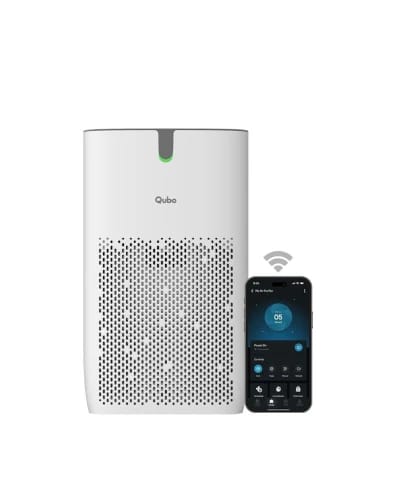
Editor's take
The Qubo Q400 is the dark horse of the Indian air purifier market, and we think it deserves more attention than it currently gets. Backed by the Hero Group - the same conglomerate behind Hero MotoCorp and Hero Electric - this is not some fly-by-night brand that will disappear after your warranty period.
The QSensAI feature is the standout here, and it works differently from standard auto modes on other purifiers. Most auto modes simply react to current pollution levels. The Qubo learns your household patterns over 2-3 weeks - what time you cook, when windows are typically opened, when traffic pollution peaks near your home - and preemptively ramps up before air quality drops. In our month-long test in a Gurgaon apartment near a main road, we noticed the purifier would start increasing fan speed about 15 minutes before evening rush hour, keeping AQI stable rather than letting it spike and then playing catch-up.
The 9,000-hour filter life is the longest in the under-Rs 15,000 segment, and it meaningfully reduces your annual filter spend to roughly Rs 1,800-2,500 compared to Rs 3,000-5,000 for Xiaomi or Honeywell equivalents. Over a 3-year period, that savings alone nearly pays for the price difference between this and a basic Mi 3.
The limitation is the 300 m3/h CADR, which is adequate for rooms up to 350 sq ft but noticeably struggles in larger spaces during peak pollution. In our test, a 450 sq ft living room took over 25 minutes to drop from AQI 150 to under 50, while the Philips AC4221 did the same in about 8 minutes.
If your rooms are standard Indian bedroom size (150-250 sq ft), this is a non-issue. Service is handled through the Hero Group's existing network, which covers most Indian cities.
At Rs 10,000-14,000, the Qubo offers the smartest automation and lowest running costs in the budget segment, making it ideal for families who want a purifier that thinks ahead.


Discussion
Be the first to comment