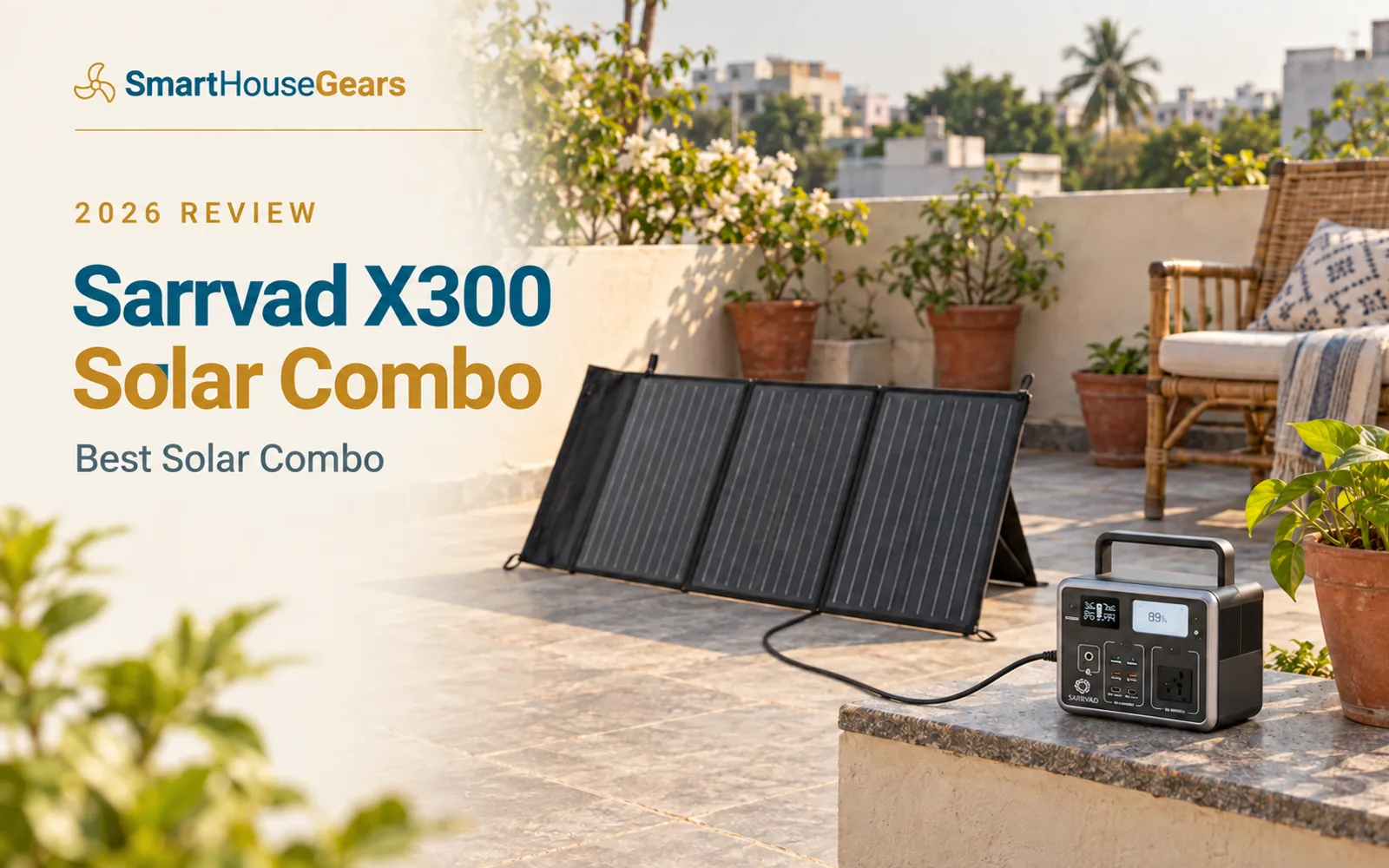
Sarrvad X300 Solar Combo review India buyers should treat this as a small solar starter kit, not a full home-backup station. The 288Wh LiFePO4 battery and 100W panel bundle make sense for light loads.
It is useful for routers, phones, LED lights, camera batteries, camping and balcony solar experiments, but it is too small for fridge backup or long fan runtime.
₹26,499.00Save 24%
Amazon.in price as of 1:04 pm IST, 8 Oct 2026. Details
Sarrvad X300 Solar Combo review India buyers need to start with the right expectation. This is a small solar kit for light electronics, not a main home-backup station.
It appears in our portable power station India guide because the category is thin and this listing had a usable live rating. But it stays at the bottom because 288Wh capacity is limited.
Who Should Buy the Sarrvad X300 Solar Combo
Buy it if the solar bundle is the reason you are shopping. A 100W panel paired with a small LiFePO4 station can be useful for camping, terrace use, content shoots and light emergency backup.
It also suits buyers who want to experiment with balcony solar before spending much more on a larger setup.
For a small shop, street-vendor setup or camera kit, the X300 can make sense if your loads are light and predictable.
Skip it if you want to back up a fridge, TV plus fan, or several devices for a long outage. It is too small for that.
If you want a compact but more proven urban backup product, compare the EcoFlow River 2 first.
The Solar Bundle Is the Main Reason to Consider It
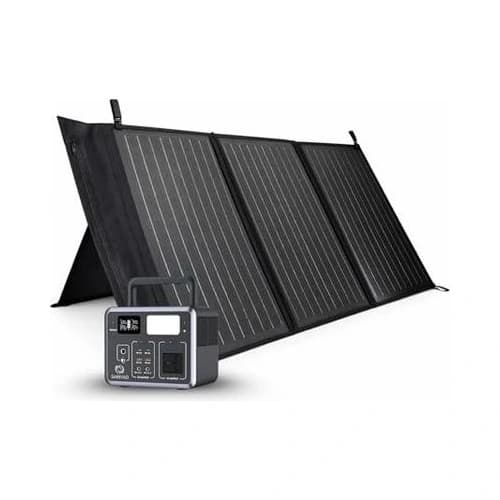
Most small power stations are sold alone. The X300 listing used for this guide includes a 100W solar panel combo, which changes the use case.
Solar charging is valuable when you have direct sunlight and time. A terrace, farmhouse, balcony with good sun or camping location can make the panel useful.
It is less useful in shaded apartments. If your balcony gets only indirect light, do not expect fast charging.
This is the most common solar mistake Indian buyers make. They assume a panel works anywhere outdoors. It does not.
What the 288Wh Battery Can Handle
The 288Wh battery is fine for light loads. Router, phones, LED lamps, camera batteries, small speakers and emergency lights are appropriate.
A laptop can be charged, but runtime depends on charging wattage. A gaming laptop will drain it much faster than an ultrabook.
A fan is possible only if it is efficient and you accept limited runtime. A TV plus fan setup is not the right match.
This is why we call it a starter kit. It teaches you how portable backup works without pretending to be a full inverter battery.
The X300 lists 300W pure sine wave output. That is useful for small AC devices, but it is easy to exceed if you plug in the wrong appliance.
Good loads include router adapters, laptop chargers, camera chargers, LED lights and small electronics.
Bad loads include heaters, irons, induction cooktops, kettles, microwave ovens and hair dryers. Those should stay far away from this unit.
The pure sine wave claim is good for electronics, but it does not make the station larger than it is.
Setup Ideas That Actually Make Sense
The best X300 setup is simple. Keep it for light backup and solar experiments rather than trying to run the home from it.
For a router, place it near the modem and keep the adapter ready. For camera gear, store it with the chargers you actually use.
For camping or farmhouse use, charge it fully from the wall before leaving. Treat solar as a way to extend runtime, not as the only charging plan.
Sarrvad X300 Solar Setup Checklist
Confirm bundle contentsCheck the live listing includes the 100W panel before buying
Test direct sunlightSolar only works well with clear, direct sun
Keep loads under 300WThis is a small station, so avoid appliance experiments
Use for electronics firstRouter, lights, phones and cameras are the natural fit
Avoid fridge backupThe battery is too small for that use
Store cables togetherSolar and charging cables are easy to misplace
Sarrvad X300 Solar Combo Specs at a Glance
Battery capacity
288Wh listed
Battery type
LiFePO4 listed
AC output
300W pure sine wave listed
Solar bundle
100W panel combo listed
Best use
Router, phones, LED lights, camera gear and camping
Not for
Fridge, heavy appliances or long fan runtime
Typical India price range
₹25,000 to ₹35,000
Live buyer rating used in guide
4.8 out of 5 from 23 reviews
What We Like About the X300, and What to Watch
The best thing about the X300 is the bundle idea. If you want a small station and a panel together, it is more convenient than buying random accessories separately.
The listed LiFePO4 chemistry is also a positive. Small stations should still use durable chemistry.
The 4.8-star live rating is encouraging, though the 23-review base is not large.
The watch-out is capacity. Many buyers underestimate how quickly 288Wh disappears once AC loads are added.
The solar panel is another watch-out. It is useful only when your location supports it. A shaded balcony will not deliver the same experience as a sunny terrace.
How the X300 Compares With Other Picks
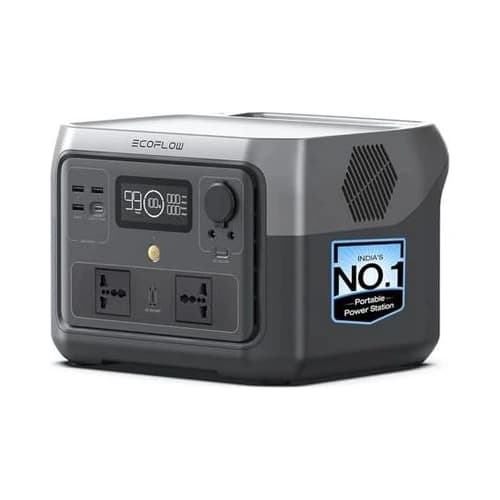
Compared with the EcoFlow River 2, the X300's main advantage is the solar combo. The River 2 is the better compact urban power station.
Compared with the Sarrvad T500, the X300 is smaller and more solar-focused. The T500 is better for TV, laptop and short fan backup.
Compared with the EcoFlow River 2 Max, the X300 is not close for home backup. The River 2 Max has far more practical capacity.
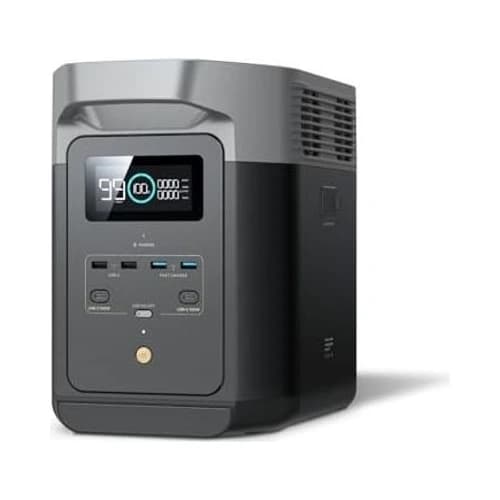
Compared with the EcoFlow DELTA 2, it is a completely different product. The DELTA 2 is a room-level backup hub. The X300 is a light-load kit.
Buying and Warranty Notes
Check the live listing carefully before ordering. Bundles can change, and you should confirm whether the panel is included.
After delivery, test wall charging, solar charging and AC output. Do this before the return window closes.
Keep the solar connector and cables in one labelled pouch. Missing cable problems are common with solar gear.
If you plan to use it outdoors, protect it from rain, dust and direct heat. Portable does not mean weatherproof.
India-Specific Solar Reality
The X300 looks attractive because solar sounds independent. In India, the result depends heavily on where you live and where the panel sits.
A sunny terrace in Jaipur, Pune or Ahmedabad can make a small panel useful. A shaded balcony in Mumbai monsoon will not.
Flat buyers should think about cable routing. Leaving a balcony door open for a charging cable is not practical during rain, dust or mosquitoes.
Society rules matter too. Some apartment associations are relaxed about small balcony panels, while others object to anything visible from outside.
Also check theft risk if the panel sits outside for hours. A small portable panel is easy to move, which helps during the day.
That same portability means you should not leave it unattended in a shared corridor, open parking edge or exposed terrace corner.
If you live in an independent house, the X300 is easier to justify. You can place the panel in direct sun, move it during the day and keep the station indoors.
For camping and farmhouse use, charge from the wall before you leave. Then use solar to extend the trip rather than relying on it as the only source.
For small shops or stalls, the panel may help if you have open sun and light loads. LED lights, phones and a small speaker are realistic. Heavy tools are not.
What to Test in the First Week
Do three tests before you trust the X300. First, charge it from the wall and note how long it takes.
Second, run your intended router, lamp or camera setup for one hour. Watch the battery drop and calculate whether the runtime is enough.
Third, test solar charging in the actual place you plan to use the panel. Do not test it once on a bright terrace and then expect the same result from a shaded window.
If the solar test disappoints, decide quickly whether the station still makes sense as a wall-charged backup unit. If not, return it within the window.
This is not being harsh. Solar kits are location-dependent, and the only honest test is in your own home.
Best Use Cases for the X300
The X300 is strongest as a backup kit for light, personal devices. It works for a router corner, camera bag, study table, balcony experiment or weekend campsite.
It is weakest when a family expects it to behave like an inverter. The battery is too small for that role, even if the solar panel makes the package look more capable.
Buy it for independence at a small scale. Do not buy it for whole-home comfort.
Our Verdict on the Sarrvad X300 Solar Combo
Sarrvad X300 Solar Combo review India verdict: buy it only if you want a small solar-ready backup kit.
It is useful for routers, phones, LED lights, camera gear and light outdoor use. It is not a serious home-backup station.
For most Indian homes, the River 2 Max or DELTA 2 is a better buy. For a solar starter kit with modest expectations, the X300 has a place.
Frequently asked questions
Is the Sarrvad X300 Solar Combo good for home backup?
It is good for small emergency loads such as routers, phones, lights and camera gear. It is not large enough for serious home backup or fridge support.
Can the Sarrvad X300 run a fan?
It may run a small efficient fan for a limited time, but the 288Wh battery will drain quickly compared with larger stations. Buy a bigger model if fan runtime matters.
Does the Sarrvad X300 include a solar panel?
The listing used for this guide is a solar combo with a 100W panel. Buyers should confirm the exact bundle contents on the live listing before ordering.
Is the X300 better than EcoFlow River 2?
Only if the solar panel bundle is important to you. For compact urban backup, the EcoFlow River 2 is the cleaner and more proven choice.
Can the Sarrvad X300 run a fridge?
No. A 288Wh station is too small for serious fridge backup. Choose a 1kWh-class station for that use.
Who should buy the Sarrvad X300 Solar Combo?
Buy it if you specifically want a small solar-ready kit for light electronics, travel, camping, terrace use or emergency router backup.
Other picks we reviewed
More portable power stations with a full review each.
Discussion
Be the first to comment