The best smart space heaters for large rooms solve a narrow but expensive problem: one room stays cold even though the furnace is heating the rest of the house. A good WiFi space heater warms that occupied zone, follows a schedule, and gives you app control without asking a bargain smart plug to carry a 1,500W load.
This guide compares eight current Amazon.com models for US homes. We verified every ASIN through Amazon's Creators API, matched each model against its manufacturer documentation, checked current CPSC recall records, and compared owner-reported patterns across Amazon and smart-home forums.
Our clear first pick is Dreo Smart Wall-mounted Heater 719S. It puts a 1,500W ceramic system on the wall, sweeps heated air vertically, and schedules warmth for a chilly bedroom or home office.
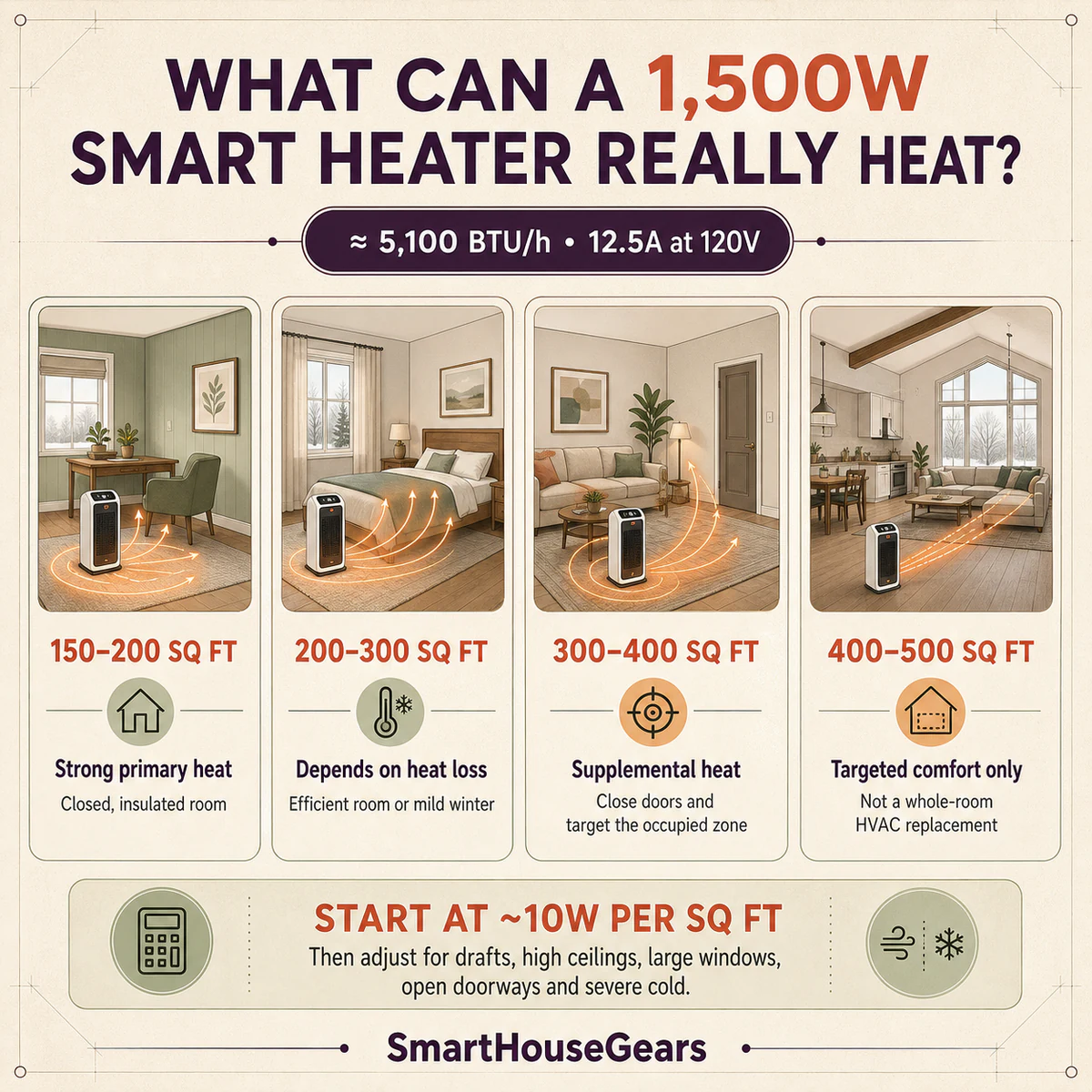
One limit applies to the entire category. A standard 120V, 1,500W heater produces roughly 5,100 BTU per hour, so no app, sensor, or voice assistant turns it into a whole-house furnace.
Large-room claims only make sense as supplemental heat, and they work best in closed rooms with decent insulation.
Quick Comparison of the Best Smart Space Heaters for Large Rooms
At a glance
Eight Smart Heaters for US Large Rooms
Verified Amazon.com models with live star ratings, realistic price ranges, and the differences that actually change the purchase.
Prices move with seller and season, so every figure here is a range. Star ratings and review counts come from the live Amazon.com listings and stay consistent throughout this guide.
How We Chose These Eight Smart Heaters
We confirmed current Amazon.com availability, removed anything below 4.0 stars, and favored clear model numbers with genuinely useful differences. CPSC screening also removed the recalled Atomi and Govee heaters that older guides still recommend.
The final group spans wall ceramic heat, infrared, fan-free convection, a mobile mica panel, one compact value model, a purifier heater, and an electric fireplace. Ten nearly identical towers would not help you choose.
What does "large room" mean for a 120V heater?
A large room here means roughly 300 to 500 sq ft, though the real answer depends on how fast your room loses heat. Heat Storm's split rating of 150 sq ft as primary heat and 750 sq ft as supplemental heat shows why one honest distinction beats an inflated coverage claim.
Which smart features actually add value?
The smart features worth paying for are remote thermostat changes, schedules, status checks, and voice control, all backed by complete onboard buttons. Those local fallbacks matter most during an internet or cloud outage on the coldest night of the year.
None of the eight advertises Matter, so Alexa and Google Home remain the practical voice ecosystems for a WiFi space heater in 2026.
1. Dreo 719S: Best Overall Smart Wall Heater for Large Rooms
Best Overall
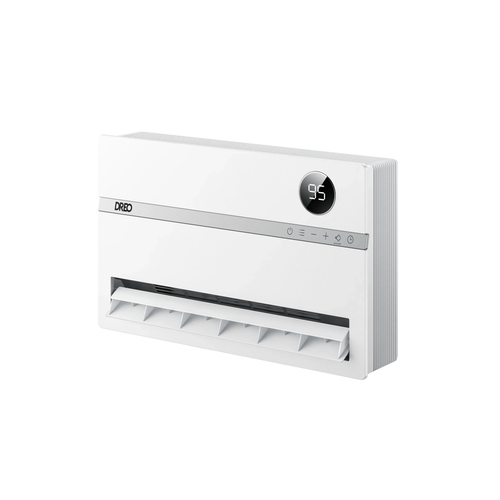
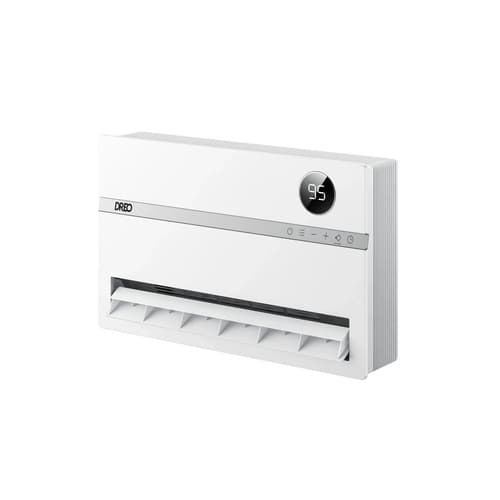
Dreo Smart Wall-mounted Heater 719S
Rated 4.3 out of 54.3· 3,691 reviews
The best all-around smart wall heater for a large bedroom, office, or closed family room. Its $110 to $140 range buys useful air direction and mature controls instead of decorative extras.
Key features
1,500W ceramic heating system
120-degree vertical oscillation
41°F to 95°F digital thermostat
Dreo app, schedules, remote, and Alexa
What we like
Moves heat from floor level toward the occupied zone
The Dreo Smart Wall-mounted Heater 719S is the right answer for most buyers because it fixes the biggest weakness of compact space heaters: heated air stays low or blows straight into the nearest chair.
Dreo's 120-degree vertical oscillation aims that air across far more of the room without exceeding the standard 1,500W ceiling.
Why does the 719S work better than a basic wall heater?
The 719S wins because it pairs wall placement with powered vertical air direction, a 41°F to 95°F thermostat range, and scheduled control. Those features do not raise the heater's maximum output. They deliver that output where you actually feel it, then stop once the room hits its target.
The Dreo app is genuinely useful for morning warmups and temperature checks from another room. Alexa voice control handles quick adjustments when your hands are full.
The included remote and onboard panel matter just as much, because an internet outage should never turn a wall heater into dead decor.
Dreo's support page specifies a stable 2.4GHz network with WPA2 security for pairing. If your mesh system merges both bands under one network name, setup usually works, though moving the phone and heater near a node first prevents a frustrating pairing session.
Installation reality in an American home
This is a plug-in 120V appliance, not a hardwired HVAC zone. Plan the mounting spot around the supplied cord and a direct wall outlet, because an extension cord or power strip is never an acceptable workaround.
In a 2,400 sq ft two-story house, the 719S makes sense for the one room that runs cold, not for the whole floor. Close the door, set a sensible target, and let the central system carry the rest of the house.
Use the supplied wall template, approved anchors or studs, and every listed clearance. Check behind the drywall before drilling, and keep the heated-air path clear of curtains or a door that swings into the cabinet.
What owners like and what they question
Across 3,691 reviews, the positive patterns center on quick warmth, reclaimed floor space, and reliable schedules. The recurring tradeoffs are slow app pairing and wall temperature readings that disagree with a desk or bed on the far side of the room.
A cheap separate thermometer across the room is the easiest way to sanity-check the wall sensor before you raise the setpoint.
Best use case for the Dreo 719S
Buy the Dreo 719S if you want the best combination of heat distribution, smart control, and floor-space savings at a sensible mid-range price. It is the heater we would put in a closed 300 to 450 sq ft bedroom or office that needs supplemental warmth every winter.
Skip it if you rent and cannot drill, if the only outlet needs an extension cord, or if absolute silence matters. The Ballu mica panel and Smart EnviMAX SM1012P handle those cases far better.
2. Dreo 517S: Best Value WiFi Wall Heater for Bathrooms
Best Wall Value
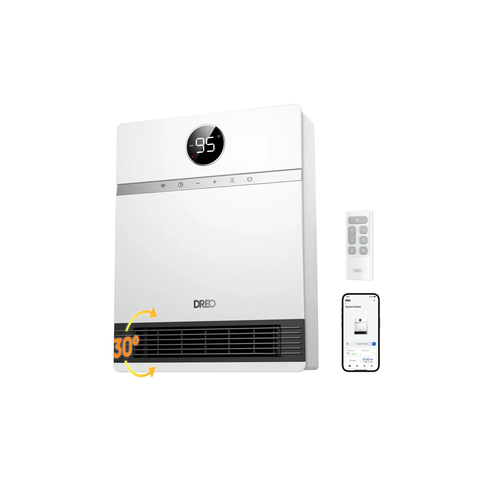
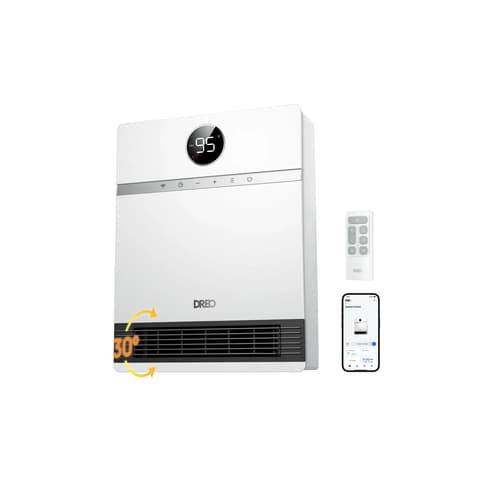
Dreo Smart Wall-mounted Heater 517S
Rated 4.5 out of 54.5· 3,089 reviews
A compact 1,500W wall heater with an IP24 enclosure, a 30-degree adjustable outlet, and a price that stays near $85 to $110. It is the better Dreo for smaller walls and moisture-aware placements.
The Dreo Smart Wall-mounted Heater 517S trades motorized vertical oscillation for a lower price and a smaller cabinet. It is the value choice when you can aim the outlet once, leave it there, and use the app mainly for schedules and thermostat changes.
Its 4.5 rating from 3,089 reviews is the strongest score-and-volume combination among the conventional wall heaters here. Its advertised IP24 enclosure and ALCI-equipped variant also make it far easier to plan around a bathroom than a generic tower heater.
The compact cabinet fits narrow wall sections without giving up any of the 1,500W output.
Is the 517S safe for a bathroom?
The 517S is the most bathroom-ready finalist, but IP24 and an ALCI plug never override the National Electrical Code, local rules, or Dreo's own mounting clearances. Install the correct variant outside prohibited wet zones, use the required receptacle protection, and call an electrician if the outlet location is questionable.
IP24 simply means the enclosure resists splashing water from specified directions. It does not mean you can mount the heater beside a tub, put its plug within reach of the shower, or skip a GFCI requirement.
Daily control and heating behavior
Dreo lists a 1,500W heating system, three heat settings, fan-only operation, and a thermostat adjustable from 41°F to 95°F in one-degree steps. The 30-degree outlet tilt is manual, so aim it before the room gets cold instead of expecting an automatic sweep.
App and Alexa support make scheduled morning heat easy to set once and forget. Physical controls and the remote still cover normal operation when WiFi drops, which is the fallback any high-wattage appliance should have.
Owners consistently praise the fast local warmth and clean wall footprint. Complaints cluster around WiFi setup, fan noise, and the expectation that a compact heater should warm an open floor plan.
Why choose the 517S over the 719S?
Choose the 517S when wall width, bathroom planning, or price matters more than automatic air direction. Its usual $85 to $110 range saves roughly $20 to $50 while keeping the same thermostat, app functions, and full 1,500W output.
Choose the 719S for a larger bedroom, family room, or office where one fixed outlet angle leaves cold corners. The extra money buys better distribution, not extra wattage, so the upgrade is really about comfort across the whole room.
Value decision on the Dreo 517S
Buy the Dreo 517S if you want a strong smart wall heater below the 719S price and can live with a manually aimed outlet. It is also the first model to investigate for a bathroom, subject to the current manual and your local electrical setup.
Skip it if you need silent heat or cannot drill. A renter gets far more flexibility from the Ballu mica panel, and a light sleeper should pay more for the fan-free Smart EnviMAX.
3. Heat Storm Phoenix: Best Proven Infrared Wall Heater
Best Proven Infrared
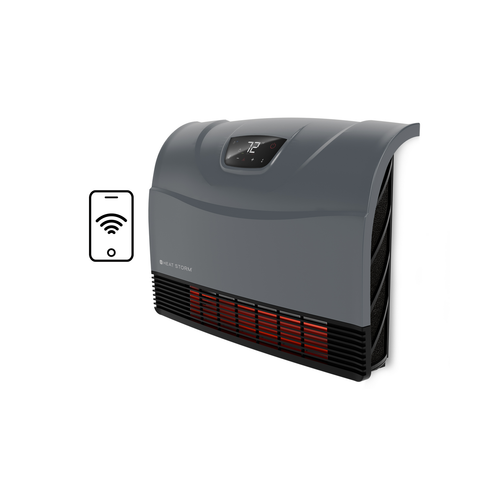
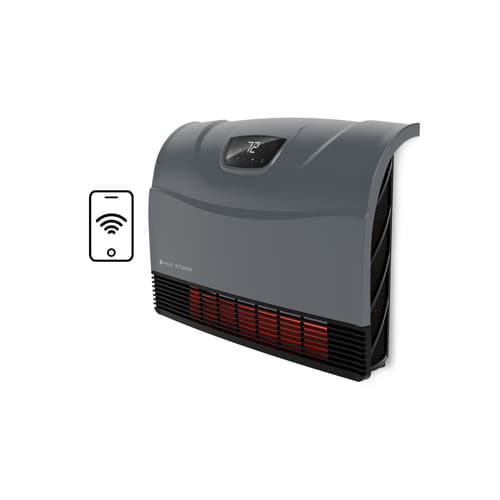
Heat Storm Phoenix HS-1500-PHX-WIFI
Rated 4.4 out of 54.4· 13,960 reviews
The most owner-proven heater here uses 750W or 1,500W infrared heat in a slim wall-only cabinet. Its $120 to $170 range is fair for dependable fundamentals and a 13,960-review history.
Key features
750W and 1,500W infrared modes
5,200 BTU per hour maximum output
Smart Life app with schedules
Optional external room thermostat support
What we like
4.4 rating across 13,960 reviews
Manufacturer separates primary and supplemental coverage
The Heat Storm Phoenix HS-1500-PHX-WIFI is the safest recommendation for anyone who values years of owner history over the newest app. Its 4.4 rating across 13,960 reviews dwarfs the evidence base behind most smart heaters.
Heat Storm also publishes unusually honest coverage limits: up to 150 sq ft as primary heat and up to 750 sq ft as supplemental heat. That split explains the product better than any single "large room" claim, because a heater that holds a small insulated bedroom may only soften the chill in a big basement.
How does infrared heat feel different from ceramic?
Infrared heat feels steadier and less blasted than a small ceramic tower, because the Phoenix warms air across quartz elements and a heat exchanger before a fan moves it out. It still draws the same 750W or 1,500W as any comparable resistance heater, so the difference is the character of the heat, not the efficiency.
At full power it draws 12.5A on 120V and produces 5,200 BTU per hour according to Heat Storm. Eco mode alternates between half and full output, which beats a vague "energy saving" label because lower power genuinely reduces the electrical load while it is active.
Heat Storm lists 42 to 47 dB. That is reasonable for a fan-assisted wall heater, but it will not disappear in a recording room or beside a very light sleeper.
Smart control is useful, but the thermostat deserves attention
The Smart Life app handles remote control and custom schedules, which is convenient when the Phoenix sits in a basement office or bonus room. The wall controls are still the faster route for an immediate change.
Heat Storm also sells a compatible external room thermostat that reads temperature away from the warm wall. It can improve cycling noticeably in a long room, though it adds cost and pairs with only one heater.
What 13,960 reviews actually reveal
Owners repeatedly praise the shallow profile and the steady warmth near a desk or bed. Complaints concentrate on connection setup, the short cord, thermostat differences, and unrealistic coverage expectations.
At 19 inches wide and 4 inches deep, the Phoenix fits walls that cannot spare an inch of floor space. Wall-only placement keeps the cabinet stable, but installation still needs strong anchors and a direct outlet.
The Heat Storm Phoenix decision
Buy the Heat Storm Phoenix if you want a proven wall-mounted infrared heater for a bedroom, office, or supplemental zone. It has the strongest evidence base in this guide and a credible path to better room sensing through the optional thermostat.
Choose the Dreo 719S instead if powered air direction and a more modern app matter more. Choose the Smart EnviMAX if even a 42 dB fan is too much noise.
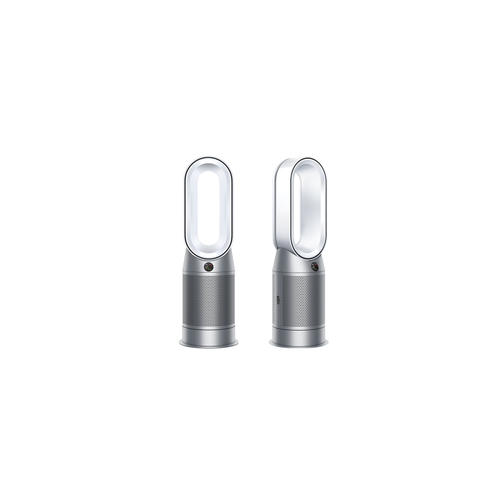
4. Dyson HP1: Best Premium Heater and Air Purifier Combo
Best Premium
Dyson Purifier Hot+Cool HP1
Rated 4.3 out of 54.3· 172 reviews
A premium heater, fan, and sealed HEPA H13 purifier for buyers who will use it through every season. The $500 to $660 range is justified only if all three functions replace separate devices.
Key features
Heating, fan airflow, and year-round purification
Sealed HEPA H13 and activated-carbon filtration
350-degree oscillation and 10 airflow speeds
MyDyson app, remote, sensors, and voice services
What we like
One appliance stays useful all year
Monitors air quality and adjusts in Auto mode
Two-year Dyson warranty
Strong distribution with a small footprint
Watch out for
Costs several times more than a dedicated heater
Cooling mode is a fan, not air conditioning
Replacement filters add ownership cost
Only 172 Amazon reviews for this current generation
The Dyson Purifier Hot+Cool HP1 is the only finalist that earns its floor space in January, allergy season, and August alike. It heats in winter, moves uncooled fan air in summer, and runs sealed HEPA H13 plus activated-carbon filtration all year.
That combination is why it costs roughly $500 to $660. If you only need heat, the price makes no sense at all. If you were already budgeting for a premium purifier and a strong circulating fan, the HP1 becomes much easier to defend.
What changed with the current Dyson HP1?
The HP1 is Dyson's current connected purifier heater, not the older HP01 or HP10 that still dominates search results. Dyson's current US documentation lists MyDyson app control, automatic pollutant sensing, 350-degree oscillation, and a combined glass HEPA plus carbon filter.
Dyson states that the sealed system captures 99.97% of particles as small as 0.3 microns. Read that as a filtration claim under Dyson's stated test conditions, not as proof that the machine removes every gas, virus, or household odor.
The technical sheet lists up to 290 liters per second of airflow across 10 speed settings. The tall loop still needs a stable spot well clear of foot traffic.
Is the Dyson HP1 worth its premium?
The Dyson HP1 is worth the premium only if you need heating, air-quality feedback, and serious particle filtration from one appliance. As a heater alone it is poor value, because a $110 to $170 finalist delivers comparable resistance-heat output without the filtration hardware.
The MyDyson app shows live air-quality readings and supports remote adjustments, and compatible voice services add convenience. The magnetic remote and full machine controls keep daily operation working when cloud features are not.
Dyson recommends replacing the filter roughly every 12 months at 12 hours of daily use, or sooner when the machine says so. Budget that recurring cost, especially in a home with wildfire smoke, pets, or heavy seasonal use.
Large-room expectations for a purifier heater
Wide 350-degree oscillation spreads air through a family room far more evenly than a narrow tower. It is still not a heat pump or a central furnace, and its "cooling" mode does not lower room temperature the way an air conditioner does.
Through a humid Southern summer the fan improves perceived comfort but removes no moisture at all. Pair it with a dedicated unit from our smart dehumidifier guide for basements when dampness, not airflow, is the real problem.
At 4.3 from 172 reviews, this is the guide's new-flagship exception to our usual review-volume preference. Owners praise the design and the combined role, while objections center on price, filter cost, and app setup.
When the Dyson premium pays off
Buy the Dyson HP1 if you will use purification and fan airflow as much as heat. Its two-year warranty and year-round utility make it the best premium pick, but only for a household that will actually run all three functions.
Skip it if a dedicated purifier already handles your air. The Dreo 719S is the far better heating value, and the money saved can fund a more efficient central HVAC upgrade.
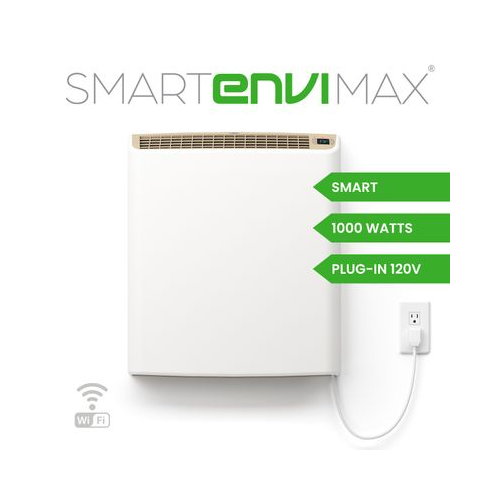
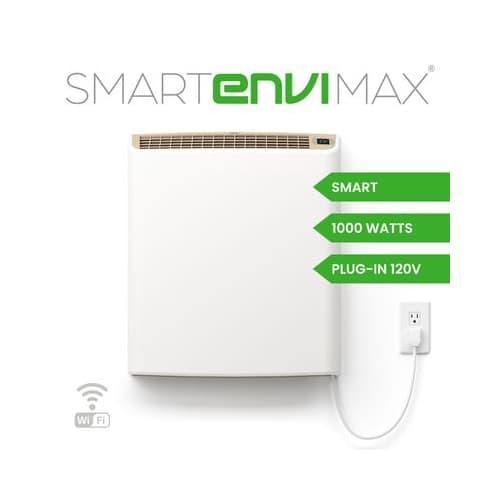
5. Smart EnviMAX SM1012P: Best Silent Fan-Free Convection Heater
Best Silent
Smart EnviMAX 1000W Wall Heater SM1012P
Rated 4.1 out of 54.1· 228 reviews
A fan-free 1,000W wall heater for bedrooms, studios, and offices where silence matters more than an instant blast of heat. Its $300 to $330 range buys quiet construction and a lower 8.33A load.
The Smart EnviMAX 1000W Wall Heater SM1012P is the specialist pick for a bedroom, podcast room, or home office where a fan cycling on and off becomes maddening. Natural convection draws cool air in at the bottom and releases warm air at the top with no blower at all.
The result is silent, steady background heat rather than an instant hot-air stream. That suits an occupied room held at a stable temperature, and it disappoints anyone who walks into a freezing space wanting warmth in five minutes.
Why choose 1,000W instead of 1,500W?
The EnviMAX draws 8.33A at 120V instead of the 12.5A a 1,500W heater needs, which is easier to accommodate on a loaded bedroom circuit. That lower draw never excuses sharing the circuit with another heavy appliance or trusting a questionable outlet.
Lower wattage also caps the maximum heat output. The EnviMAX belongs in a well-insulated room, a mild winter climate, or any space where it can run gently for long stretches, not in a drafty Midwest great room during a cold snap.
Its 19.3 inch cabinet projects only 3.1 inches from the wall, which reads as deliberate design in a finished bedroom rather than an appliance bolted on as an afterthought.
Smart controls without fan noise
App control plus Alexa and Google Home support let you change the setpoint or schedule without walking to the wall panel. Freeze protection and geofencing help in a seasonal room, though any remote automation still assumes a safely prepared space.
The onboard thermostat is the fallback that matters. When the router reboots during a snow day, the heater keeps holding local temperature even though remote commands stop working.
There is no Matter or native Apple Home support. Apple households can still use the brand app, but strict HomeKit buyers should treat that gap as a genuine limitation instead of improvising a bridge around a high-wattage heater.
Safety listing and daily tradeoffs
The current manual states that the EnviMAX conforms to UL 2021, the standard covering fixed and location-dedicated electric room heaters. That is exactly the documentation to look for, though certification never removes your placement, wiring, and maintenance responsibilities.
Owners who bought it for silence appreciate the quiet background warmth. Buyers expecting a forceful blast call convection slow, and its 4.1 rating from 228 reviews reflects that split. Treat this as a deliberate noise-first purchase with a 3-year warranty attached.
The noise-first choice
Buy the Smart EnviMAX SM1012P if silence is the deciding specification and your room can warm up gradually. It makes the most sense beside a bed, microphone, or desk where fan noise would defeat the whole point of better comfort.
Skip it when you need fast recovery in a leaky room. The Dreo 719S moves more heat through the occupied zone for far less money, and the Ballu mica panel offers a quiet format you can relocate.
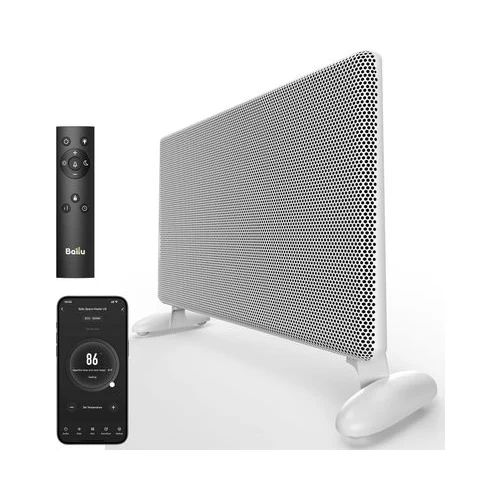
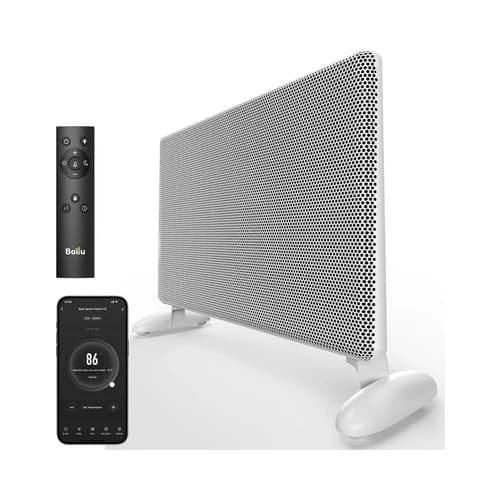
6. Ballu Mica Panel: Best Movable Wall or Caster Panel Heater
Best Mobile Panel
Ballu Mica Infrared 1500W WiFi Panel Heater
Rated 4.3 out of 54.3· 346 reviews
A quiet mica panel that can stand on casters or mount on a wall. At roughly $170 to $200, it is the most flexible choice for renters who dislike the noise and narrow airflow of a ceramic tower.
The Ballu Mica Infrared 1500W WiFi Panel Heater is the practical compromise between fixed silent convection and a portable ceramic tower. Its mica element blends radiant warmth with natural air circulation, and the casters let a renter move it without drilling a landlord's wall.
Ballu includes wall-mount hardware too, so a homeowner can convert it into a permanent zone heater later. That dual placement is the model's single strongest advantage, especially when you are still unsure whether the cold spot sits beside the sofa or nearer the sliding door.
Does a mica panel heat a large room well?
A 1,500W mica panel adds real supplemental warmth to a large closed room, but it feels nothing like a fan heater. It warms nearby surfaces and lets heated air rise naturally, producing a broad, even effect instead of the fast directional blast the Dreo models deliver.
The panel runs at 750W or 1,500W. Use the lower mode to hold comfort after warmup or to ease circuit load, but never confuse lower wattage with better conversion efficiency.
Nearly every resistance heater turns its electrical input into room heat at the appliance. Real savings come from heating only the occupied zone, lowering the central thermostat, and cutting runtime, never from a brand claiming more than 100 percent heat conversion.
Placement matters more than the app
The broad front needs open space around it. Do not park it behind a sofa, under hanging fabric, or in the traffic line between a kitchen and family room.
Casters keep the panel mobile enough for a condo or rental, yet the cord must still reach a wall outlet directly. Moving a heater is never a reason to move it onto an extension cord.
The app and Alexa add schedules and remote temperature changes. The remote and panel controls matter more for resilience, because basic heating should stay reachable when a cloud service or router goes down.
Owner feedback and value
The 4.3 rating from 346 reviews is solid for a newer model, though it lacks the decade-scale proof behind the Phoenix. Positive patterns focus on quiet warmth, broad distribution, and the freedom to choose casters or wall hardware.
Common cautions involve assembly, app pairing, and how long a fan-free panel needs to change the temperature of a genuinely cold room. Buyers also underestimate its physical width next to a narrow tower.
At $170 to $200, the Ballu costs more than either Dreo wall heater and far more than the MORENTO. You are paying for quiet operation plus placement flexibility, and no cheaper product here offers both.
Mobility wins here
Buy the Ballu Mica Panel if you rent, need quiet heat, or want to test several placements before committing to a wall. It is the most adaptable heater in this guide, and it carries a 2-year warranty.
Choose the Smart EnviMAX for a cleaner permanent bedroom install and a lower electrical draw. Choose the Dreo 719S when fast air movement across a large room beats quiet warmth.
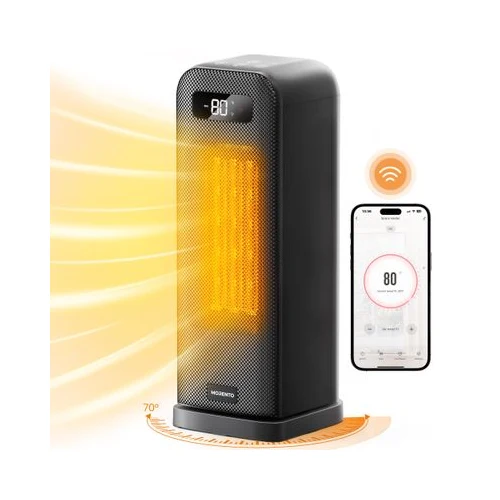
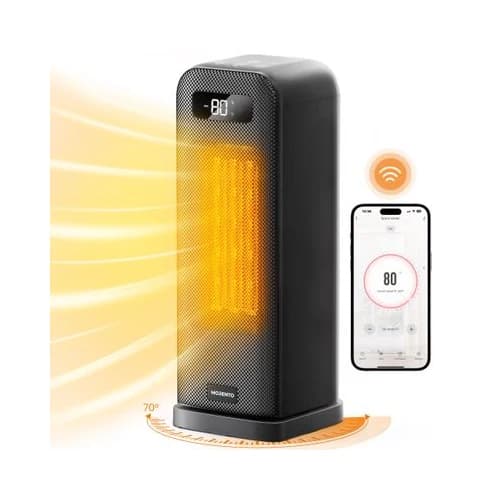
7. MORENTO AT-SH40-WF: Best Budget Smart Space Heater Under $70
Best Portable Value
MORENTO Smart Space Heater AT-SH40-WF
Rated 4.1 out of 54.1· 235 reviews
The value exception in this premium guide costs about $40 to $70 yet retains 1,500W heat, oscillation, app scheduling, and two major voice platforms. Buy it for an occupied zone, not a whole open floor.
Key features
900W, 1,500W, ECO, and fan modes
70-degree oscillation
Havaworks app on 2.4GHz WiFi
Alexa and Google Home control
What we like
Lowest purchase cost in the final group
Compact and easy to reposition
Manufacturer-rated 36 dB operation
Child lock, tip-over, and overheat protection
Watch out for
Best for a zone rather than a true whole-room result
The MORENTO Smart Space Heater AT-SH40-WF earns its place by delivering the controls people actually use at a fraction of the premium models' cost. You get 1,500W high heat, 900W low heat, ECO cycling, fan-only operation, and 70-degree oscillation for about the price of a takeaway dinner for two.
This is not the best whole-room heater in the guide. It is the cheapest honest way to warm the occupied half of a larger room without drilling, buying a $300 panel, or paying for a purifier you do not need.
Where does a compact 1,500W heater make sense?
Put the MORENTO near a home-office desk, a reading chair, or a family-room seating area, keeping every clearance the manual specifies. Its oscillation spreads warmth across several people better than a fixed personal heater, though the short cabinet cannot aim air as broadly as a wall-mounted unit.
In a 400 sq ft living room, expect a noticeable comfort zone rather than an even wall-to-wall temperature. Closing doors and sealing drafts buys more comfort than nudging the setpoint up again and again.
Smart features without the premium bill
The Havaworks app handles temperature, status, and schedules over 2.4GHz WiFi. Alexa and Google Home cover the two ecosystems most US buyers already own, and the local controls keep basic heating alive if the internet drops.
MORENTO advertises 36 dB operation. Treat that as a manufacturer figure, not a guarantee for every mode and room, because hard floors and bare walls make fan sound far more obvious.
Child lock, a tip-over switch, overheat protection, and 24-hour automatic shutdown cover the common portable-heater risks. They are backups, not substitutes for a stable floor and 3 ft of clear space.
What a 4.1 rating tells us
The 4.1 rating from 235 reviews clears our selection floor but gives this model a thinner evidence base than either Dreo. That is a fair trade for a value pick aimed at renters and tight budgets, provided you treat the return window seriously.
Positive feedback highlights fast local warmth and genuinely useful voice control at a low price. Complaints skew toward WiFi pairing, app expectations, and the gap between "large room" marketing and a compact heater's real distribution.
Test every mode, the thermostat, oscillation, tip-over response, and the app connection inside the seller's stated return period. Keep the packaging until you are sure the unit suits the room and the circuit.
The value case for the MORENTO
Buy the MORENTO AT-SH40-WF if you want maximum smart control per dollar in a portable occupied-zone heater. It is the only sub-$100 model that adds enough value to survive this shortlist.
Skip it when you need a permanent large-room result or a long owner history. The Heat Storm Phoenix has vastly more proof, and the Dreo 719S distributes heat more deliberately from the wall.
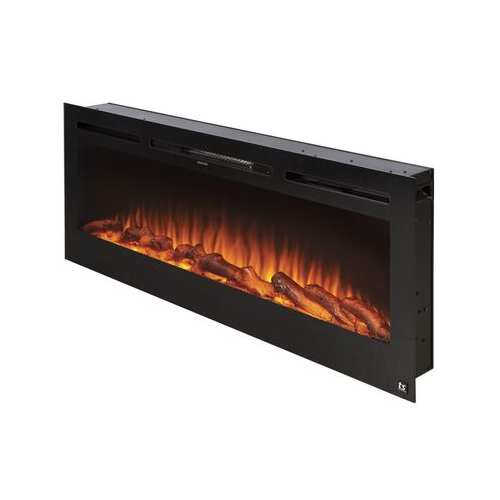
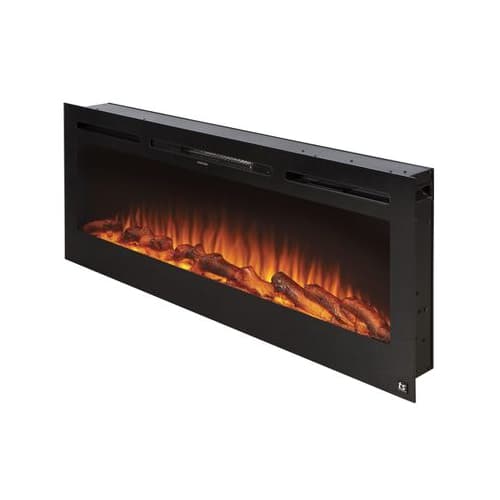
8. Touchstone Sideline 50: Best Smart Electric Fireplace Heater
Best Design Pick
Touchstone Sideline 50 Smart Electric Fireplace 80004
Rated 4.6 out of 54.6· 3,692 reviews
A 50-inch recessed or wall-mounted fireplace that adds 5,000 BTU of supplemental heat and a convincing focal point. Its $500 to $570 range is for renovations where design matters as much as warmth.
Key features
1,500W and 5,000 BTU supplemental heater
Rated by Touchstone for up to 400 sq ft
Alexa, Google Home, app, and remote control
Three flame colors and 10 ember-bed colors
What we like
Excellent 4.6 rating across 3,692 reviews
Recessed or surface wall mounting
Flames can run without heat
Front vent works in a properly planned media wall
Watch out for
Installation is a project rather than a quick setup
The Touchstone Sideline 50 Smart Electric Fireplace 80004 is a room-design purchase with a useful heater inside, not a heater that happens to show flames. Its 50 3/8 inch frame becomes the focal point of a living room while the front vent supplies up to 5,000 BTU of supplemental heat.
Touchstone rates model 80004 for up to 400 sq ft. That is a believable supplemental target for a closed living room, and it should never be read as primary heat for a 400 sq ft basement with bare concrete and an open stairway.
What do you get beyond heat?
The Sideline 50 offers three flame colors, five flame-speed levels, and 10 ember-bed colors, with logs and crystals both included. The flame display runs with the heater switched off, which keeps the unit decorative through warm evenings rather than idle for eight months a year.
The Touchstone app adds WiFi control, and Alexa or Google Home handle power and temperature commands once paired. The included remote covers standard functions with no smart-home connection at all, so the fireplace still works during an internet outage.
Recessed install or surface mount?
Recessing needs a rough opening 47 1/8 inches wide, 20 1/2 inches high, and 5 3/4 inches deep. The unit either plugs into 120V or gets hardwired, but cutting a new wall cavity and hardwiring call for a professional in most homes.
Touchstone recommends mounting it at least 6 inches above the floor and 8 inches below a ceiling or wall-mounted television. Follow the current manual, since a mantel, TV model, wall material, or local code can force a different plan.
Heating limits and owner patterns
The coil heater draws up to 1,500W, so this large cabinet produces no more heat than a compact high-power space heater. What changes is presentation, mounting, and how the front vent delivers warmth from an accent wall.
Owner sentiment strongly favors the flame appearance, the room transformation, and the choice of log or crystal media. Critical reports concentrate on installation effort, blower sound, and disappointment when the fireplace is asked to heat 600 sq ft or more on its own.
A renovation, not an impulse buy
Buy the Touchstone Sideline 50 if you are already building a media wall or remodeling a family room. It is the best design-first option and, at 4.6 stars from 3,692 reviews, the highest-rated product in this guide.
Skip it if heat is the only objective. The Heat Storm Phoenix or Dreo 719S delivers the same class of electrical output for hundreds less and far less installation work.
How to Choose a Smart Space Heater for a Large Room
A smart space heater is an electric room heater with built-in app or voice control for temperature, schedules, status, and power. The connected features improve control, but wattage, room heat loss, air distribution, and safe electrical placement still decide whether the heater works in your home.
How many watts do you need for a large room?
Plan on roughly 10W per sq ft for an insulated room with an 8 ft ceiling, then add more for drafts, high ceilings, large windows, or a harsh regional winter. Almost every plug-in US heater stops at 1,500W because a standard 120V circuit caps the practical output.
That rule points to about 3,000W for a 300 sq ft room, which is exactly why one 1,500W portable heater usually works as supplemental heat.
A manufacturer may advertise 500 sq ft or more. That claim almost always assumes your central system is already carrying part of the load.
Use wattage as the starting point, then adjust for insulation, ceiling height, open doorways, and your regional winter.
Which heater type is best for your room?
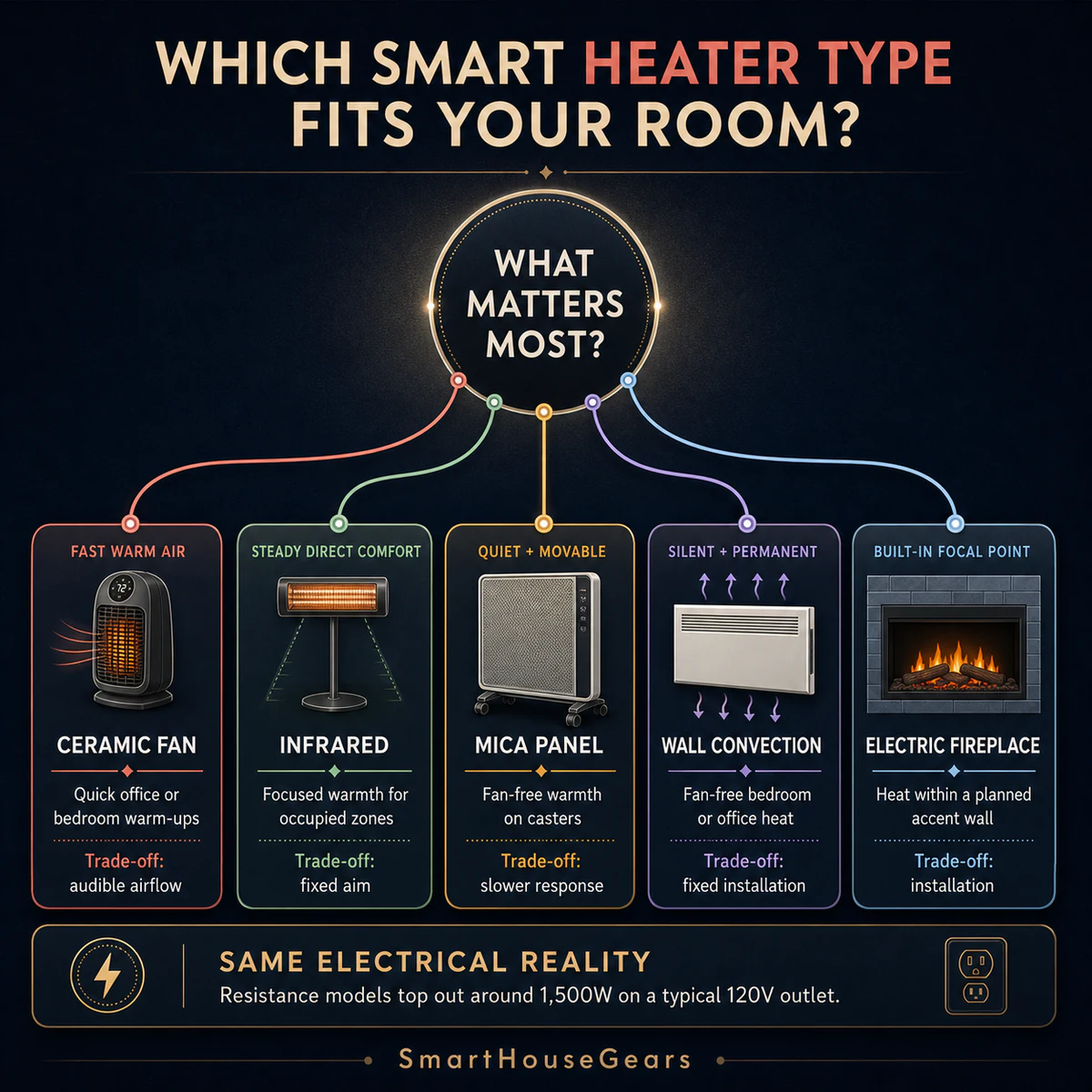
Choose ceramic fan heat for fast warm air, infrared for steadier direct comfort, and fan-free convection for silence. A mica panel blends radiant and convection effects, while a smart electric fireplace trades portability for appearance and permanent placement.
No resistance type creates free extra heat, so treat every "more efficient element" claim as marketing.
Ceramic models suit quick office warmups, and infrared or mica panels favor quieter, longer sessions. The Touchstone fireplace stays a design purchase because its large cabinet still shares the same 1,500W ceiling.
Match the heating method to how quickly you need warmth, how much noise you accept, and whether the installation can be permanent.
What electrical setup does a 1,500W heater require?
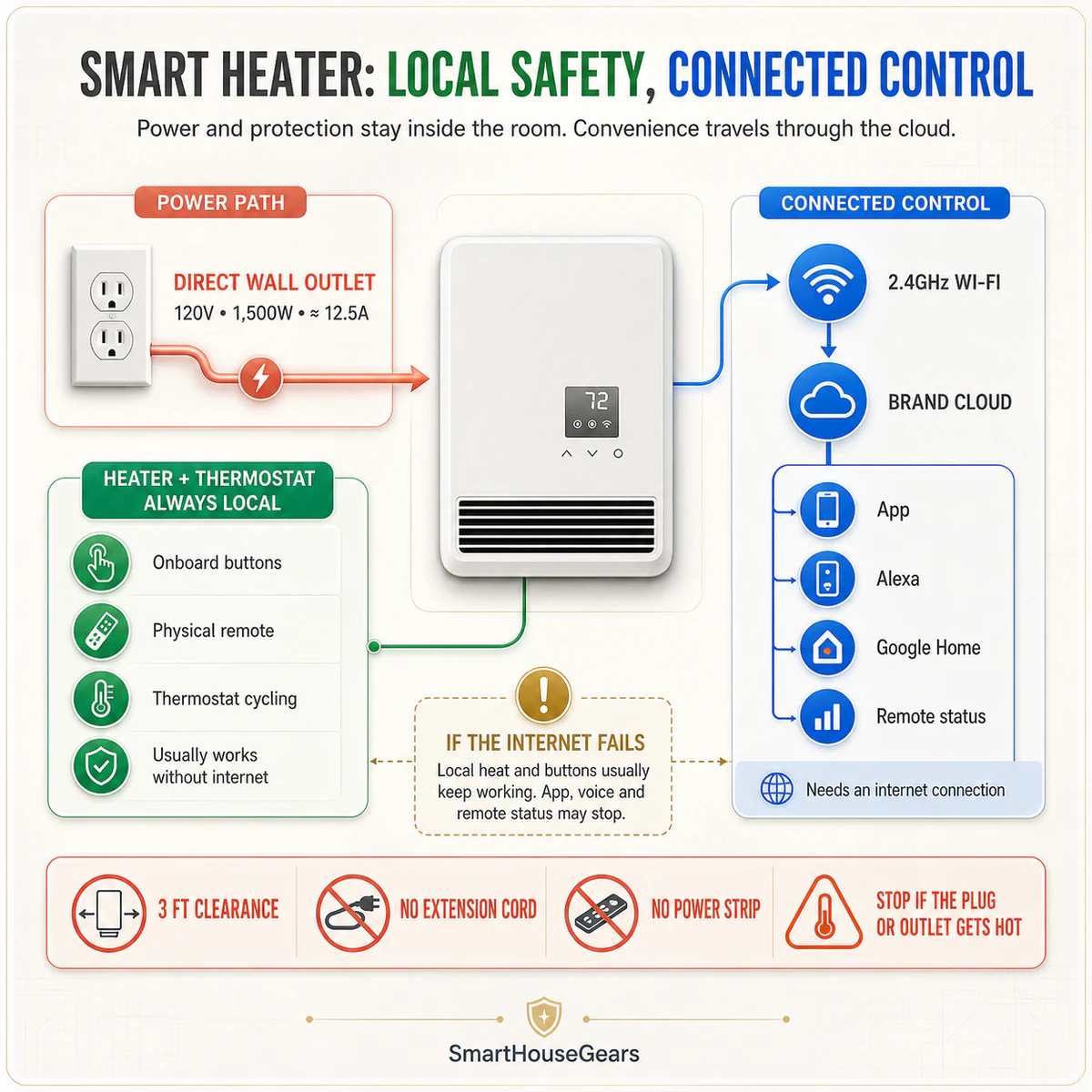
A 1,500W heater draws about 12.5A at 120V, which is a heavy, sustained load on a common 15A branch circuit. Plug it straight into a tight, grounded wall receptacle and keep other high-draw appliances off that circuit.
Ask an electrician to inspect any outlet that runs warm, feels loose, looks discolored, or buzzes.
The CPSC and NFPA advise a direct wall connection, at least 3 ft of clearance from anything combustible, and shutting a portable heater off before you leave it unattended. Never route the cord under a rug, and never use an extension cord or power strip.
Do not bolt a generic WiFi plug onto a conventional heater to make it smart. Built-in connectivity keeps the wireless control inside the appliance's own safety design, while an add-on plug adds one more high-current contact point that nobody engineered for the job.
Electrical and placement check before first use
Direct 120V grounded wall outlet
Tight plug with no heat or discoloration
At least 3 ft from anything combustible
No extension cord, power strip, or adapter
Stable floor or manual-approved wall anchors
Working smoke alarm in the occupied area
Bathroom placement needs extra care. An IP rating describes enclosure resistance, while an ALCI or GFCI addresses leakage current under defined conditions. Neither label lets you ignore prohibited zones, outlet distance, or local code.
How do WiFi, voice control, and offline use differ?
Most smart heaters pair over 2.4GHz because that band reaches farther and passes through walls better than 5GHz. Local buttons and the remote normally keep basic heat working offline.
What disappears in an outage is remote status, Alexa or Google commands, geofencing, and cloud schedules, which is precisely when you would want them.
None of these finalists advertises Matter, so read our guide to Matter smart home hubs before assuming a heater will join that ecosystem.
None charges a subscription for the basic heating controls described here, though app terms and cloud features can change after purchase.
Privacy varies by brand. Give the app only the permissions it needs for setup and alerts, use a unique password, turn on multifactor authentication when offered, and skip location-based automations unless the convenience really justifies sharing your location.
Power safety stays local, while app and voice features depend on the heater's 2.4GHz connection and cloud service.
Do UL, ETL, FCC, ENERGY STAR, and rebates mean the same thing?
No, and the difference matters. UL and ETL marks mean a recognized testing organization evaluated the appliance against an applicable safety standard, while FCC compliance only covers radio emissions.
ENERGY STAR addresses qualified energy performance, and ordinary plug-in resistance space heaters are not a typical ENERGY STAR rebate category.
UL 1278 applies to movable and certain hung room heaters. UL 2021 covers fixed, location-dedicated models. ETL can test to those same standards, so match the mark and the standard to the exact model instead of ranking one logo above another.
Utility rebates overwhelmingly favor heat pumps, weatherization, panel upgrades, and qualified whole-home equipment. Space heaters rarely earn home-insurance discounts either, so confirm any claimed incentive with the utility or insurer before you count it as savings.
What changes by climate and home type?
Cold Northeast and Midwest homes need conservative sizing, because low outdoor temperatures and air leaks multiply heat loss. Ranch homes tend to have cold end rooms, two-story homes have chilly bedrooms above the garage, and Southern homes need to remember that heat does nothing about humidity.
Renters should get written permission before wall mounting anything. An indoor heater rarely trips an HOA street-appearance rule, but condo associations and leases often restrict high-draw portable appliances or hardwired fireplace work.
A portable option like the MORENTO AT-SH40-WF avoids that conversation entirely.
Detached spaces are the exception to all of this. If you are trying to heat a garage or workshop through a full winter rather than take the chill off a room, a space heater is the wrong tool, and our best mini split heat pump for garage picks cover the units that handle it on a fraction of the running cost.
Rural buyers should prioritize complete local controls, because rural internet outages last longer.
Remember too that every electric heater stops in a power outage unless a properly sized backup system feeds it, which is worth planning with our smart home power outage checklist.
How much does a smart space heater cost to run?
The formula is simple: heater kW multiplied by hours of active heat multiplied by your electricity rate. At the EIA's recent US residential range of roughly $0.17 to $0.19 per kWh, a 1,500W heater costs about $0.26 to $0.29 for one uninterrupted full-power hour.
Thermostat cycling cuts that consumption sharply after warmup. A 1,000W heater draws one-third less at full output but often runs longer to reach the same comfort.
Real savings come from zone heating with the central setpoint lowered, never from adding a space heater while the thermostat stays where it was. Our smart thermostat guide for US homes covers that half of the equation.
What should you check during the return window?
Test heating modes, thermostat cycling, app reconnection, remote range, noise, and outlet temperature the day the heater arrives. Amazon items usually carry about a 30-day return window, though the exact listing, seller, season, and your account control the real deadline.
Keep the packaging through several cold-room cycles, and run a wall model on the floor before you drill anything.
Warranties run one year on Dreo, Heat Storm, MORENTO, and Touchstone, two years on Dyson and Ballu, and three years on Smart EnviMAX, all subject to current terms and proof of purchase.
Which Smart Heater Wins Head-to-Head?
The best heater changes once two products solve the same room in different ways, so these matchups focus on the single decision that separates them. Each comparison names an overall winner, then gives the one narrow reason the runner-up can still be the right purchase.
Dreo 719S vs Heat Storm Phoenix: which wall heater wins?
The Dreo 719S wins for most large rooms, because powered vertical oscillation spreads warmth further and its control system feels current rather than dated. The Heat Storm Phoenix wins only when infrared character, an optional remote thermostat, and a 13,960-review owner history outweigh automatic air direction.
Side by sideDreo 719S vs Heat Storm Phoenix
Overall Winner
Dreo Smart Wall-mounted Heater 719S
$110 to $140
Distribution
120-degree vertical oscillation(wins this comparison)
Heat Style
Ceramic fan heat(wins this comparison)
Smart Control
Dreo app and Alexa(wins this comparison)
Owner Proof
4.3 from 3,691 reviews
Best Use
Bedrooms and offices(wins this comparison)
Review-Proof Winner
Heat Storm Phoenix HS-1500-PHX-WIFI
$120 to $170
Distribution
Fixed front outlet
Heat Style
Infrared plus fan
Smart Control
Smart Life app
Owner Proof
4.4 from 13,960 reviews(wins this comparison)
Best Use
Steady supplemental zones
Specification
Overall WinnerDreo Smart Wall-mounted Heater 719S$110 to $140
Review-Proof WinnerHeat Storm Phoenix HS-1500-PHX-WIFI$120 to $170
Distribution
120-degree vertical oscillation(wins this comparison)
Fixed front outlet
Heat Style
Ceramic fan heat(wins this comparison)
Infrared plus fan
Smart Control
Dreo app and Alexa(wins this comparison)
Smart Life app
Owner Proof
4.3 from 3,691 reviews
4.4 from 13,960 reviews(wins this comparison)
Best Use
Bedrooms and offices(wins this comparison)
Steady supplemental zones
Dyson HP1 vs Touchstone Sideline 50: which premium model wins?
The Dyson HP1 wins overall, because filtration, air-quality sensing, fan airflow, and portable placement stay useful in every month of the year. The Touchstone Sideline 50 owns the design category, yet its permanent installation and standard 1,500W output make it the less flexible climate appliance.
Side by sideDyson HP1 vs Touchstone Sideline 50
Overall Winner
Dyson Purifier Hot+Cool HP1
$500 to $660
Year-Round Use
Heat, fan, and purification(wins this comparison)
Placement
Portable floor unit(wins this comparison)
Air Treatment
HEPA H13 plus carbon(wins this comparison)
Warranty
2 years(wins this comparison)
Owner Proof
4.3 from 172 reviews
Design Winner
Touchstone Sideline 50 Model 80004
$500 to $570
Year-Round Use
Flames with or without heat
Placement
Recessed or wall mounted
Air Treatment
None
Warranty
1 year
Owner Proof
4.6 from 3,692 reviews(wins this comparison)
Specification
Overall WinnerDyson Purifier Hot+Cool HP1$500 to $660
Design WinnerTouchstone Sideline 50 Model 80004$500 to $570
Year-Round Use
Heat, fan, and purification(wins this comparison)
Flames with or without heat
Placement
Portable floor unit(wins this comparison)
Recessed or wall mounted
Air Treatment
HEPA H13 plus carbon(wins this comparison)
None
Warranty
2 years(wins this comparison)
1 year
Owner Proof
4.3 from 172 reviews
4.6 from 3,692 reviews(wins this comparison)
Smart EnviMAX vs Ballu: which quiet panel wins?
The Ballu wins on overall value, because it delivers up to 1,500W, caster mobility, and wall hardware for substantially less money. The Smart EnviMAX wins the quietest permanent bedroom install, a lower 8.33A draw, US manufacturing, and the longest standard warranty in this guide.
Side by sideSmart EnviMAX vs Ballu Mica Panel
Silence Winner
Smart EnviMAX SM1012P
$300 to $330
Maximum Output
1,000W
Noise
Fan-free(wins this comparison)
Placement
Wall only
Warranty
3 years(wins this comparison)
Owner Proof
4.1 from 228 reviews
Overall Value Winner
Ballu Mica Infrared WiFi Panel
$170 to $200
Maximum Output
1,500W(wins this comparison)
Noise
Fan-free
Placement
Casters or wall(wins this comparison)
Warranty
2 years
Owner Proof
4.3 from 346 reviews(wins this comparison)
Specification
Silence WinnerSmart EnviMAX SM1012P$300 to $330
Overall Value WinnerBallu Mica Infrared WiFi Panel$170 to $200
Maximum Output
1,000W
1,500W(wins this comparison)
Noise
Fan-free(wins this comparison)
Fan-free
Placement
Wall only
Casters or wall(wins this comparison)
Warranty
3 years(wins this comparison)
2 years
Owner Proof
4.1 from 228 reviews
4.3 from 346 reviews(wins this comparison)
Full Smart Space Heater Specification Table
TableSpecifications That Decide the Purchase
Output, placement, smart-home support, ratings, price ranges, and manufacturer warranties for eight smart heaters.
Product
Rating
Price Range
Output
Placement
Smart Home
Warranty
Dreo 719S
4.3, 3,691 reviews
$110 to $140
1,500W ceramic
Wall
Dreo app, Alexa
1 year
Dreo 517S
4.5, 3,089 reviews
$85 to $110
1,500W ceramic
Wall
Dreo app, Alexa
1 year
Heat Storm Phoenix
4.4, 13,960 reviews
$120 to $170
750W to 1,500W infrared
Wall
Smart Life app
1 year
Dyson HP1
4.3, 172 reviews
$500 to $660
Heater, fan, purifier
Portable
MyDyson, voice services
2 years
Smart EnviMAX
4.1, 228 reviews
$300 to $330
1,000W convection
Wall
App, Alexa, Google
3 years
Ballu Mica Panel
4.3, 346 reviews
$170 to $200
750W to 1,500W mica
Casters or wall
Ballu app, Alexa
2 years
MORENTO AT-SH40-WF
4.1, 235 reviews
$40 to $70
900W to 1,500W ceramic
Portable
Havaworks, Alexa, Google
1 year
Touchstone Sideline 50
4.6, 3,692 reviews
$500 to $570
1,500W, 5,000 BTU
Recessed or wall
App, Alexa, Google
1 year
Dreo 719S
Rating
4.3, 3,691 reviews
Price Range
$110 to $140
Output
1,500W ceramic
Placement
Wall
Smart Home
Dreo app, Alexa
Warranty
1 year
Dreo 517S
Rating
4.5, 3,089 reviews
Price Range
$85 to $110
Output
1,500W ceramic
Placement
Wall
Smart Home
Dreo app, Alexa
Warranty
1 year
Heat Storm Phoenix
Rating
4.4, 13,960 reviews
Price Range
$120 to $170
Output
750W to 1,500W infrared
Placement
Wall
Smart Home
Smart Life app
Warranty
1 year
Dyson HP1
Rating
4.3, 172 reviews
Price Range
$500 to $660
Output
Heater, fan, purifier
Placement
Portable
Smart Home
MyDyson, voice services
Warranty
2 years
Smart EnviMAX
Rating
4.1, 228 reviews
Price Range
$300 to $330
Output
1,000W convection
Placement
Wall
Smart Home
App, Alexa, Google
Warranty
3 years
Ballu Mica Panel
Rating
4.3, 346 reviews
Price Range
$170 to $200
Output
750W to 1,500W mica
Placement
Casters or wall
Smart Home
Ballu app, Alexa
Warranty
2 years
MORENTO AT-SH40-WF
Rating
4.1, 235 reviews
Price Range
$40 to $70
Output
900W to 1,500W ceramic
Placement
Portable
Smart Home
Havaworks, Alexa, Google
Warranty
1 year
Touchstone Sideline 50
Rating
4.6, 3,692 reviews
Price Range
$500 to $570
Output
1,500W, 5,000 BTU
Placement
Recessed or wall
Smart Home
App, Alexa, Google
Warranty
1 year
Final Verdict on the Best Smart Space Heaters for Large Rooms
The best smart space heaters for large rooms never beat the 1,500W reality of a US wall outlet. They win by distributing heat better, holding the occupied zone accurately, and fitting a real room without unsafe adapters or fantasy coverage claims.
For most buyers, the Dreo Smart Wall-mounted Heater 719S is the clear number one. Its $110 to $140 range, powered vertical oscillation, wall-saving design, and mature app controls give the strongest balance in a large bedroom or home office.
The best value depends on whether you can drill. Choose the Dreo 517S for an affordable permanent wall setup, or the MORENTO AT-SH40-WF for a portable, rental-friendly zone heater under $70.
If long owner history matters more than anything else, the 13,960-review Heat Storm Phoenix is the confidence pick. Noise-sensitive buyers should take the Ballu mica panel for value or the Smart EnviMAX for a permanent fan-free bedroom.
Spend $500 to $660 on the Dyson HP1 only if you will genuinely use heat, fan airflow, and filtration. Choose the Touchstone Sideline 50 only when warmth is one part of a planned accent wall.
Safety and honest room fit should decide the final purchase, not the longest feature list.
Quick answers
Smart Space Heater FAQ for Large US Rooms
What is the best smart space heater for a large room?
The Dreo Smart Wall-mounted Heater 719S is the best pick for most large rooms. It combines 1,500W heat, vertical oscillation, and app control for $110 to $140. Use it as targeted or supplemental heat, not as an open-plan HVAC replacement.
Can a 1,500W space heater heat 400 sq ft?
A 1,500W heater can improve comfort across 400 sq ft, but it may not maintain the entire room. Insulation, ceiling height, weather, and air leaks decide the result. Treat 400 sq ft as supplemental coverage unless the room is closed and efficient.
How much electricity does a 1,500W smart heater use?
A 1,500W smart space heater uses 1.5 kWh during one uninterrupted full-power hour. Multiply 1.5 by your electricity rate to estimate the cost. At the recent US average of about $0.17 to $0.19 per kWh that is roughly $0.26 to $0.29 an hour, and state rates from $0.14 to $0.28 per kWh work out to $0.21 to $0.42 before thermostat cycling.
Are WiFi space heaters safe to control remotely?
Remote control is appropriate only when the heater and room meet every manual requirement. Keep 3 ft of clearance and use a direct wall outlet. Remote start never overrides the manufacturer's warning about unattended use.
Can I plug a space heater into a smart plug?
Do not add a generic smart plug unless both manufacturers approve that exact use. A 1,500W heater draws about 12.5A at 120V, leaving little accessory margin. Built-in WiFi keeps control and safety logic inside one designed appliance.
Can I use an extension cord or power strip with a space heater?
No, connect a space heater directly to a properly fitted wall outlet. The CPSC and NFPA advise against extension cords and power strips because weak connections can overheat. Stop if the plug, cord, outlet, or faceplate becomes hot.
Do smart space heaters work without the internet?
Most smart heaters retain local buttons, thermostat operation, and their remote without internet. App control, voice commands, remote status, and cloud schedules may stop. Choose complete onboard controls if offline use matters.
Which is better, an infrared or ceramic smart heater?
Choose ceramic fan heat for fast airflow across an occupied zone. Pick infrared or mica for quieter, steadier warmth with slower response. Both remain resistance heaters, so placement and thermostat control matter more than efficiency slogans.
What is the quietest smart heater for a bedroom?
The Smart EnviMAX SM1012P is the quietest finalist because it has no fan. Its 1,000W natural convection suits an efficient bedroom or office. Choose the Ballu mica panel if quiet heat must remain movable.
Do any smart space heaters support Matter or Apple Home?
None of the eight finalists advertises native Matter or Apple Home support. Alexa and Google Home remain the practical voice platforms, backed by brand apps. Apple users should not assume Siri or HomeKit control unless the current listing promises it.
Can I run a smart space heater overnight?
Follow the exact manual because overnight guidance differs by model. The CPSC advises turning portable heaters off before bed, and a wall mount does not automatically permit unattended use. Maintain clearance and a working smoke alarm.
Are smart space heaters eligible for ENERGY STAR rebates?
Typical resistance space heaters are not an ENERGY STAR rebate category. Incentives more often cover qualified heat pumps, wiring, or whole-home efficiency work. Check your utility, but treat a plug-in heater rebate as an exception.
Discussion
Be the first to comment
Have a question or experience to share? Scroll down to leave a comment.

Discussion
Be the first to comment