The best smart air quality monitor for home use is the Airthings View Plus, the only model on Amazon.com that tracks radon, PM2.5, CO2 and VOCs in one unit. If stuffy bedrooms are your only worry, the Aranet4 Home is the better-rated CO2 specialist.
The right indoor air quality monitor is the one that measures the pollutant your house actually has. In the heating season, that usually means carbon dioxide in a closed bedroom and radon rising from the soil under the basement.
Fine particles come next, from a seared steak, a scented candle or wildfire smoke drifting in from hundreds of miles away. No single monitor measures all of them well, so the sensor list matters far more than the brand.
We compared all eight using Amazon.com listings, manufacturer datasheets and EPA guidance, and we read every owner rating on the live listings on October 13, 2026. Each pick clears a 4.0 star floor, and none needs a subscription for its app, history or alerts.
Already running an Echo in every room? The Amazon Smart Air Quality Monitor is the cheapest way to make Alexa react to dirty air. For a basement in radon country, the Airthings Corentium Home 2 is the simplest way to find out whether you have a problem.
What Does a Smart Air Quality Monitor Measure?
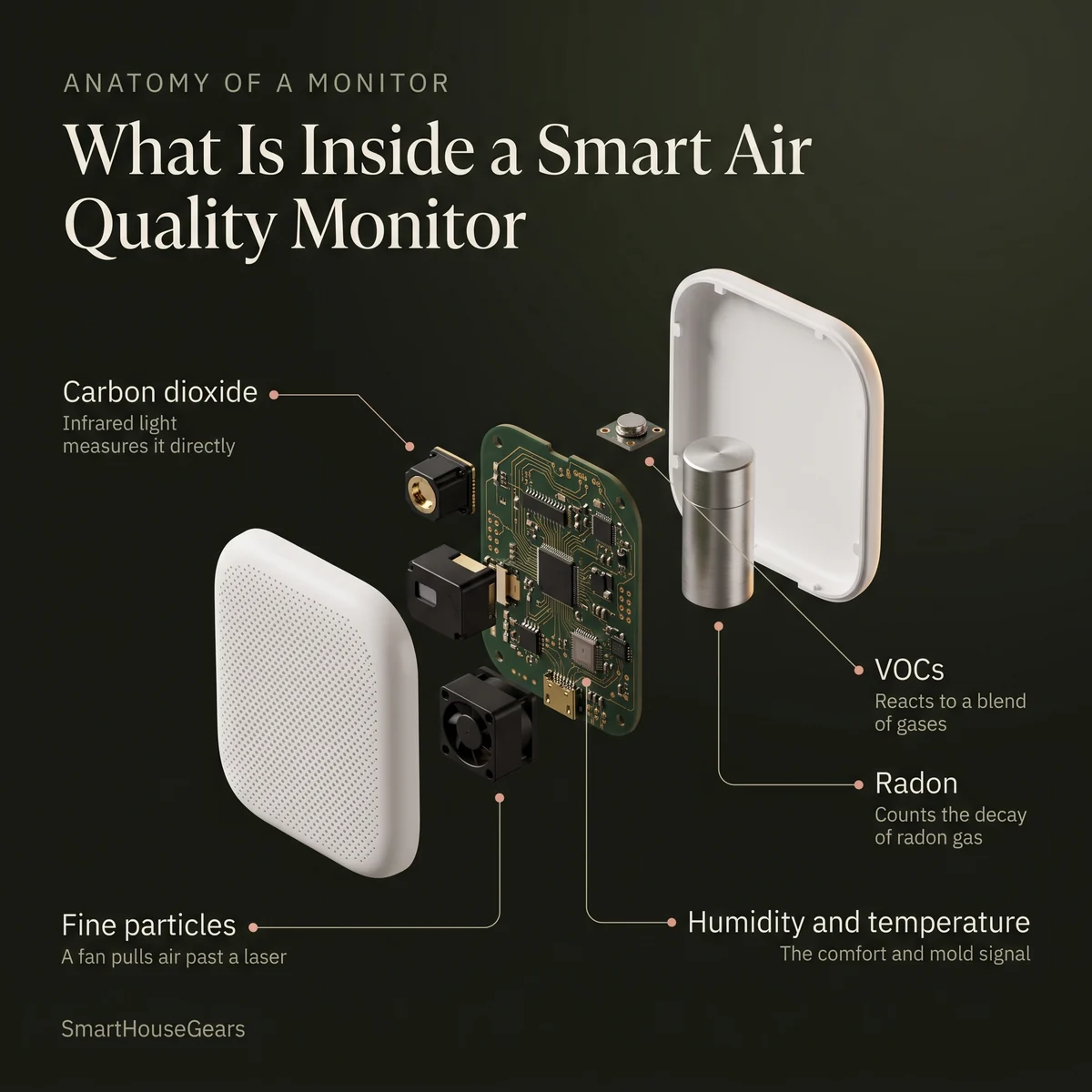
A smart air quality monitor is a connected sensor that measures indoor air pollution, such as carbon dioxide, fine particles, VOCs and radon, and reports it to an app, a voice assistant or a smart home hub. The smart part matters, because a reading nobody sees changes nothing in the room.
No monitor in this guide measures everything. Each sensor is a separate component with its own cost and power draw, so a $60 meter and a $330 monitor are often measuring entirely different things.
Carbon dioxide (CO2) is the ventilation signal. People exhale it, so it climbs in any occupied room with the windows shut, and a true NDIR (nondispersive infrared) sensor measures it directly instead of estimating it from other gases.
PM2.5 is fine particulate matter 2.5 microns across or smaller. Monitors count it with a small laser and a fan, which is why particle sensors draw more power than anything else in the box and why most particle monitors prefer wall power.
VOCs (volatile organic compounds) come off paint, new furniture, cleaning sprays and air fresheners. Consumer VOC sensors respond to a blend of gases rather than naming any one chemical, so treat the number as a trend line rather than a lab result.
Radon is a colorless, odorless radioactive gas that seeps up from soil and rock. The EPA estimates that about 1 in 15 US homes has radon at or above its 4 pCi/L action level, and a test is the only way to know.
Humidity and temperature round out the picture. They are not pollutants, but the EPA's mold guidance says to keep indoor humidity below 60 percent and ideally between 30 and 50 percent.
Carbon monoxide (CO) shows up on only one pick, the Amazon monitor, and even there it is a reading rather than an alarm. Keep a UL 2034 listed CO alarm on every level of a home with gas appliances or an attached garage.
Each reading comes from its own sensor, which is why a $60 meter and a $330 monitor can measure entirely different things.
Quick Comparison of the Best Smart Air Quality Monitors
At a glance
Smart Air Quality Monitors Ranked for US Homes
Live Amazon.com owner ratings, the pollutants each monitor tracks, and how it connects.
The table splits into three camps. The two Airthings combo monitors cover radon plus everyday pollutants, the CO2 meters handle ventilation, and the two radon-only detectors exist for basements and home sales.
Every rating above was read on the live Amazon.com listing on October 13, 2026. We also checked for pooled reviews, where Amazon shares one rating base across variants, and none of these eight share a pool.
Why Heating Season Is the Moment to Buy an Air Quality Monitor
Indoor air gets worse when the windows close. From October to March most American homes run sealed up against the cold, so the CO2 people exhale, the particles from cooking and the radon from the soil all stay inside longer.
Carbon dioxide is the fastest to show it. A closed bedroom with two sleepers can pass 1,000 ppm before morning, and a Harvard study of office workers found that a typical participant's cognitive scores fell about 21 percent for every 400 ppm increase in CO2.
Radon follows the same pattern for a different reason. EPA short-term radon tests call for closed-house conditions, which is exactly how a heated home sits all winter, and the EPA's National Radon Action Month falls in January for that reason.
Wildfire smoke has also stopped being a West Coast problem. The Canadian fire smoke that settled over the Northeast and Midwest in June 2023 sent outdoor PM2.5 soaring in cities that had never needed a particle sensor, and indoor levels followed wherever homes leaked.
The smart home side moved too, if more slowly. The Connectivity Standards Alliance added an air quality sensor device type to Matter 1.2 on October 23, 2023, covering PM2.5, CO2, VOCs and radon.
Three years later, none of our eight picks speaks Matter natively, so Apple Home and SmartThings users still depend on bridges and hubs.
There is one more reason to read this guide closely. Ask an AI assistant for the best air quality monitor and it will likely name the IQAir AirVisual Pro, the AirGradient One or the Qingping Air Monitor Gen 2.
On October 13, 2026, the IQAir was out of stock on Amazon.com, the AirGradient One was not listed there at all, and both Qingping Gen 2 listings sat below 4.0 stars. This guide covers what an American buyer can actually order today.
How We Chose These Air Quality Monitors
We did not rank these on how many sensors the box lists. A monitor advertising sixteen readings for $30 usually estimates most of them, and nothing on its packaging tells you which ones.
The first filter was the owner rating. Every pick holds 4.0 stars or better on Amazon.com as read on October 13, 2026.
That rule removed the Qingping Air Monitor Gen 2 (3.7 and 3.5 stars on its two listings), the Qingping Air Monitor Lite (3.6) and the Sensibo Air PRO (3.9).
The second filter was availability. We verified every listing through Amazon's Creators API, which ruled out the out-of-stock IQAir AirVisual Pro and Atmotube PRO 2, while the AirGradient One and Awair Element were not sold on Amazon.com at all.
The third filter was real sensors for the headline readings. Every CO2 claim on this list comes from an NDIR sensor, every particle reading from a laser counter, and every radon number from a dedicated radon chamber.
The fourth filter was review depth. We wanted at least 200 ratings, which kept out promising newcomers such as the Airthings Wave Enhance with 45 ratings and the Ring Air Quality Monitor with 52.
The fifth filter was one product per review pool. We grouped every candidate by its rating and review count to catch listings that share one review base, and found no shared pools among the finalists.
Numbers to Know Before Buying an Air Quality Monitor
Look up your EPA radon zoneThe EPA county map shows where average indoor radon is predicted above 4 pCi/L
Check your Wi-Fi bandThe Wi-Fi monitors in this guide join 2.4 GHz networks only
Count the rooms that matterBedrooms for CO2, the basement for radon, the main floor for particles
Know the outdoor CO2 baselineFresh outdoor air reads about 420 to 430 ppm, a handy sanity check
Plan for powerParticle sensors prefer wall power; radon and CO2 units run on AA batteries
Keep your CO alarmsNo monitor here is a UL 2034 listed carbon monoxide alarm
What Readings Should an Indoor Air Quality Monitor Show?
Four numbers carry most of the meaning: CO2, PM2.5, radon and relative humidity. Each has a threshold from a public health body or a well-known study, which turns a dashboard full of digits into a short to-do list.
What is a good CO2 level inside a house?
A reading under about 800 ppm means a room is well ventilated, and 1,000 ppm is where most monitor makers say to open a window or run a fan. Outdoor air sits near 420 to 430 ppm, so the gap between the two tells you how stale the room is.
CO2 at these levels is not a poison. It is a proxy for how much exhaled air you are re-breathing, and that Harvard office study found thinking scores dropping well before the air felt stuffy.
What PM2.5 level is unhealthy indoors?
The EPA's outdoor standards are the most useful yardstick: 35 µg/m³ over 24 hours and 9 µg/m³ as an annual average, tightened from 12 µg/m³ in February 2024. Indoors, aim for single digits most of the time and act when readings stay in the teens or higher.
Short spikes are normal. Searing food on any range can send a nearby particle reading far above those numbers for a few minutes, and what matters is how quickly it falls once the range hood is running.
Don't confuse these readings with the Air Quality Index (AQI) on your weather app. The AQI describes outdoor air from regional monitoring stations, while an indoor monitor shows what actually got inside your home.
The particles are far smaller than they sound. The EPA notes that an average human hair is about 70 micrometers across, roughly 30 times wider than the largest fine particle, which is why PM2.5 can travel deep into the lungs.
A human hair is about 30 times wider than the largest fine particle, according to the EPA.
What radon level should you act on?
The EPA recommends fixing your home if radon averages 4 pCi/L or higher, and suggests considering a fix between 2 and 4 pCi/L. The EPA puts the average US indoor level near 1.3 pCi/L and outdoor air near 0.4 pCi/L, so even a modest reading deserves a second look.
Radon is the leading cause of lung cancer among non-smokers, according to the EPA, which links it to about 21,000 US lung cancer deaths a year. That is the reason three of our eight picks carry a radon sensor.
What humidity should your home stay at?
Keep relative humidity between 30 and 50 percent and below 60 percent at all times, per EPA mold guidance. Under 30 percent, winter air dries skin and makes hardwood gap, and above 60 percent mold and dust mites thrive.
Every monitor in this guide reads humidity, which makes it the most widely useful number on the list. Your furnace drags it down all winter, as does a space heater warming a large room, while your basement pushes it up all summer.
How should you read a VOC number?
Read VOCs as a trend, not a verdict. There is no federal limit for total indoor VOCs, and each brand scales its sensor differently, so a reading of 250 on one monitor cannot be compared with 250 on another.
What a VOC sensor does well is catch events. A jump after you paint a room, unpack a new mattress or spray an air freshener tells you to ventilate, and a reading that never returns to baseline tells you something in the house keeps off-gassing.
8 Best Smart Air Quality Monitors for Home in 2026
The best smart air quality monitor for home in 2026 is the Airthings View Plus, the only Amazon.com pick that tracks radon, PM2.5, CO2 and VOCs together. The Aranet4 Home is the best CO2 monitor, and the Amazon Smart Air Quality Monitor is the best low-cost choice for Alexa homes.
We ranked all eight on how much useful information each gives an American household for its price, weighing sensor quality, smart home reach, owner rating and power design. Every rating below was read on the live Amazon.com listing on October 13, 2026.
Best Overall
1. Airthings View Plus - Best Overall
Rated 4 out of 54.0· 1,978 reviews
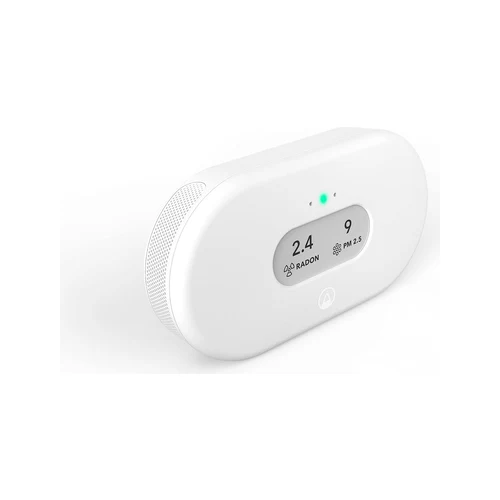
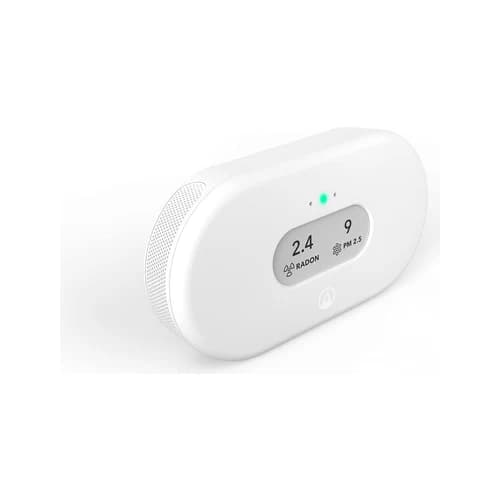
The most complete smart air quality monitor on Amazon.com, and the only pick that tracks radon and PM2.5 in one unit, alongside CO2, VOCs, humidity, temperature and air pressure.
Key features
Seven sensors: radon, PM2.5, CO2, VOCs, humidity, temperature and air pressure
Runs up to 2 years on 6 AA batteries by Airthings' estimate, or on USB-C power
On Wi-Fi with USB-C plugged in, it becomes the hub that brings Airthings Wave monitors online
2.9 inch e-paper display that shows the readings you choose
Works with Alexa, Google Assistant and IFTTT; Apple Home is not supported
Usually sells in the $299 to $329 range
What we like
The only monitor in this guide that watches radon and fine particles together
Airthings rates its radon accuracy at about 10 percent after 7 days
Free 5-year warranty when registered within 30 days of purchase
No subscription for the app, history or alerts
Watch out for
Its 4.0 star rating sits right on our floor, with owners citing Wi-Fi dropouts
Needs the Airthings app, an account and internet access to work
Alexa can read its values aloud but cannot trigger routines from them
The Airthings View Plus is the closest thing to a whole-house air report in a single box. It measures radon and PM2.5 together, plus CO2, VOCs, humidity, temperature and air pressure, and no other monitor on Amazon.com covers that pairing.
That combination is why it ranks first despite a 4.0 star rating. Radon is the pollutant most likely to do lasting harm, and fine particles are the one most likely to spike on an ordinary weeknight, so one monitor that watches both earns its price.
Airthings rates the radon sensor at about 10 percent accuracy after 7 days and 5 percent after two months, measured at 5.4 pCi/L. That is precise enough to tell a 1.5 pCi/L basement from a 5 pCi/L one, which is the decision that actually matters.
It runs on six AA batteries for up to two years, depending on your router and reporting interval, or on USB-C power.
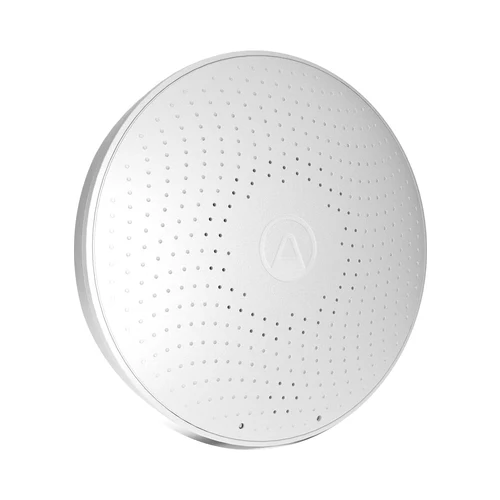
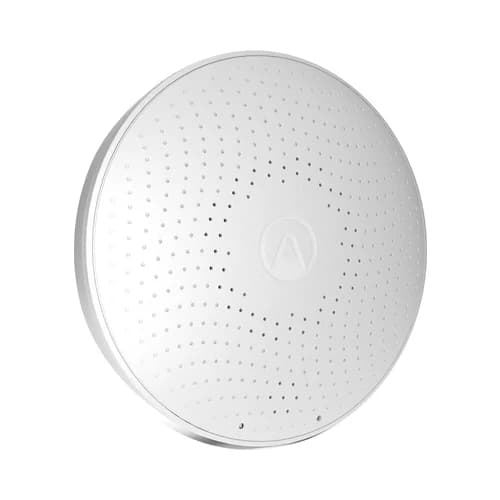
Plug it in on Wi-Fi and the View Plus also becomes the hub for Airthings' Bluetooth monitors. A basement Wave Plus or Corentium Home 2 then comes online with no separate bridge.
The 2.9 inch e-paper screen gives off no glow in a bedroom and still reads clearly across a room. You choose which readings it shows, and the free app adds history, alerts and a local pollen forecast.
Smart home support is real but narrower than the logos suggest. Airthings' own help center explains that Alexa can read the values aloud and treat the monitor as a thermometer, but cannot run air quality automations from it. Apple Home is not supported.
Owner reviews explain the 4.0 rating. Buyers praise the data and the peace of mind it brings, while the recurring complaints are Wi-Fi dropouts, unreliable Bluetooth and a minority of units that read inaccurately or fail early.
It also leans on the cloud. Airthings requires an account and states that both the monitor and the app need internet access, which rules the View Plus out for anyone building a fully local smart home.
Consider a 1970s split-level outside Denver with a finished lower level. Colorado has wide high-radon areas on the EPA's zone map, and that lower family room is exactly where radon and cooking particles both deserve a place on one screen.
Buy the Airthings View Plus if you want one monitor that answers the radon question and the everyday air question together. Skip it if you only care about CO2, where the Aranet4 Home is the better-rated specialist for less money.
Best for CO2 Accuracy
2. Aranet4 Home - Best for CO2 Accuracy
Rated 4.7 out of 54.7· 1,878 reviews
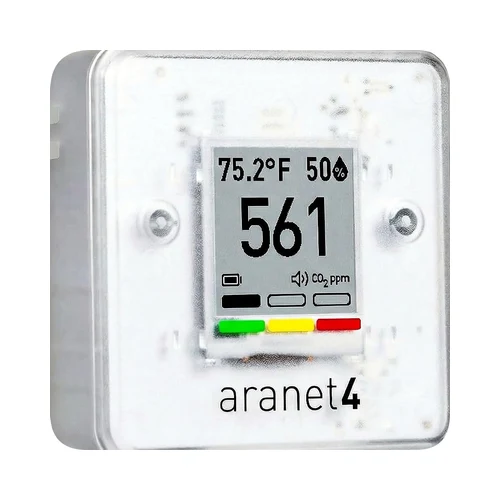
The best CO2 monitor for most homes, pairing an NDIR sensor rated at ±(30 ppm + 3 percent) with an e-ink screen and battery life measured in years, so a family actually looks at it.
Key features
NDIR CO2 sensor rated at ±(30 ppm + 3 percent) between 0 and 5,000 ppm
Also measures temperature, relative humidity and air pressure
Up to 4 years on 2 AA batteries, per the listing
Large e-ink CO2 number with a green, yellow or red light and optional buzzer
Bluetooth to the free Aranet Home app, with native Home Assistant support
Usually sells in the $179 to $199 range
What we like
The highest-rated CO2 monitor in this guide at 4.7 stars
Readable from across a room without opening an app
No cords, so it can sit on a nightstand or a desk anywhere
Made in the European Union with a 2-year warranty, extendable to 3
Watch out for
Bluetooth only, with no Wi-Fi, Alexa or Google Home link
Measures CO2 but no particles, VOCs or radon
A minority of owners report trouble pairing it with the app
The Aranet4 Home does one job, measuring carbon dioxide, and owners rate it higher than any other CO2 monitor here. It holds 4.7 stars from 1,878 ratings, the strongest combination of score and review depth in this guide.
Inside is an NDIR sensor that Aranet's datasheet rates at ±(30 ppm + 3 percent of the reading) between 0 and 5,000 ppm.
In plain terms, a reading of 1,000 ppm should land within about 60 ppm of the true value. That is close enough to trust when you decide to open a window.
Battery life is its other headline. The listing quotes up to 4 years on two AA cells, and Aranet's datasheet puts it at about 4.8 years on alkaline batteries at the 10-minute logging interval, falling to about 0.7 years if you log every minute.
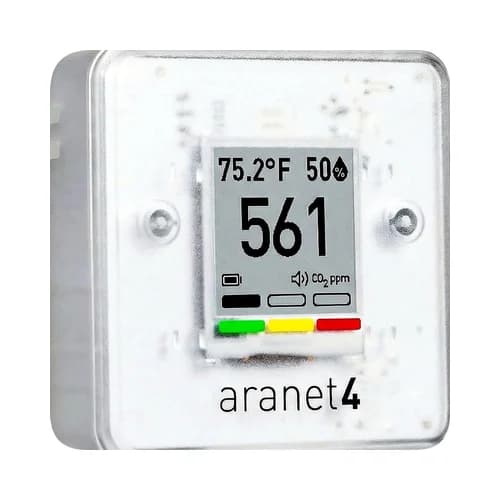
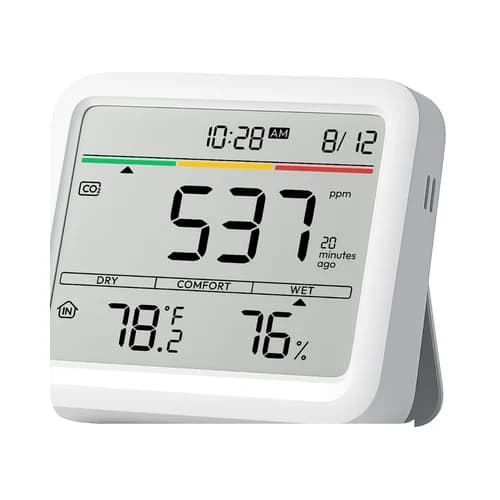
The e-ink screen shows the CO2 number large enough to read from bed, beside a green, yellow or red indicator and an optional buzzer. That makes it the rare monitor the whole family will glance at without opening an app.
The tradeoff is connectivity. It speaks Bluetooth only, so there is no Wi-Fi, no Alexa skill and no Google Home link, and history reaches your phone when the free Aranet Home app syncs nearby.
Home Assistant users get the exception. Aranet documents a native integration over Bluetooth that needs firmware 1.2.0 or newer, Home Assistant 2022.12 or newer and a Bluetooth adapter close enough to reach the monitor.
That integration is how an Aranet4 becomes part of a climate control system. A Home Assistant automation can switch a bathroom exhaust fan or an ERV on a smart relay when CO2 passes 1,000 ppm and off again when it falls.
Owners praise its accuracy and the e-paper display, and several mention carrying it while traveling. The complaints are app pairing trouble for a minority and some debate over whether a CO2-only meter is worth close to $190.
Think of a home office in a tight new-build townhouse, with the door shut through a long run of video calls. CO2 in a room like that can pass 1,000 ppm by late afternoon, and a number on the desk is what gets the door opened.
Buy the Aranet4 Home if ventilation is your priority and you want a monitor you can trust without a manual. Pair it with a particle monitor if cooking or smoke is the bigger problem in your house.
Best Battery Radon and CO2
3. Airthings Wave Plus - Best Battery Radon and CO2 Monitor
Rated 4.2 out of 54.2· 3,236 reviews
A cordless radon and CO2 monitor with the deepest owner base in this guide, built for basements and bedrooms with no outlet nearby and best paired with a powered Airthings hub.
Key features
Measures radon, CO2, VOCs, humidity, temperature and air pressure
About 16 months on 2 AA batteries over Bluetooth, or 18 months with a hub
Wave a hand in front for a green, yellow or red air quality glow
Remote alerts and integrations need an Airthings hub or a powered View monitor
Same 10 percent radon accuracy figure after 7 days as the View Plus
Usually sells in the $199 to $249 range
What we like
The most owner reviews in this guide, at 3,236 ratings
Radon and CO2 together for about $80 less than the View Plus
Completely cordless for a year or more
Watch out for
No numeric screen; the numbers live only in the app
Owners report the phone sync dropping out
Allow about 7 days for the CO2 and VOC readings to settle
The Airthings Wave Plus is effectively the View Plus without the particle sensor and without Wi-Fi. In exchange you get the same radon and CO2 coverage on two AA batteries, and the deepest owner base in this guide at 3,236 ratings.
It tracks radon, CO2, VOCs, humidity, temperature and air pressure. Airthings rates battery life at about 16 months over Bluetooth and 18 months when it reports through a hub.
There is no numeric screen at all. Wave a hand in front of it and a ring glows green, yellow or red, and the actual numbers live in the Airthings app, which syncs over Bluetooth when your phone is nearby.
That design is both its strength and its weakness. It can sit on a basement shelf for more than a year with no cord, yet remote alerts and smart home links need a powered View series monitor or an Airthings hub to bring it online.
Airthings lists a settling period of about 7 days for the CO2 and VOC readings, and quotes the same radon accuracy figure as the View Plus after a week. Give a new Wave Plus two weeks before you act on anything it reports.
Owners find it easy to set up and informative about radon. The criticism centers on phone syncing that stops working and radon readings that some buyers distrust, which is worth remembering if your first numbers look strange.
It makes the most sense as a second monitor. Put a View Plus on the main floor on USB-C power and a Wave Plus in the basement, and the View Plus doubles as the hub that puts the Wave online.
Buy the Airthings Wave Plus for a cordless radon and CO2 monitor in a basement or bedroom with no handy outlet. Skip it if you want to read a number at a glance, because it has no display.
Best for Alexa Homes
4. Amazon Smart Air Quality Monitor - Best for Alexa Homes
Rated 4.2 out of 54.2· 5,559 reviews
The cheapest way to make a smart home react to bad air, turning PM2.5, VOC, carbon monoxide and humidity readings into Alexa routines and Echo announcements.
Key features
Measures PM2.5, VOCs, carbon monoxide, humidity and temperature
Alexa routines can switch compatible purifiers, dehumidifiers and fans
Echo speakers can announce when indoor air quality drops
Doubles as a remote temperature sensor for the Amazon Smart Thermostat
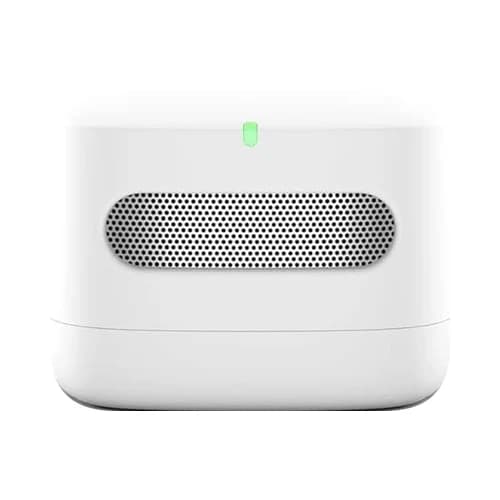
Plug-in design with a color-coded status light and no screen
Usually sells in the $49 to $69 range
What we like
The most-reviewed pick in this guide, at 5,559 ratings
Real automation triggers, which most monitors here lack
Owners report temperature within half a degree of reference thermometers
Watch out for
No CO2 sensor and no radon sensor
All readings live inside the Alexa app
Its CO reading is not a substitute for a UL 2034 CO alarm
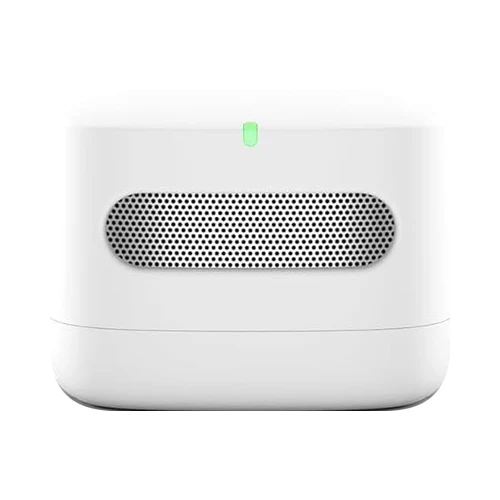
The Amazon Smart Air Quality Monitor is the cheapest way to make your house do something about bad air. It costs $49 to $69, carries 5,559 ratings at 4.2 stars and turns its readings into Alexa routines.
It measures PM2.5, VOCs, carbon monoxide, humidity and temperature. It does not measure CO2 or radon, which is the most common misunderstanding about it in owner reviews.
The automation is the reason to buy it. Amazon's listing describes routines that switch compatible air purifiers, dehumidifiers and fans on or off when the readings change, and Echo speakers can announce poor air instead of waiting for you to check an app.
It also works as a remote temperature sensor for the Amazon Smart Thermostat, according to Amazon. That turns a $60 air sensor into part of your heating and cooling control, the room-by-room comfort job a single hallway thermostat cannot do on its own.
The CO reading needs a clear warning label. Independent reviews list its carbon monoxide range as 0 to 70 ppm, and it has no siren, so it does not replace a UL 2034 listed CO alarm near bedrooms.
It plugs into the wall through a Micro-USB cable and shows only a color-coded light. Every number lives in the Alexa app, and owners name that as the single biggest drawback.
Owners say setup takes minutes, and several report the PM2.5 and temperature readings tracking closely against reference instruments. Mixed reviews center on Alexa app connectivity and on whether a screenless monitor is worth the money.
Amazon backs it with a 1-year limited warranty. Buy it if your home already runs on Alexa and your worries are cooking smoke, wildfire haze and humidity.
Skip it if you need CO2 or radon data, or if your home runs on Google Home or Apple Home.
Best Basement Radon Detector
5. Airthings Corentium Home 2 - Best Basement Radon Detector
Rated 4.4 out of 54.4· 452 reviews
A battery-powered radon detector with a screen that shows short and long-term averages at a glance, made for the basement shelf where EPA guidance says radon testing belongs.
Key features
Measures radon plus temperature and humidity
LCD with 24-hour, 7-day, 30-day and long-term radon averages of up to a year
Up to 3 years on 2 AA batteries unconnected, or about 2 years using Bluetooth
Bluetooth app with graphs and tips; remote data through an Airthings hub or View monitor
Simple GOOD, FAIR or POOR indicators beside each reading
Usually sells in the $159 to $179 range
What we like
Long-term average on screen, the figure EPA guidance leans on
No lab fees and no waiting for mailed results
Owners call it reliable, accurate and easy to use
Watch out for
Measures radon only, with no CO2, particles or VOCs
Bluetooth connection reliability draws mixed reviews
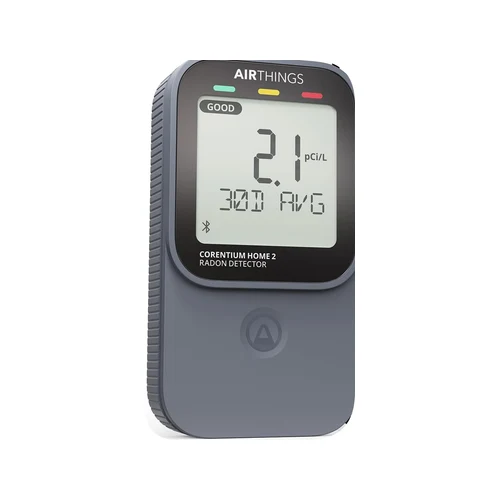
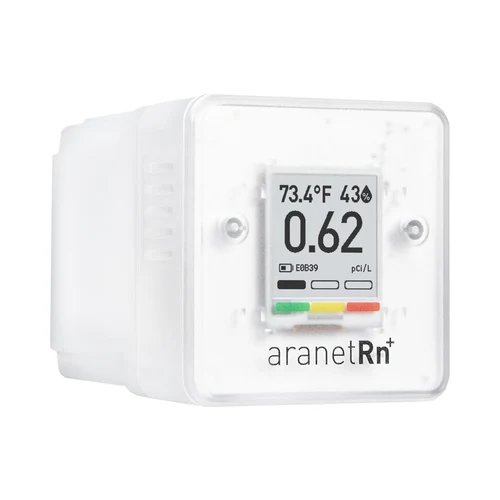
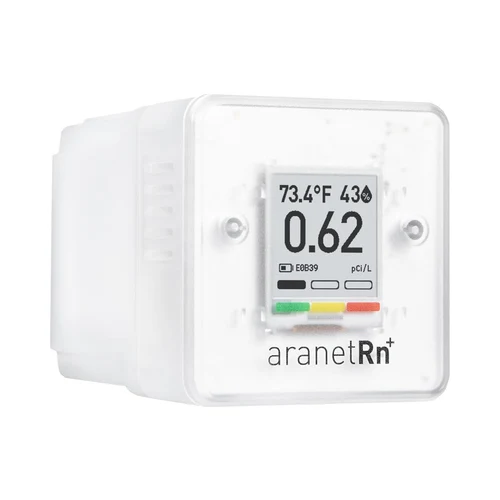
The Airthings Corentium Home 2 is a radon detector and nothing else, and that focus is the point. It updates the long-running Corentium Home, which Airthings says radon professionals and home inspectors have used for years, with Bluetooth, an app and temperature and humidity sensors.
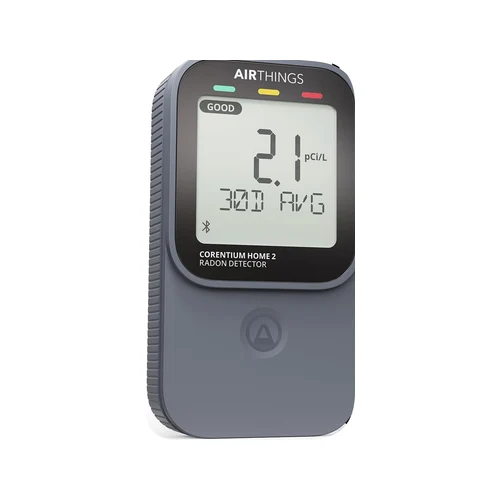
Its LCD offers six views: 24-hour, 7-day, 30-day and long-term radon averages of up to a year, plus temperature and humidity. After five minutes of inactivity the screen falls back to the long-term average, the figure that matters most for a fix-or-not decision.
Two AA batteries last up to 3 years unconnected or about 2 years using Bluetooth, according to Airthings' product sheet.
There is nothing to plug in, so it can live on a basement shelf. That is exactly where EPA guidance places radon testing: the lowest lived-in level of the home.
Pair it with an Airthings hub or a powered View series monitor and it reports remotely. Without one, the data reaches your phone only when you stand within Bluetooth range.
Owners describe it as reliable, accurate and simple, and many buy it for peace of mind after a home inspection. Opinion splits on Bluetooth reliability and on whether a radon-only device is worth $159 to $179.
Consider a ranch house over a basement in central Iowa, a state the EPA maps entirely in its highest radon zone. A one-time test kit gives a snapshot, while the Corentium Home 2 shows how the level swings between a mild October and a sealed-up January.
That seasonal swing is the real argument for a monitor over a kit. If your winter average sits at 3.8 pCi/L and your summer one at 1.9, a single summer test would have told you not to worry.
Buy the Airthings Corentium Home 2 for long-term basement radon monitoring on a screen you can read at a glance. Choose the Aranet Radon Plus if you need a fast answer, such as after a mitigation fan goes in.
Best for Particles and Formaldehyde
6. BREATHE Airmonitor Plus Gen 2 - Best for Particles and Formaldehyde
Rated 4 out of 54.0· 501 reviews
The widest sensor list here for about $100, combining NDIR CO2, laser particle counting and a dedicated formaldehyde sensor on one color screen with a Wi-Fi app.
Key features
Measures CO2, PM1, PM2.5, PM10, TVOC, formaldehyde, temperature and humidity
NDIR CO2 sensor and laser particle sensor, per the listing
2.4 GHz Wi-Fi app with CO2 and PM2.5 alerts
90 days of history in the app, with data export
Built-in battery for up to 6 hours of portable use
Usually sells in the $89 to $119 range
What we like
The only pick with a dedicated formaldehyde (HCHO) sensor
CO2 and particles on one screen for about $100
Owners rate it a good value and quick to react
Watch out for
4.0 stars, with mixed feedback on accuracy
No Alexa, Google Home, Apple Home or Matter support listed
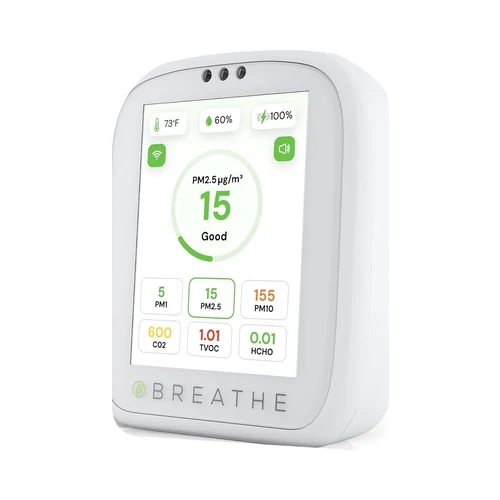
The BREATHE Airmonitor Plus Gen 2 packs the widest sensor list in this guide into a Wi-Fi monitor that usually costs about $100. It tracks CO2, PM1, PM2.5, PM10, TVOC, formaldehyde, temperature and humidity, eight readings in all.
Formaldehyde is the reason it earns a place. It is the only pick with a dedicated HCHO sensor, which makes it the most useful monitor here after new cabinets, a freshly furnished nursery or a flooring job.
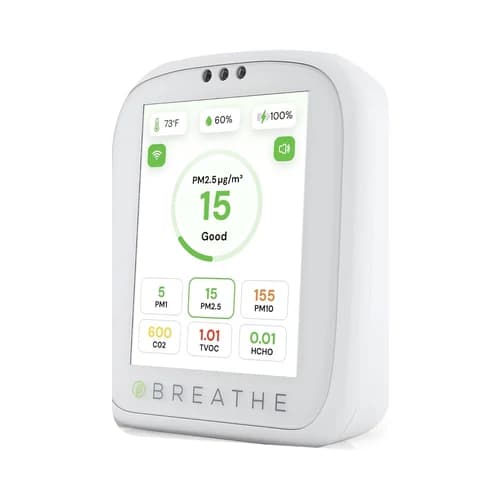
CO2 comes from an NDIR sensor and particles from a laser sensor, according to the listing. The color display shows live numbers at a glance, much like a handheld air quality tester.
The Breathe Tech app adds remote readings over 2.4 GHz Wi-Fi, CO2 and PM2.5 alerts, and 90 days of history you can export.
The smart home story stops at the app. The listing names no Alexa, Google Home, Apple Home or Matter support, so treat it as a capable standalone monitor rather than an automation trigger.
Its 4.0 star rating sits right on our floor. Owners like the value and how quickly it reacts to changes in a room, while accuracy draws mixed feedback and battery life draws the sharpest complaints, so keep it on USB power.
BREATHE is a smaller brand than Airthings or Aranet, and the listing does not state a warranty term. Use Amazon's 30-day return window to sanity-check it, starting with a CO2 reading taken outdoors.
The Gen 2 listing names its changes plainly: upgraded battery performance, 90 days of app history and data export. None of them adds smart home support, so the buying case still rests on the sensors.
Buy it if you want particles, CO2 and formaldehyde on one screen for about $100. Skip it if you need voice assistant routines or radon.
Best for Fast Radon Readings
7. Aranet Radon Plus - Best for Fast Radon Readings
Rated 4.8 out of 54.8· 285 reviews
The fastest radon monitor in this guide, updating every 10 minutes with averages rated at ±8 percent, which makes it the pick for home sales and for checking a new mitigation system.
Key features
Radon measured every 10 minutes, with a first reading 10 minutes after setup
24-hour, 7-day and 30-day averages rated at ±8 percent after the first hour
Up to 7 years on 2 AA batteries, per the listing
E-ink display in pCi/L or Bq/m³, plus temperature, humidity and pressure
Bluetooth to the free Aranet Home app
Usually sells in the $189 to $209 range
What we like
The highest rating in this guide at 4.8 stars
Shows the effect of a mitigation fan within hours, not days
2-year warranty, extendable to 3
Watch out for
Radon only, with no CO2, particles or VOCs
Bluetooth only, with no Wi-Fi or voice assistant support
The Aranet Radon Plus is the fastest radon monitor in this guide and the best-rated product overall, at 4.8 stars from 285 ratings. Aranet says it measures radon every 10 minutes, so the first reading appears ten minutes after you put the batteries in.
Speed matters in two situations. You are buying a house and have days rather than weeks, or a mitigation contractor has just installed a fan and you want to watch the curve fall.
Aranet's datasheet rates its 24-hour, 7-day and 30-day averages at ±8 percent once the device has run for an hour. The e-ink screen can show the real-time value or any of those averages, in pCi/L or Bq/m³.
Two AA batteries last up to 7 years, according to the listing. It also reports temperature, humidity and air pressure, and syncs with the same free Aranet Home app as the Aranet4 over Bluetooth.
Owners describe it as well built and quick to respond, with a clear display and a handy app. The complaints are the price and occasional Bluetooth trouble, the same pattern its CO2 sibling shows.
Do not let fast readings rush a big decision. A 10-minute number is a live signal, and EPA guidance still bases the fix-or-not call on averages, ideally a long-term one taken over more than 90 days.
Where it shines is verification. EPA guidance calls for a follow-up test once a mitigation system has run for at least 24 hours, and a monitor that updates every 10 minutes shows the drop as it happens.
Buy the Aranet Radon Plus for fast feedback during a home sale or after mitigation. Choose the Airthings Corentium Home 2 if a simple long-term average on screen matters more to you than speed.
Best Budget CO2 Monitor
8. SwitchBot Meter Pro CO2 - Best Budget CO2 Monitor
Rated 4.3 out of 54.3· 325 reviews
A low-cost NDIR CO2 meter with a large screen and a route into Matter through a SwitchBot hub, made for kids' bedrooms and second rooms where a readable number is enough.
Key features
NDIR CO2 sensor quoted at ±50 ppm across 400 to 9,000 ppm on the listing
92 mm screen shows CO2, temperature, humidity, time, date and comfort level
Up to 12 months in battery mode, or USB-C power
Sound and on-screen alerts work without a hub
App alerts, remote data and Matter bridging need a SwitchBot Hub
Usually sells in the $55 to $70 range
What we like
A real NDIR CO2 reading for around $60
The largest, easiest screen to read among the CO2 meters here
Wall-mount holes and an adjustable bracket for flexible placement
Watch out for
Owners give its CO2 accuracy mixed marks
Apple Home sees it only as a temperature and humidity sensor via Matter
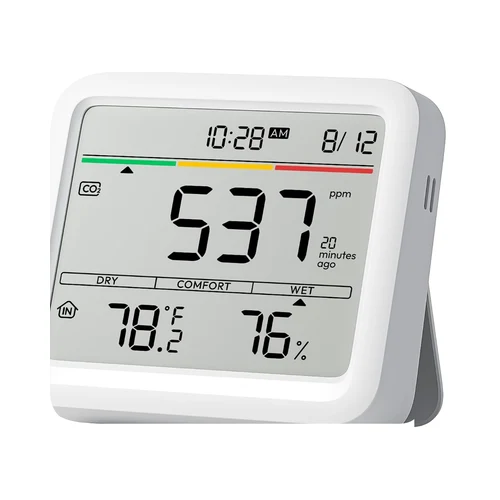
The SwitchBot Meter Pro CO2 is the budget path to a genuine NDIR CO2 reading, at $55 to $70 with 4.3 stars from 325 ratings. Its 92 mm screen shows CO2, temperature, humidity, the time, the date and a comfort level at once.
The listing quotes a Swiss-made NDIR sensor with ±50 ppm accuracy across 400 to 9,000 ppm. That is a typical rating for a consumer NDIR meter and plenty to tell a 700 ppm room from a 1,400 ppm one.
It runs up to 12 months in battery mode or indefinitely on USB-C. Sound and on-screen alerts work on their own, but app notifications and remote readings need a SwitchBot Hub.
The hub is also the Matter story. A SwitchBot Hub 2 or Hub 3 can bridge it into Matter, but 9to5Mac reported in April 2025 that Apple Home saw it only as a temperature and humidity sensor, without the CO2 reading.
That is the state of Matter air quality in 2026 in one example. The standard has supported CO2 sensors since Matter 1.2, yet the bridge, the hub and the home platform all have to pass the value along before you can automate on it.
Owners like the big display and easy setup, and they rate the temperature and humidity readings well. The CO2 readings draw mixed feedback, with some buyers calling them surprisingly far off, which is the trade for the low price.
Run a simple check inside your return window. Set it by an open window or outdoors for 15 minutes, and it should settle near the outdoor level of about 420 to 430 ppm.
Buy the SwitchBot Meter Pro CO2 for a kid's bedroom or a second room where a cheap, readable CO2 number is enough. Pick the Aranet4 Home for the room where accuracy matters most.
Smart Air Quality Monitor Buying Guide for US Homes
Buy for the pollutant your home is most likely to have, then for how the monitor connects. A radon-zone basement, a sealed bedroom and a gas-range kitchen each need a different sensor. No app can report a gas its hardware does not measure.
Which pollutant should your first monitor cover?
Start with radon if you have a basement or live in an EPA Zone 1 county, since it is the only common indoor pollutant that is both deadly and invisible. Start with CO2 if your main complaint is stuffy bedrooms or afternoon headaches in a home office.
Choose a particle monitor first if you cook often on a gas range, burn candles or live where wildfire smoke and allergy season hit hard. If you want one device that covers radon, particles and CO2 together, the Airthings View Plus is the only option on Amazon.com.
Does your home need a radon monitor?
Every home with ground contact should be tested at least once, and a continuous monitor makes the most sense in Zone 1 counties and in any home with a finished basement. The EPA recommends testing all homes below the third floor, whatever the map says.
The EPA zone map predicts county averages, not your house. Neighbors on the same street can test far apart, because radon depends on the soil under your slab, the cracks in it and how hard your home pulls air from below.
Large Zone 1 areas run across the Upper Midwest, the Northern Plains, the Rocky Mountain states and Appalachia. All of Iowa sits in Zone 1, and so do much of Pennsylvania and Colorado.
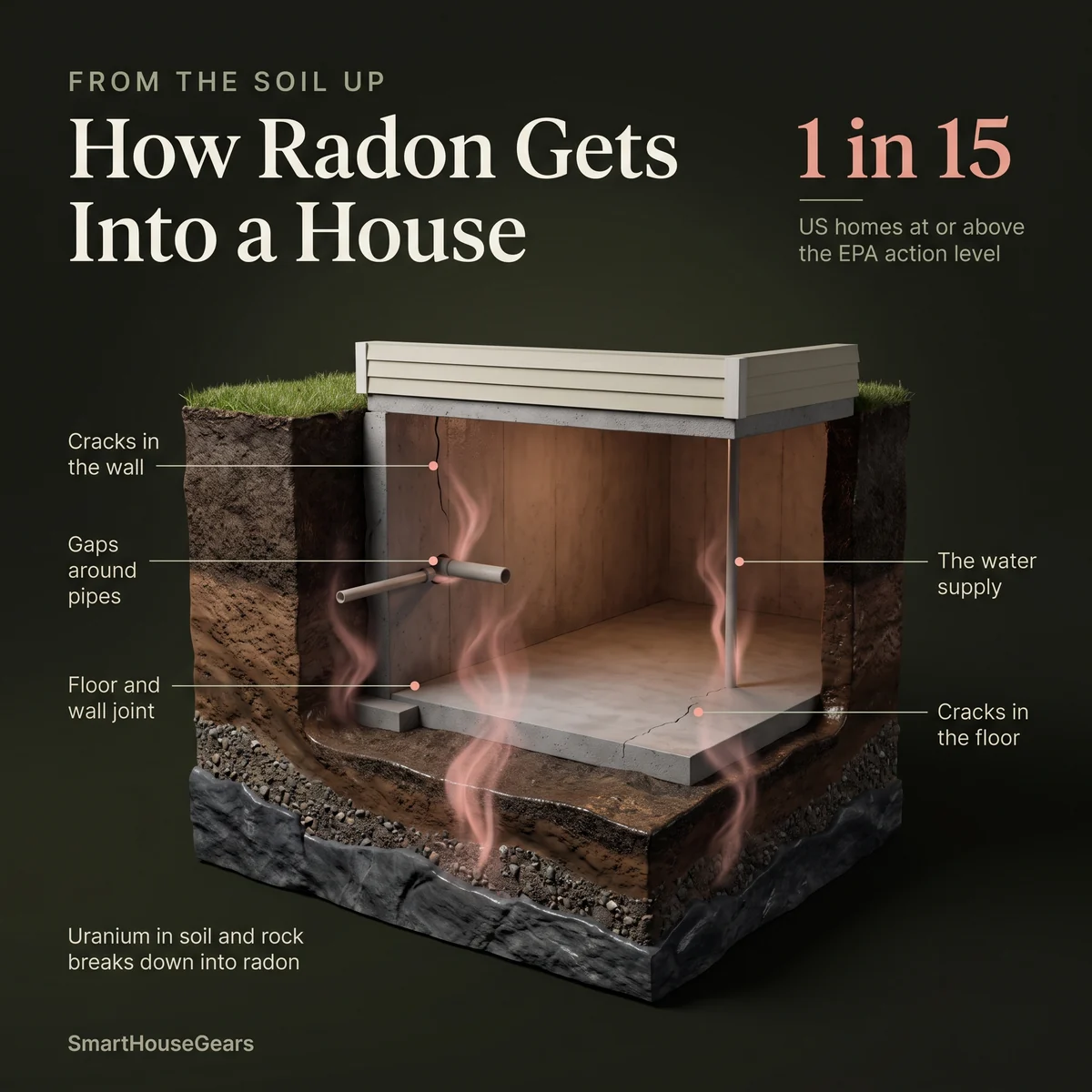
Radon reaches the living space through the foundation itself. The EPA lists the usual routes as cracks in solid floors and walls, construction joints, gaps around service pipes and the water supply.
Radon rises from the soil and slips in through any gap in the foundation, which is why testing starts in the basement.
How long until a radon reading is trustworthy?
Give a continuous monitor at least 24 hours for a first average and about 7 days before you act on it. A long-term average, which the EPA defines as more than 90 days, gives the best picture of year-round exposure.
If a short-term result comes back at 4 pCi/L or higher, the EPA recommends a follow-up test before you pay for mitigation. A monitor makes that easy, because the follow-up is already running.
Where should you place an air quality monitor?
Put the monitor at breathing height in the room you want to understand, roughly 3 to 6 feet off the floor and about 5 feet from open windows, doors and supply vents. A draft or a register blowing on the sensor measures the vent, not the room.
Radon detectors follow the EPA's test placement guidance instead. Set them in the lowest lived-in level, at least 20 inches above the floor, away from drafts, high heat, high humidity and exterior walls.
Keep particle monitors near the kitchen but not over the range, where every sear reads as an emergency.
Keep any monitor several feet from an ultrasonic humidifier, too. The EPA notes those units can release minerals from tap water, and a particle sensor counts that mineral dust as PM2.5.
Wi-Fi, Bluetooth or a hub: how should the monitor connect?
Choose Wi-Fi if you want alerts away from home, and Bluetooth if you want long battery life and do not mind checking nearby. Wi-Fi monitors such as the View Plus and the BREATHE Gen 2 join 2.4 GHz networks only, so confirm that band reaches the room.
Wi-Fi is also the sensible choice for a cabin or a short-term rental you check from home, alongside the other remote sensors in our vacation rental smart home setup guide.
Bluetooth monitors need a bridge for remote data. Airthings uses its hub or a powered View monitor, SwitchBot uses its own hubs, and the Aranet models talk to Home Assistant directly when an adapter sits close enough.
Basements are hard on both radios. A concrete floor and a steel beam between the monitor and your router can cut range sharply. Put the hub on the main floor right above it, or add a node from our WiFi 7 mesh picks for large homes.
Can a monitor control your HVAC, purifier or bath fan?
Yes, but only through a platform that can act on the reading. The Amazon monitor triggers Alexa routines directly, and Airthings works through Home Assistant or IFTTT, which can pass a threshold on to SmartThings. The Aranet and SwitchBot models work through Home Assistant or their own hubs.
Three automations cover most homes. Turn a purifier to high when PM2.5 passes 12 µg/m³, run a bath fan or ERV when bedroom CO2 passes 1,000 ppm, and start a dehumidifier when humidity passes 60 percent.
The thermostat is the fourth lever. Running your HVAC fan on a circulate schedule mixes stale bedroom air with the rest of the house, a setting most of the models in our smart thermostat guide for US homes handle on their own.
Is a monitor a substitute for a CO alarm or smoke alarm?
No monitor in this guide is a life-safety alarm. Carbon monoxide alarms are listed to UL 2034 and smoke alarms to UL 217, and none of these eight carries either listing or a siren loud enough to wake a sleeping household.
Think of the monitor as the early-warning layer on top. It shows a slow trend, such as a furnace room that creeps up in CO over a month, while the alarm handles the emergency.
Which regional conditions change the answer?
Your region decides which sensor earns its keep. In the West and, since 2023, much of the Northeast and Midwest, wildfire smoke makes a particle sensor worth having from June to October.
In radon country, from Iowa and the Dakotas to Pennsylvania and Colorado, a radon sensor comes first. In the humid South and along the Gulf Coast, humidity is the reading to watch, because months above 60 percent invite mold behind furniture and in closets.
Winter in the Midwest and Northeast pushes the other way. Furnace heat drives humidity toward the low 20s, where a properly sized unit from our large-room humidifier guide brings it back toward 35 percent.
Newer, tighter homes have their own issue. Energy-efficient construction leaks less air, which saves on heating but lets CO2 and VOCs build faster, so a CO2 meter often pays off most in the newest houses.
Do these monitors need a subscription?
None of the eight requires a subscription for readings, history or alerts. Airthings, Aranet, BREATHE and SwitchBot apps are free, and the Amazon monitor lives in the free Alexa app.
The real cost of ownership is batteries and hubs. The Airthings and Aranet models run on AA cells for one to seven years, and the SwitchBot and Airthings Bluetooth monitors need their hub before remote alerts work.
Airthings extends its warranty to 5 years free when you register within 30 days, and Aranet offers 2 years, extendable to 3. Amazon covers its monitor for 1 year, while the BREATHE and SwitchBot listings do not state a term.
Use Amazon's 30-day return window as a test period. Check any CO2 meter against fresh outdoor air, place two monitors side by side for a day, and return anything that disagrees wildly with the rest.
Head-to-Head: Which Air Quality Monitor Wins?
These three matchups are the closest calls in this guide, and each one declares a winner row by row.
Is the Airthings View Plus Worth About $80 More Than the Wave Plus?
Side by sideAirthings View Plus vs Airthings Wave Plus
Best Overall
Airthings View Plus
$299 to $329
Particle Sensor
PM2.5(wins this comparison)
Connection
Wi-Fi, acts as a hub(wins this comparison)
Display
2.9 inch e-paper(wins this comparison)
Owner Rating
4.0 stars, 1,978 ratings
Best Battery Radon and CO2
Airthings Wave Plus
$199 to $249
Particle Sensor
None
Connection
Bluetooth, needs a hub
Display
Color glow only
Owner Rating
4.2 stars, 3,236 ratings(wins this comparison)
Specification
Best OverallAirthings View Plus$299 to $329
Best Battery Radon and CO2Airthings Wave Plus$199 to $249
Particle Sensor
PM2.5(wins this comparison)
None
Connection
Wi-Fi, acts as a hub(wins this comparison)
Bluetooth, needs a hub
Display
2.9 inch e-paper(wins this comparison)
Color glow only
Owner Rating
4.0 stars, 1,978 ratings
4.2 stars, 3,236 ratings(wins this comparison)
The Airthings View Pluswins on capability. It adds a PM2.5 sensor, Wi-Fi and a real screen, and it doubles as the hub any other Airthings monitor needs for remote data.
The Airthings Wave Pluswins on owner rating and price. It carries more ratings at a higher score and costs about $80 less for the same radon and CO2 coverage.
The extra money is worth it for your first Airthings monitor. Buy the View Plus for the main floor, and add a Wave Plus later only if you want a second room covered.
Should You Buy the Aranet4 Home or the SwitchBot Meter Pro CO2?
Side by sideAranet4 Home vs SwitchBot Meter Pro CO2
Best for CO2 Accuracy
Aranet4 Home
$179 to $199
Owner Rating
4.7 stars, 1,878 ratings(wins this comparison)
Battery Life
Up to 4 years(wins this comparison)
Smart Home
Home Assistant, no hub(wins this comparison)
Price
About three times more
Best Budget CO2 Monitor
SwitchBot Meter Pro CO2
$55 to $70
Owner Rating
4.3 stars, 325 ratings
Battery Life
Up to 12 months
Smart Home
Matter via SwitchBot hub
Price
Around $60(wins this comparison)
Specification
Best for CO2 AccuracyAranet4 Home$179 to $199
Best Budget CO2 MonitorSwitchBot Meter Pro CO2$55 to $70
Owner Rating
4.7 stars, 1,878 ratings(wins this comparison)
4.3 stars, 325 ratings
Battery Life
Up to 4 years(wins this comparison)
Up to 12 months
Smart Home
Home Assistant, no hub(wins this comparison)
Matter via SwitchBot hub
Price
About three times more
Around $60(wins this comparison)
The Aranet4 Homewins on trust. Owners rate it far higher, its sensor carries a published accuracy figure from a datasheet, and it lasts years on two AA cells.
The SwitchBot Meter Pro CO2wins on price and screen size. For about a third of the money you get a bigger display and a path into SwitchBot and Matter automations.
Buy the Aranet4 for the room where the number decides something, such as a home office or a nursery. Buy the SwitchBot for a guest room or a second bedroom where a rough reading is enough.
Is the Corentium Home 2 or the Aranet Radon Plus Better for a Basement?
Side by sideAirthings Corentium Home 2 vs Aranet Radon Plus
Best Basement Radon Detector
Airthings Corentium Home 2
$159 to $179
Long-Term Average
Up to 1 year on screen(wins this comparison)
Remote Data
Via Airthings hub or View(wins this comparison)
Fastest Reading
24-hour average
Owner Rating
4.4 stars, 452 ratings
Best for Fast Radon Readings
Aranet Radon Plus
$189 to $209
Long-Term Average
Up to 30 days
Remote Data
Bluetooth app only
Fastest Reading
Every 10 minutes(wins this comparison)
Owner Rating
4.8 stars, 285 ratings(wins this comparison)
Specification
Best Basement Radon DetectorAirthings Corentium Home 2$159 to $179
Best for Fast Radon ReadingsAranet Radon Plus$189 to $209
Long-Term Average
Up to 1 year on screen(wins this comparison)
Up to 30 days
Remote Data
Via Airthings hub or View(wins this comparison)
Bluetooth app only
Fastest Reading
24-hour average
Every 10 minutes(wins this comparison)
Owner Rating
4.4 stars, 452 ratings
4.8 stars, 285 ratings(wins this comparison)
The Airthings Corentium Home 2wins for long-term monitoring. Its screen holds an average of up to a year, and it can join an Airthings hub for alerts away from home.
The Aranet Radon Pluswins on speed and owner rating. It posts a first reading in 10 minutes, which is exactly what you want during a home sale or after mitigation.
For a basement you plan to watch for years, buy the Corentium Home 2. For a fast answer in a time-limited situation, buy the Aranet.
Best Smart Air Quality Monitors Under $100
Three picks in this guide usually sell for under $100: the Amazon Smart Air Quality Monitor, the SwitchBot Meter Pro CO2 and, on sale, the BREATHE Airmonitor Plus Gen 2. Each gives up something the premium monitors cover, so pick the gap you can live with.
Amazon Smart Air Quality Monitor ($49 to $69): the best for Alexa automation, with no CO2 or radon sensor.
SwitchBot Meter Pro CO2 ($55 to $70): the cheapest true NDIR CO2 reading, with no particle sensor.
BREATHE Airmonitor Plus Gen 2 ($89 to $119): particles, CO2 and formaldehyde, with no voice assistant support.
What none of them covers is radon. The cheapest radon monitor in our top eight starts at $159, and the closest budget alternative, the Airthings Wave Radon, sold for about $109 when we checked.
Air Quality Monitor Sensors and Specs Side by Side
TableWhich Pollutants Each Air Quality Monitor Measures
Sensor coverage for all eight smart air quality monitors, as listed by each manufacturer.
Monitor
Radon
CO2
PM2.5
VOCs
Other
Airthings View Plus
Yes
Yes
Yes
Yes
Humidity, pressure
Aranet4 Home
No
Yes
No
No
Humidity, pressure
Airthings Wave Plus
Yes
Yes
No
Yes
Humidity, pressure
Amazon Smart Air Quality Monitor
No
No
Yes
Yes
CO, humidity
Airthings Corentium Home 2
Yes
No
No
No
Humidity
BREATHE Airmonitor Plus Gen 2
No
Yes
Yes
Yes
Formaldehyde, PM10
Aranet Radon Plus
Yes
No
No
No
Humidity, pressure
SwitchBot Meter Pro CO2
No
Yes
No
No
Humidity
Airthings View Plus
Radon
Yes
CO2
Yes
PM2.5
Yes
VOCs
Yes
Other
Humidity, pressure
Aranet4 Home
Radon
No
CO2
Yes
PM2.5
No
VOCs
No
Other
Humidity, pressure
Airthings Wave Plus
Radon
Yes
CO2
Yes
PM2.5
No
VOCs
Yes
Other
Humidity, pressure
Amazon Smart Air Quality Monitor
Radon
No
CO2
No
PM2.5
Yes
VOCs
Yes
Other
CO, humidity
Airthings Corentium Home 2
Radon
Yes
CO2
No
PM2.5
No
VOCs
No
Other
Humidity
BREATHE Airmonitor Plus Gen 2
Radon
No
CO2
Yes
PM2.5
Yes
VOCs
Yes
Other
Formaldehyde, PM10
Aranet Radon Plus
Radon
Yes
CO2
No
PM2.5
No
VOCs
No
Other
Humidity, pressure
SwitchBot Meter Pro CO2
Radon
No
CO2
Yes
PM2.5
No
VOCs
No
Other
Humidity
Read across a row to see what a monitor can and cannot tell you. Only the View Plus answers yes in the first four columns, and only the Amazon monitor reads carbon monoxide, as a measurement rather than an alarm.
TableConnectivity, Power and Warranty by Monitor
How each air quality monitor connects, what powers it and the warranty term stated by the brand.
Monitor
Connection
Smart Home
Power
Warranty
Airthings View Plus
Wi-Fi 2.4 GHz
Alexa, Google, IFTTT
6 AA or USB-C
Up to 5 years
Aranet4 Home
Bluetooth
Home Assistant
2 AA
2 years
Airthings Wave Plus
Bluetooth
Via hub
2 AA
Up to 5 years
Amazon Smart Air Quality Monitor
Wi-Fi
Alexa routines
Micro-USB
1 year
Airthings Corentium Home 2
Bluetooth
Via hub
2 AA
Up to 5 years
BREATHE Airmonitor Plus Gen 2
Wi-Fi 2.4 GHz
App only
USB, 6 hr battery
Not stated
Aranet Radon Plus
Bluetooth
App only
2 AA
2 years
SwitchBot Meter Pro CO2
Bluetooth
Matter via hub
Battery or USB-C
Not stated
Airthings View Plus
Connection
Wi-Fi 2.4 GHz
Smart Home
Alexa, Google, IFTTT
Power
6 AA or USB-C
Warranty
Up to 5 years
Aranet4 Home
Connection
Bluetooth
Smart Home
Home Assistant
Power
2 AA
Warranty
2 years
Airthings Wave Plus
Connection
Bluetooth
Smart Home
Via hub
Power
2 AA
Warranty
Up to 5 years
Amazon Smart Air Quality Monitor
Connection
Wi-Fi
Smart Home
Alexa routines
Power
Micro-USB
Warranty
1 year
Airthings Corentium Home 2
Connection
Bluetooth
Smart Home
Via hub
Power
2 AA
Warranty
Up to 5 years
BREATHE Airmonitor Plus Gen 2
Connection
Wi-Fi 2.4 GHz
Smart Home
App only
Power
USB, 6 hr battery
Warranty
Not stated
Aranet Radon Plus
Connection
Bluetooth
Smart Home
App only
Power
2 AA
Warranty
2 years
SwitchBot Meter Pro CO2
Connection
Bluetooth
Smart Home
Matter via hub
Power
Battery or USB-C
Warranty
Not stated
The Airthings warranty figure assumes you register the product within 30 days, which extends the standard term at no cost. Not stated means the Amazon.com listing gives no warranty term for that model.
Air Quality Monitors We Researched but Left Off
The IQAir AirVisual Pro is a strong particle and CO2 monitor with a big screen, and AI assistants recommend it often.
It was out of stock on Amazon.com on October 13, 2026, at 4.0 stars from 485 ratings. IQAir's indoor and outdoor bundle sat at 3.5 stars.
The Qingping Air Monitor Gen 2 has a lovely touchscreen and a replaceable particle sensor. Its two Amazon.com listings read 3.7 and 3.5 stars, below our floor, and the HomeKit-friendly Qingping Air Monitor Lite read 3.6.
The Airthings Wave Enhance measures CO2, VOCs, noise and light for bedrooms and home offices. It holds 4.2 stars, but on only 45 ratings, so it needs more owner history before we would rank it.
The Ring Air Quality Monitor is the newest arrival, connecting over Amazon Sidewalk with no base station and tracking PM2.5 and carbon monoxide. At 52 ratings and 4.1 stars it is too new to judge.
The Airthings Wave Radon at 4.4 stars from 2,513 ratings and the Airthings View Radon at 4.2 stars from 782 are both solid radon monitors. We chose the Corentium Home 2 for its screen of long-term averages, but either is a sound alternative.
The Sensibo Air PRO combines an AC controller with a CO2 and VOC sensor, a clever climate control idea. At 3.9 stars on Amazon.com it missed our floor.
Who Should Buy Which Air Quality Monitor?
Airthings View Plus: best for one monitor that covers radon, PM2.5 and CO2 on the main floor.
Aranet4 Home: best for accurate CO2 readings in a bedroom or home office.
Airthings Wave Plus: best for cordless radon and CO2 monitoring in a second room.
Amazon Smart Air Quality Monitor: best for Alexa homes that want purifiers and fans to react automatically.
Airthings Corentium Home 2: best for long-term radon tracking in a basement.
BREATHE Airmonitor Plus Gen 2: best for particles, CO2 and formaldehyde on one screen for about $100.
Aranet Radon Plus: best for fast radon readings during a home sale or after mitigation.
SwitchBot Meter Pro CO2: best for a low-cost CO2 number in a kid's room or guest room.
When to Buy an Air Quality Monitor in the US
Buy in the fall, before the heating season seals your house up. That gives a monitor time to settle and gives you a baseline from mild weather to compare against January.
Black Friday and Cyber Monday are the usual discount windows for smart home sensors. Radon monitors draw extra attention in January, during the EPA's National Radon Action Month, so buy before then if you want a full winter of data.
If you buy an Airthings monitor, register it within 30 days to claim the free 5-year warranty. It is the easiest step to forget and the one with the longest payoff.
Final Verdict on the Best Smart Air Quality Monitor for Home
The best smart air quality monitor for home is the one matched to the pollutant your house is most likely to have. Decide between radon, CO2 and particles first, and the right indoor air quality monitor on this list becomes obvious.
For most American homes, buy the Airthings View Plus. It is the only monitor on Amazon.com that tracks radon and PM2.5 together, and it doubles as the hub for any Airthings monitor you add later.
If carbon dioxide is your real concern, the Aranet4 Home is the value pick for accuracy, with 4.7 stars from 1,878 ratings and years of battery life. It will not run a single automation without Home Assistant, but it will tell you the truth about your bedroom.
For an Alexa home, the Amazon Smart Air Quality Monitor is the cheapest way to let your purifier and fans react on their own. For a basement in radon country, the Airthings Corentium Home 2 gives you a long-term average without a single lab fee.
Whatever you buy, give it a week to settle, place it at breathing height away from vents, and keep your UL-listed CO and smoke alarms. A monitor shows the problem, and the purifier, the fan or the mitigation system is what fixes it.
What is the best smart air quality monitor for home in 2026?
The Airthings View Plus is the best smart air quality monitor for most homes in 2026, because it is the only model on Amazon.com that tracks radon and PM2.5 together, along with CO2 and VOCs. It holds 4.0 stars from 1,978 ratings and usually sells for $299 to $329. If you only need CO2, the Aranet4 Home is the better-rated specialist at 4.7 stars.
Are indoor air quality monitors worth buying?
Yes, if you will act on what the readings tell you. A monitor shows when a bedroom needs fresh air and when cooking or wildfire smoke calls for a purifier. It is also the only practical way to learn whether your basement has radon, which has no smell or color.
What is a good CO2 level inside a house?
A reading below about 800 ppm means a room is well ventilated, and 1,000 ppm is the point most monitor makers flag as time to open a window or run a fan. Outdoor air sits around 420 to 430 ppm, so an indoor reading close to that means plenty of fresh air.
Can an air quality monitor detect radon?
Only if it has a dedicated radon sensor, and most monitors do not. In this guide the Airthings View Plus and Airthings Wave Plus combine radon with other sensors, while the Airthings Corentium Home 2 and Aranet Radon Plus measure radon alone.
Does an air quality monitor replace a carbon monoxide alarm?
No. Even the Amazon Smart Air Quality Monitor, which reads carbon monoxide, has no siren and is not a UL 2034 listed CO alarm. Keep a listed CO alarm on every level of a home with gas appliances, a fireplace or an attached garage.
Where should I put an air quality monitor in my house?
Put it at breathing height in the room you want to understand, away from windows, doors, supply vents and the direct plume of a stove or humidifier. Radon monitors belong in the lowest lived-in level, at least 20 inches above the floor, which matches EPA test placement guidance.
How many air quality monitors does a house need?
Most two-story homes do well with two: an all-in-one monitor on the main floor and a radon or CO2 monitor where that pollutant concentrates. Add a bedroom CO2 meter if anyone sleeps with the door closed, because overnight CO2 builds room by room.
Can an air quality monitor detect mold?
No monitor in this guide detects mold spores directly. What it can do is warn you when humidity stays above 60 percent, the condition mold needs, so you can run a dehumidifier before growth starts.
Which air quality monitors work with Alexa, Google Home or Apple Home?
The Amazon Smart Air Quality Monitor is built for Alexa routines, and Airthings monitors link to Alexa, Google Assistant and IFTTT, although Alexa only reads Airthings values aloud. None of the eight picks supports Apple Home directly, and the SwitchBot Meter Pro CO2 reaches Matter only through a SwitchBot hub.
Do Airthings monitors need a subscription?
No. The Airthings app, history, alerts and integrations are free for home users. The View Plus does need an Airthings account and an internet connection to function, according to its Amazon.com listing.
How accurate are home air quality monitors?
Accuracy depends on the sensor, not the brand. Aranet rates the NDIR CO2 sensor in the Aranet4 at ±(30 ppm + 3 percent), and Airthings rates its radon sensor at about 10 percent after seven days, while consumer VOC sensors only show relative trends.
What PM2.5 level is unhealthy indoors?
Use the EPA's outdoor standards as a guide: 35 µg/m³ is the 24-hour limit and 9 µg/m³ is the annual average limit set in 2024. Indoors, aim to keep PM2.5 in the single digits and run a purifier when it climbs into the teens.
Is an indoor air quality monitor the same as the AQI on my weather app?
No. The Air Quality Index (AQI) on a weather app describes outdoor air from regional monitoring stations, while an indoor monitor measures the air in the room where it sits. During wildfire smoke the two can differ widely, depending on how well your home is sealed and filtered.
Is a radon monitor better than a radon test kit?
A continuous monitor is better for watching radon over months and for checking that a mitigation system works. A lab-analyzed test kit or a certified tester is still the usual route for a formal result, such as during a home sale.
Discussion
Be the first to comment
Have a question or experience to share? Scroll down to leave a comment.

Discussion
Be the first to comment